|
 |
 |
 |
 |
 |
 |
 |
 |
 |

| . |  |
. |
PoliSci: Bills Aim To Ban, Protect Cloning
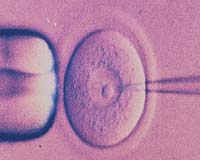
Washington (UPI) April 25, 2005 A bill expected to be introduced this week will round out a quartet of congressional legislation laying bare the choice to either protect or ban human cloning for research and therapeutic medical purposes. Rep. Mary Bono, R-Calif., plans to offer legislation that would, like three other cloning bills already before the House and Senate, explicitly ban cloning intended to produce a child. Bono's legislation, however -- and bill S. 876 by Sen. Orin Hatch, R-Utah -- would protect research that uses human cells developed through somatic cell nuclear transfer. SCNT is a form of cloning that involves removing the DNA from an adult human egg cell and replacing it with the DNA from another person. The technique causes the resulting cell to de-differentiate, or regress to an earlier state, from which it can become nearly any cell in the body. Scientists think such cells, a type of stem cell, someday could be used to repair severed spinal cords by literally bridging the damage with new cells. They could also be used to treat diabetes, Alzheimer's disease and a host of other disorders that require cellular repair, and they can help researchers learn how diseases develop in the first place. "Somatic cell nuclear transfer is one of the most promising forms of this research, which under strict ethical standards and federal regulation, could make leaps to improve the quality of life for individuals who are suffering from diseases such as Alzheimer's, Parkinson's and multiple sclerosis," Bono told UPI's PoliSci. The technique is essentially the same as that used to clone animals, such as Dolly the sheep. Though it is not considered possible now, theoretically it could be used to clone humans -- a prospect widely viewed with disapproval. Banning the cloning of children is what bill H.R. 1357, introduced by Rep. Dave Weldon, R-Fla., would appear to do -- except it does not stop with reproductive cloning. Rather than simply forbidding implanting a nuclear-transferred cell into a womb or otherwise growing it into a child, Weldon's bill -- and bill S. 658 by Sen. Sam Brownback, R-Kan. -- would ban SCNT itself, thereby possibly outlawing an entire branch of scientific study. "The whole point of (Weldon's) bill is to make illegal an important form of research," said Sean Tipton, vice president of communication for the Coalition for the Advancement of Medical Research in Washington, which represents patient, science and research organizations. "You (would be) preventing science from progressing to provide potential extraordinarily beneficial (therapies) for human beings," said Dr. Louis Elsas, director of Medical Genetics at the University of Miami School of Medicine. He noted such a research ban would create economic consequences. "These (developments) are patentable and are definitely going to be the future approach to therapy, to giving organ transplants," Elsas told UPI. "Other countries are doing this and doing it in a big way." Both the Weldon and Brownback bills also would ban interstate and international transport of the products of nuclear transfer. Though this appears aimed at stopping the sale or importation of cells, it effectively would prohibit anyone from seeking stem cell treatment outside the United States, the legislation's opponents claim. "Suppose in England, where they are going ahead with this research, they develop a cure for diabetes," Tipton said. "An American with diabetes goes over to get some new pancreatic tissue to cure the diabetes. When they re-enter the country, they will have committed a crime." Robert Klein, chairman of the board of the California Institute for Regenerative Medicine, said the bill, "if therapies are developed, would deny even your ability to go out of the country to get these therapies. It would criminalize you as a parent if you participated in the therapy and tried to bring your child back into the country." Weldon's office declined to comment for this article. Not everyone agrees a ban on SCNT would hamper stem cell research. "If our focus is to move from research to human clinical application then non-embryonic cells are going to be the ones that are safest to work with in human trials," said Dr. Gary Friedman, director of the Center for Regenerative Medicine in Morristown, N.J. Friedman, whose organization focuses solely on research involving adult stem cells obtained from bone marrow, umbilical code blood and other sources, said embryonic stem cells develop into tumors 10 percent to 15 percent of the time and therefore were not considered safe for therapy. Elsas said adult stem cells, though valuable and appropriate for treatment of some diseases, were not flexible enough to differentiate into cells to combat other illnesses. As for the risk of tumors, he agreed they had occurred in experiments with mice. "That is only because we don't know quite yet how to maintain the differentiation process," Elsas told UPI. "There needs to be a lot more research. That's the harm of a ban on (studying) nuclear-transplanted stem cells, because that process is what is required." He said it is important for researchers to learn how to avoid turning differentiated cells into a non-differentiated tumor, and inducing them to become "useful tissue that is constant, like heart tissue, that could be put back into your heart." Related Links SpaceDaily Search SpaceDaily Subscribe To SpaceDaily Express  Nanoshells Simultaneously Detect And Destroy Cancerous Cells
 Houston TX (SPX) Apr 14, 2005
Researchers at Rice University in Texas have developed a new approach to fighting cancer, based on nanoscale particles that can both detect and destroy cancerous cells. |
|
|

| The content herein, unless otherwise known to be public domain, are Copyright 1995-2006 - SpaceDaily.AFP and UPI Wire Stories are copyright Agence France-Presse and United Press International. ESA PortalReports are copyright European Space Agency. All NASA sourced material is public domain. Additionalcopyrights may apply in whole or part to other bona fide parties. Advertising does not imply endorsement,agreement or approval of any opinions, statements or information provided by SpaceDaily on any Web page published or hosted by SpaceDaily. Privacy Statement |