
Subscribe free to our newsletters via your
. Military Space News .


BIO FUEL
Potential of disk-shaped small structures, coccoliths
by Staff Writers
Hiroshima, Japan (SPX) Sep 07, 2015


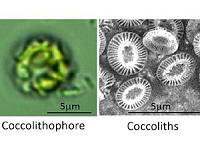
Coccolithophore phytoplankton Emiliania huxleyi and cells covering crystals of calcium carbonate - coccoliths. The coccoliths are 2-3 m in diameter. Image courtesy Hiroshima University. For a larger version of this image please go here.

Researchers at Hiroshima University and the University of Tsukuba showed that coccolith disks made of calcium carbonate in Emiliania huxleyi, one of the promising biomass resources, potentially perform roles in reducing and enhancing the light that enters the cell by light scattering. Elucidation of the physiological significance of coccolith formation in E. huxleyi can help promote efficient bioenergy production using microalgae.

The energy issue is one of the most important problems on earth. Recently, many types of renewable energy resources such as solar light, wind, water, and biomass have attracted attention for their use as alternatives for fossil fuels.

Coccoliths are disk-shaped plates of calcium carbonate formed by coccolithophores, which are single-celled algae such as E. huxleyi. The most important question concerning coccolith function is with regard to how they modulate solar light in the ocean, where huge blooms of E. huxleyi have frequently been observed as satellite images by SeaWiFS Color Senor from space. Recently, studies that focus on the optical function of coccoliths have been reported. In these studies, the light scattering of randomly oriented coccoliths was measured.

Professor Masakazu Iwasaka at Hiroshima University and Professor Yoshihiro Shiraiwa at the University of Tsukuba prepared an aqueous suspension of isolated coccoliths of Emiliania cells and examined their light-scattering properties. They found that the coccoliths showed magnetic orientation when floating in water, and the light scattering was changed by the magnetically oriented coccoliths.

Professor Iwasaka said, "Surprisingly, the percentage of coccoliths oriented in the same direction increased during exposure to the 400 mT to 500 mT magnetic field." "In addition, an individual coccolith has a specific direction of light-scattering," Professor Iwasaka explained.

These results can contribute to the understanding of how coccoliths control light and utilize optical energy for the photosynthesis in E. huxleyi. Furthermore, since no artificial method to reproduce precise structures such as a coccolith without a coccolithophore exists so far, these coccoliths can be used as novel micro/nano optical devices owing to their ability to modify light.

Mizukawa, Y. et al. Light intensity modulation by coccoliths of Emiliania huxleyi as a micro-photo-regulator. Sci. Rep. 5, 13577; doi: 10.1038/srep13577 (2015)


Thanks for being here;
We need your help. The Space Media Network continues to grow but revenues have never been harder to maintain.

With the rise of Ad Blockers, and Facebook - our traditional revenue sources via quality network advertising continues to decline. And unlike so many other news sites, we don't have a paywall - with those annoying usernames and passwords.

Our news coverage takes time and effort to publish 365 days a year.

If you find our news sites informative and useful then please consider becoming a regular supporter or for now make a one off contribution.
SpaceMediaNetwork Contributor
$5 Billed Once


credit card or paypal
SpaceMediaNetwork Monthly Supporter
$5 Billed Monthly


paypal only


.


Related Links
Hiroshima University
Bio Fuel Technology and Application News


Comment on this article via your Facebook, Yahoo, AOL, Hotmail login.

Share this article via these popular social media networks
del.icio.usdel.icio.us DiggDigg RedditReddit GoogleGoogle


BIO FUEL
Waste coffee used as fuel storage
London, UK (SPX) Sep 03, 2015
Scientists have developed a simple process to treat waste coffee grounds to allow them to store methane. The simple soak and heating process develops a carbon capture material with the additional environmental benefits of recycling a waste product. The results are published today, 03 September 2015, in the journal Nanotechnology. Methane capture and storage provides a double environm ... read more


BIO FUEL
Russian Anti-Missile Warning System Protects on Multiple Tiers

Russian Missile Warning System Can Detect Mass Launch of Ballistic Missiles

US runs missile defense wargames to break Russian jamming

Japan requests Aegis systems for new destroyers

BIO FUEL
Advanced Sidewinder missile approved for full-rate production

Moscow, Tehran Sign Roadmap For S-300 Deal Implementation

Air-launched Sidewinder tested as ground-based weapon

Hundreds of Russian R-73 Air-to-Air Missiles in High Demand Worldwide

BIO FUEL
DARPA project studies new uses for drones

WB Electronics,Thales to offer UAS to Polish military

CIA, US special forces launch drone campaign in Syria: media

Spaceport America and ARCA to jointly test Launch Vehicles and High Altitude UAVs

BIO FUEL
MUOS-4 Responding Normally To Ground Control Post-Launch

US Military to Launch 'Smartphone' Communications Satellite on Monday

Russia, China discuss joint mobile satellite communications

Harris delivers Falcon tactical radios

BIO FUEL
After Humvee, US Army to unleash latest beast

Russia's Newest Grom Smart Bombs Unveiled at MAKS 2015

U.S. creating National Manufacturing Innovation Institute

Pentagon joins Silicon Valley in 'flexible' tech hub

BIO FUEL
Middle Eastern leaders flood to Moscow for Syrian talks, aerospace salon

Growth for Turkish defense industry

Nigeria to step up local arms manufacture in Boko Haram fight

French defence minister visits Cairo after warplane deal

BIO FUEL
India announces major pensions overhaul for army veterans

Philippines, Vietnam to sign partnership deal by year-end

Tale of two parades as ordinary Chinese barred from display

China lauds power, proclaims peace at military spectacular

BIO FUEL
Nanoporous gold sponge makes DNA detector

Researchers use laser to levitate, glowing nanodiamonds in vacuum

Nanoparticles - small but unique

Making nanowires from protein and DNA


The content herein, unless otherwise known to be public domain, are Copyright 1995-2014 - Space Media Network. All websites are published in Australia and are solely subject to Australian law and governed by Fair Use principals for news reporting and research purposes. AFP, UPI and IANS news wire stories are copyright Agence France-Presse, United Press International and Indo-Asia News Service. ESA news reports are copyright European Space Agency. All NASA sourced material is public domain. Additional copyrights may apply in whole or part to other bona fide parties. Advertising does not imply endorsement, agreement or approval of any opinions, statements or information provided by Space Media Network on any Web page published or hosted by Space Media Network. Privacy Statement All images and articles appearing on Space Media Network have been edited or digitally altered in some way. Any requests to remove copyright material will be acted upon in a timely and appropriate manner. Any attempt to extort money from Space Media Network will be ignored and reported to Australian Law Enforcement Agencies as a potential case of financial fraud involving the use of a telephonic carriage device or postal service.