|
 |
 |
 |
 |
 |
 |
 |
 |
 |

| . |  |
. |
Powerful Antenna Attached To NASA's GLAST Satellite
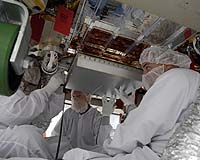
Greenbelt MD (SPX) Apr 22, 2008 The powerful antenna system that will enable NASA's Gamma-ray Large Area Telescope (GLAST) to communicate with stations on Earth has been successfully connected to the spacecraft in the Astrotech payload processing facility near NASA's Kennedy Space Center, Fla. The Ku Band system is used to downlink science and engineering telemetry. The Ku band system includes a Ku antenna, an antenna pointing mechanism that steers the antenna, and two Ku band transmitters. The Ku band (K-under band) is a portion of the electromagnetic spectrum in the microwave range of frequencies that is used to transmit data. "The Ku Band system on GLAST enables the transmittal of recorded science and engineering data at a high rate to the ground through the Tracking and Data Relay Satellites (TDRS)," said Al Vernacchio, GLAST Deputy Project Manager at NASA's Goddard Space Flight Center, Greenbelt, Md. "It provides the link that enables the transmission of the large quantity of information gathered by the Large Area Telescope (LAT) and GLAST Burst Monitor (GBM) instruments." Ku band satellites are also used in satellite communications from remote locations back to a television network's studio for editing and broadcasting. The S-band antennas have already been connected to GLAST. S-band antennas are used for command uplink, that is, to send commands to the GLAST spacecraft from Earth and to gather real-time engineering telemetry. Currently, the GLAST satellite is being prepared for launch and is in its final stages of preparation, as the Delta II launch vehicle that will carry it spaceward is also being prepared on Launch-pad 17B. In the drawings of GLAST, this antenna is the little square panel sticking out below the bottom of the spacecraft. Like the solar panels, the Ku band antenna is stowed at launch and will be deployed once GLAST is in orbit. The installation of the Ku band antenna completes the integration of the Ku system and of the observatory. The only things that remain are the closeout of the thermal blankets, installation of the star tracker shade and fueling of the propulsion system before the observatory goes to the launch pad. GLAST will launch from the Cape Canaveral Air Station, Fla. GLAST is a powerful space observatory that will explore the most extreme environments in the Universe, where nature harnesses energies far beyond anything possible on Earth. It will search for signs of new laws of physics and what composes the mysterious dark matter, explain how black holes accelerate immense jets of material to nearly light speed, and help crack the mysteries of the stupendously powerful explosions known as gamma-ray bursts. NASA's GLAST mission is an astrophysics and particle physics partnership, developed in collaboration with the U.S. Department of Energy, along with important contributions from academic institutions and partners in France, Germany, Italy, Japan, Sweden, and the United States. Community Email This Article Comment On This Article Related Links Space Telescope News and Technology at Skynightly.com
 Paranal Receives New Mirror
 Cerro Paranal, Chile (SPX) Apr 22, 2008
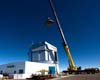
A 4.1-metre diameter primary mirror, a vital part of the world's newest and fastest survey telescope, VISTA (the Visible and Infrared Survey Telescope for Astronomy) has been delivered to its new mountaintop home at Cerro Paranal, Chile. The mirror will now be coupled with a small camera for initial testing prior to installing the main camera in June. Full scientific operations are due to start early next year. |
|
|

| The content herein, unless otherwise known to be public domain, are Copyright 1995-2007 - SpaceDaily.AFP and UPI Wire Stories are copyright Agence France-Presse and United Press International. ESA Portal Reports are copyright European Space Agency. All NASA sourced material is public domain. Additional copyrights may apply in whole or part to other bona fide parties. Advertising does not imply endorsement,agreement or approval of any opinions, statements or information provided by SpaceDaily on any Web page published or hosted by SpaceDaily. Privacy Statement |