|
 |
 |
 |
 |
 |
 |
 |
 |
 |

| . |  |
. |
 by Staff Writers Washington DC (SPX) Mar 29, 2016
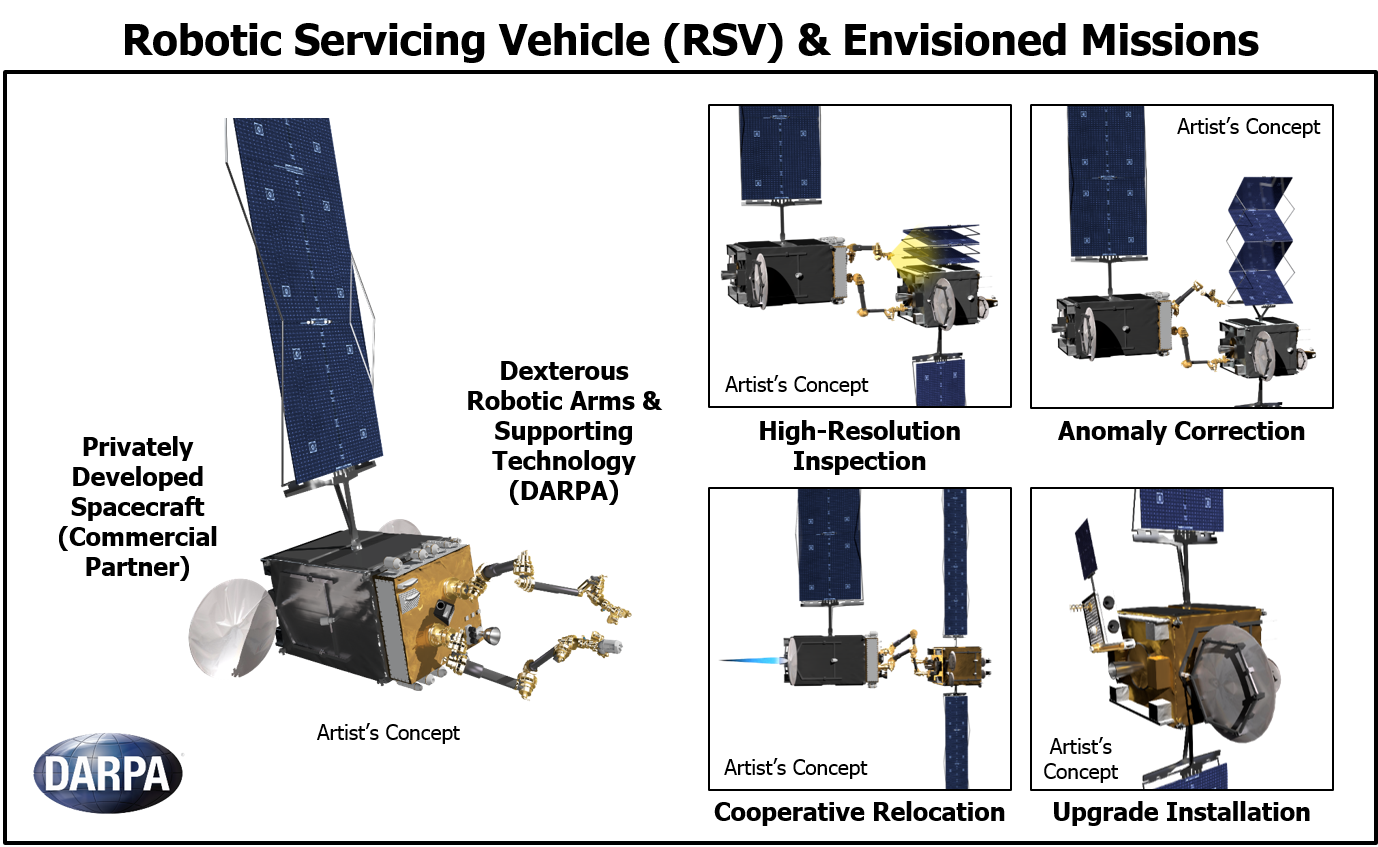
Hundreds of military, government and commercial satellites reside today in geosynchronous Earth orbit (GEO) some 22,000 miles (36,000 kilometers) above the Earth-a perch ideal for providing communications, meteorology and national security services, but one so remote as to preclude inspection and diagnosis of malfunctioning components, much less upgrades or repairs. Even fully functional satellites sometimes find their working lives cut short simply because they carry obsolete payloads-a frustrating situation for owners of assets worth hundreds of millions of dollars. With no prospects for assistance once in orbit, satellites destined for GEO today are loaded with backup systems and as much fuel as can be accommodated, adding to their complexity, weight and cost. But what if help was just a service call away? DARPA's new Robotic Servicing of Geosynchronous Satellites (RSGS) program intends to answer that question by developing technologies that would enable cooperative inspection and servicing in GEO and demonstrating those technologies on orbit within the next five years. Under the RSGS vision, a DARPA-developed modular toolkit, including hardware and software, would be joined to a privately developed spacecraft to create a commercially owned and operated robotic servicing vehicle (RSV) that could make house calls in space. DARPA would contribute the robotics technology, expertise, and a Government-provided launch. The commercial partner would contribute the satellite to carry the robotic payload, integration of the payload onto it, and the mission operations center and staff. If successful, the joint effort could radically lower the risk and cost of operating in GEO. "The ability to safely and cooperatively service satellites in GEO would vastly expand public and private opportunities in space. It could enable entirely new spacecraft designs and operations, including on-orbit assembly and maintenance, which could dramatically lower construction and deployment costs while extending satellite utility, resilience and reliability," said RSGS program manager Gordon Roesler. "Commercial and government space operators have sought this capability for decades. By investing together, we can achieve a capability that would be extremely challenging to do individually." To formalize that collaboration, DARPA aims to establish a public-private partnership through which the Agency would develop and provide technical capabilities for transition to a commercial space robotics enterprise that would make cooperative robotic servicing available to both military and commercial GEO satellite owners on a fee-for-service basis. DARPA seeks to engage a commercial partner with a strategic interest in this capability, and an interest in providing services to the Defense Department (DoD).
By executing the RSGS program, DARPA seeks to: + Demonstrate in or near GEO that a robotic servicing vehicle can perform safe, reliable, useful and efficient operations, with the flexibility to adapt to a variety of on-orbit missions and conditions + Demonstrate satellite servicing mission operations on operational GEO satellites in collaboration with commercial and U.S. Government spacecraft operators + Support the development of a servicer spacecraft with sufficient propellant and payload robustness to enable dozens of missions over several years After a successful on-orbit demonstration of the robotic servicing vehicle, U.S. Government and commercial satellite operators would have ready access to diverse capabilities including high-resolution inspection; correction of some mission-ending mechanical anomalies, such as solar array and antenna deployment malfunctions; assistance with relocation and other orbital maneuvers; and installation of attachable payloads, enabling upgrades to existing assets. Satellite operators would be able to purchase these services on request to the robotic servicing vehicle operator. A critical component of the RSV would be the robotic arm developed by DARPA known as FREND. Constructed to enable automated, cooperative connection to satellites that are not designed for docking, the FREND arm has multiple joints enabling dexterous movement and can carry and switch among multiple generic and mission-specific tools. DARPA will augment the arm by adding advanced algorithms for machine vision and supervised autonomous robotic operations. Also new will be onboard mission-planning software and a variety of sensors designed to provide reliable, high-fidelity spatial orientation information, essential for safely guiding the spacecraft with its robotic systems on orbit. "In addition to these technical advances, a key goal of the RSGS program is to establish best practices and voluntary standards for space servicing operations," said Brad Tousley, director of DARPA's Tactical Technology Office, which oversees RSGS. "Government and industry need to work together to set safety standards as well as to take advantage of the servicer's new capabilities." DARPA plans to kick off the public-private partnership via a Program Solicitation in the near future. Shortly thereafter, DARPA will host a Proposers Day to provide potential partners with further technical and programmatic details about the RSGS program. The date of issue of the Solicitation and the date and location of the Proposers Day have yet to be determined.
Related Links Defense Advanced Research Projects Agency All about the robots on Earth and beyond!
|
|||||||||||||
|
|
| The content herein, unless otherwise known to be public domain, are Copyright 1995-2024 - Space Media Network. All websites are published in Australia and are solely subject to Australian law and governed by Fair Use principals for news reporting and research purposes. AFP, UPI and IANS news wire stories are copyright Agence France-Presse, United Press International and Indo-Asia News Service. ESA news reports are copyright European Space Agency. All NASA sourced material is public domain. Additional copyrights may apply in whole or part to other bona fide parties. All articles labeled "by Staff Writers" include reports supplied to Space Media Network by industry news wires, PR agencies, corporate press officers and the like. Such articles are individually curated and edited by Space Media Network staff on the basis of the report's information value to our industry and professional readership. Advertising does not imply endorsement, agreement or approval of any opinions, statements or information provided by Space Media Network on any Web page published or hosted by Space Media Network. General Data Protection Regulation (GDPR) Statement Our advertisers use various cookies and the like to deliver the best ad banner available at one time. All network advertising suppliers have GDPR policies (Legitimate Interest) that conform with EU regulations for data collection. By using our websites you consent to cookie based advertising. If you do not agree with this then you must stop using the websites from May 25, 2018. Privacy Statement. Additional information can be found here at About Us. |


 del.icio.us
 Digg
Digg Reddit
 Google