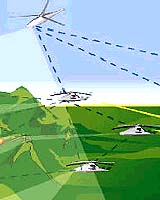
Northrop Grumman Corporation's Integrated Systems sector has successfully completed a comprehensive program milestone review with the U.S. government on its unmanned combat armed rotorcraft (UCAR), concluding work for the first half of the program's initial phase.
UCAR, an advanced concept technology development program sponsored by the Defense Advanced Research Projects Agency (DARPA) and the U.S. Army, will provide enhanced reconnaissance and attack capabilities for Army aviation. It combines autonomous operations and advanced command and control technologies with the advantages of vertical takeoff and landing.
Integrated with the Army's manned aircraft, the UCAR system will perform armed reconnaissance and attack missions, operating within the Army's Objective Force concept, effectively identifying and prosecuting targets that are camouflaged and concealed in close combat situations such as dense, mountainous and urban terrain.
In this initial stage of the four-phase, eight-year program, Northrop Grumman is conducting concept development and system tradeoff studies. During the November review, Northrop Grumman provided details about its progress toward demonstrating UCAR operational system capabilities, effectiveness analyses, preliminary total ownership cost estimates and initial program risk assessment.
Since the award in June 2002 valued at $3 million, Northrop Grumman has been evaluating a broad range of interrelated systems for mission management and control, support and UCAR air vehicles.
These systems must come together in an overarching operational concept and architecture that will enable UCAR to operate seamlessly with other components of the Army's system-of-systems Objective Force construct.
The team has been considering a broad range of system architectures and on- and off-board sensors. By the next program milestone review, scheduled for February 2003, Northrop Grumman will have selected a single system concept for subsequent phases of the program.
Highly autonomous system capability, mission effectiveness and cost have been the driving factors in Northrop Grumman's tradeoff evaluations.
"We are building on the demonstrated effectiveness of our Global Hawk and Fire Scout unmanned systems to leap further ahead in autonomous control to develop a smart, affordable, lethal UCAR system with capabilities that are consistent with real-world Army operations," said Greg Zwernemann, Northrop Grumman's UCAR program manager.
After completion of the 12-month UCAR concept development phase, DARPA will select two contractors for a preliminary design concept development effort, which is expected to last nine months.
The design concept development will be followed by a system development phase that will include the development and test of two demonstration vehicles.
This will be followed by a system maturation phase, during which the contractor will develop and test a final system concept. The program is scheduled to transfer to the Army in 2009.
Northrop Grumman is performing its UCAR work at its Integrated Systems facility in San Diego, Calif.