|
 |
 |
 |
 |
 |
 |
 |
 |
 |

| . |  |
. |
QDR Budget Mesh For Air Force Future
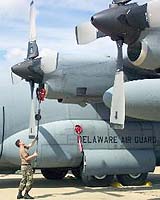
Washington DC (SPX) Feb 14, 2006 Air Force officials announced Feb. 6 how the service's budget will mesh with the Department of Defense quadrennial defense review, creating an overall financial plan for the service's future. The Air Force re-examines its budget annually, while DOD conducts a QDR across the armed forces every four years. Between the two, the Air Force will begin to retire older aircraft no longer essential to its operation. The budget and QDR analyses also outline funding for new or refurbished aircraft as well as expanding existing missions, all so the Air Force can better fight the global war on terror. "The QDR was a tough, but inclusive process," said Lt. Gen. Stephen G. Wood, the deputy chief of staff for strategic plans and programs. "We provided input and we're convinced our defense strategy is right for today and right for tomorrow." As a result of both the QDR and budget assessments, the legislation requirements will be eased so aging weapon systems, like the F-117A Nighthawk, C-130E Hercules and KC-135E Stratotanker, will be retired over the next few years. The Air Force will also reduce its number of U-2s and B-52 Stratofortresses. In addition, as the Air Force prepares for the future, it will modernize the fleet of C-5 Galaxy, C-130J and A-10 Thunderbolt II aircraft, as well as refurbish the AWACS and JSTARS systems. The Air Force will also continue to acquire F-22A Raptors and C-17 Globemaster IIIs, as well as add more unmanned aerial vehicles to the inventory, such as the Predator and Global Hawk. There will also be funding for future projects, including a new long-range strike bomber by 2018, a new combat search-and-rescue aircraft, a new tanker that will also provide airlift capabilities and a new light cargo aircraft for both the Air Force and Army, General Wood said. Aircraft numbers aren't the only changes, however. The Air Force will add more than 1,000 "battlefield Airmen" to its ranks. "We'll continue to improve cooperation with the other services," General Wood said. "This means putting more tactical air control party Airmen in with Army units so they can call in air strikes should the Soldiers need support." Overall, the Air Force is looking to spend its dollars more effectively. Some operational cost increases are inevitable, such as rising fuel prices. But by saving money in some arenas, it will be able to reinvest in its other programs such as recapitalization of our force structure, said Maj. Gen. Frank R. Faykes, director of the Air Force budget. "We're to rebalance the Air Force to a leaner, more agile force through a total force integration that fully exploits the capabilities of the active, Guard and Reserve components," General Faykes said. "We're also doing more construction than we ever have, eliminating substandard housing units and improving dormitories. "We'll also teach many of our Airmen more language skills and cultural awareness, both of which are key attributes in the global environment we operate in," he added. The Air Force will also continue to expand its role in space, with additional space launches planned. New satellite systems will be put in orbit, such as updating the country's Global Positioning System over the next few years and expanding the capabilities inherent in our transformational, or TSAT, satellites. "Airmen will see their Air Force change, but transformation is not new to us," General Faykes said. "What we have is a new focus. They will see new opportunities, better quality of life, better work centers and a more effective Air Force that leverages the capabilities of our transformational systems. We'll continue to fly and fight in air, space and cyberspace, and we will be the dominant air and space force for the 21st century." Related Links -  L3 Comms Completes Trials Of US Army Warfighter Information Network
 New York NY (SPX) Feb 13, 2006
L-3 Communications has announced that its Microwave Group (L-3 Microwave Group) successfully completed demonstration and trials of several L-3 Communications products designed to support the U.S. Army's Warfighter Information Network - Tactical (WIN-T) initiative. |
|
|

| The content herein, unless otherwise known to be public domain, are Copyright 1995-2006 - SpaceDaily.AFP and UPI Wire Stories are copyright Agence France-Presse and United Press International. ESA PortalReports are copyright European Space Agency. All NASA sourced material is public domain. Additionalcopyrights may apply in whole or part to other bona fide parties. Advertising does not imply endorsement,agreement or approval of any opinions, statements or information provided by SpaceDaily on any Web page published or hosted by SpaceDaily. Privacy Statement |