|
 |
 |
 |
 |
 |
 |
 |

| . |  |
. |

|
|
. |

 by Staff Writers Paris (AFP) Aug 10, 2011
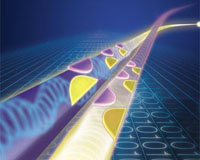
Physicists in the United States on Wednesday notched up a lab success in the quest for quantum computers, whose stellar capacities have already earned them the nickname of "super-computers on steroids." Atoms can be excited to a quantum condition using microwaves, an advance over larger and bulkier lasers, until now the only way to achieve this essential state, they said. In theory, it means that quantum computers -- if they are commercially feasible -- could be as tiny as a small book, the team reported in Nature, the British science journal. "It is conceivable a modest-sized quantum computer could eventually look like a smart phone combined with a laser pointer-like device," said Dietrich Leibfried of the US National Institute of Standards and Technology (NIST). "Sophisticated machines might have an overall footprint comparable to a regular desktop PC." The idea behind quantum computing is to exploit a weird discovery of particle physics. When two particles interact, they become "entangled," which means one particle affects the other. The connection lasts long after they are separated. In "entanglement," particles also go into state called superposition. Today's computers use a binary code, in which data is stored in a bit that could be either zero or 1. But in superposition, a quantum bit, known as a qubit, could be either zero or one, or both zero and one at the same time. This potentially offers a massive increase in data storage, greatly helping number-crunching tasks such as running climate-change models and breaking encrypted codes. In the new experiments, NIST physicists held two electrically-charged atoms, also called ions, of magnesium in a "trap" of electro-magnetic fields. The ions hovered just above a chip consisting of gold electrodes, some of which were activated to create targeted pulses of microwave energy in the one to two gigahertz range. The microwaves produced minute magnetic fields to manipulate the spin of the ions so that they reached entanglement. The scientists hit the spot 76 percent of the time, above the threshold of 50 percent considered to define the onset of quantum properties, thus providing solid proof that microwaves work. But it was still well short of the best laser-controlled operations, which stand at 99.3 percent, indicating that many improvements remain. Lasers are still needed in the new technique, for low-powered ultraviolet lasers kept the ions cool and were used to measure the results. But -- again, if many practical hurdles are overcome -- this should not be a problem for miniaturising the quantum computer of the future, say the scientists. In a commentary also published in Nature, Winfried Hensinger of Britain's Sussex University hailed the achievement as "step-changing innovations." "Quantum computing is likely to revolutionise many areas of science, and we have only just started to appreciate its true potential."
|
. |
|
| The content herein, unless otherwise known to be public domain, are Copyright 1995-2011 - Space Media Network. AFP and UPI Wire Stories are copyright Agence France-Presse and United Press International. ESA Portal Reports are copyright European Space Agency. All NASA sourced material is public domain. Additional copyrights may apply in whole or part to other bona fide parties. Advertising does not imply endorsement,agreement or approval of any opinions, statements or information provided by Space Media Network on any Web page published or hosted by Space Media Network. Privacy Statement |

 del.icio.us
 Digg
Digg Reddit
 Google