|
 |
 |
 |
 |
 |
 |
 |
 |
 |

| . |  |
. |
RCW 103: A Star With A Mystery Partner
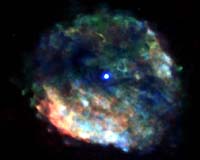
Boston MA (SPX) Jul 13, 2007 When stars are more massive than about 8 times the Sun, they end their lives in a spectacular explosion called a supernova. The outer layers of the star are hurtled out into space at thousands of miles an hour, leaving a debris field of gas and dust. Where the star once was located, a small, incredibly dense object called a neutron star is often found. While only 10 miles or so across, the tightly packed neutrons in such a star contain more mass than the entire Sun. A new X-ray image shows the 2,000 year-old-remnant of such a cosmic explosion, known as RCW 103, which occurred about 10,000 light years from Earth. In Chandra's image, the colors of red, green, and blue are mapped to low, medium, and high-energy X-rays. At the center, the bright blue dot is likely the neutron star that astronomers believe formed when the star exploded. For several years astronomers have struggled to understand the behavior of the this object, which exhibits unusually large variations in its X-ray emission over a period of years. New evidence from Chandra implies that the neutron star near the center is rotating once every 6.7 hours, confirming recent work from XMM-Newton. This is much slower than a neutron star of its age should be spinning. One possible solution to this mystery is that the massive progenitor star to RCW 103 may not have exploded in isolation. Rather, a low-mass star that is too dim to see directly may be orbiting around the neutron star. Gas flowing from this unseen neighbor onto the neutron star might be powering its X-ray emission, and the interaction of the magnetic field of the two stars could have caused the neutron star to slow its rotation. Community Email This Article Comment On This Article Related Links Chandra X-ray Observatory Stellar Chemistry, The Universe And All Within It
 Star Surface Polluted By Planetary Debris
 Paris, France (ESO) Jul 11, 2007
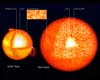
Looking at the chemical composition of stars that host planets, astronomers have found that while dwarf stars often show iron enrichment on their surface, giant stars do not. The astronomers think that the planetary debris falling onto the outer layer of the star produces a detectable effect in a dwarf star, but this pollution is diluted by the giant star and mixed into its interior. |
|
|

| The content herein, unless otherwise known to be public domain, are Copyright 1995-2006 - SpaceDaily.AFP and UPI Wire Stories are copyright Agence France-Presse and United Press International. ESA PortalReports are copyright European Space Agency. All NASA sourced material is public domain. Additionalcopyrights may apply in whole or part to other bona fide parties. Advertising does not imply endorsement,agreement or approval of any opinions, statements or information provided by SpaceDaily on any Web page published or hosted by SpaceDaily. Privacy Statement |