
 |
 |
 |
 |
 |
 |
 |
 |
 |
 |

| . |  |
. |

Washington DC (SPX) Jul 09, 2010 Galaxies like our own were built billions of years ago from a deluge of giant clouds of gas, some of which continue to rain down. Now new calculations tie the rain of giant clouds of gas to active galactic nuclei (AGN), the extremely bright centers of some galaxies. If a gas cloud with millions of times more mass than our Sun wanders too close to the center of a galaxy, it can either be consumed by the supermassive black hole that lurks there or, through shocks and collapse, give birth to new stars. "For a while, people have known that gas clouds are falling onto galaxies, and they've also known that active galactic nuclei are powered by gas falling onto supermassive black holes," says Barry McKernan, a research associate in the Department of Astrophysics at the American Museum of Natural History and an assistant professor at the Borough of Manhattan Community College (BMCC), City University of New York. "But no one put the two ideas together until now and said, 'Hey, maybe one is causing the other!'" All galaxies are believed to host a supermassive black hole at their center, yet only a fraction of galactic centers show signs of brighter activity due to black hole feeding. The new research provides an explanation for the apparent conundrum: galactic centers which have sustained recent cloud impacts have enough fuel to light up by giving birth to hundreds of stars and feeding the central black hole. Galactic centers that have not been hit for a while (in cosmic terms, for more than about 10 million years) will be relatively inactive and their cores will appear normal. "It's interesting that only some galaxies are active, even though we think every galaxy contains a supermassive black hole," says K. E. Saavik Ford, a research associate at the Museum and an assistant professor at BMCC. "The cloud bombardment idea provides an explanation: it's just random luck."
Share This Article With Planet Earth
Related Links American Museum of Natural History Stellar Chemistry, The Universe And All Within It

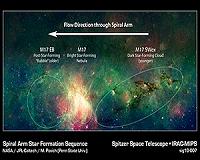 Newborn Stars Discovered In Dark Cosmic Cloud
University Park PA (SPX) Jul 08, 2010 A wave of massive star formation appears poised to begin within a mysterious, dark cloud in the Milky Way. NASA's Spitzer Space Telescope has revealed a secluded birthplace for stars within a wispy, dark cloud named named M17 SWex. The dark cloud is part of the larger, parent nebula known as M17, a vast region of our galaxy with a bright, central star cluster. "We believe we've managed to ... read more |
|
|
| The content herein, unless otherwise known to be public domain, are Copyright 1995-2010 - SpaceDaily. AFP and UPI Wire Stories are copyright Agence France-Presse and United Press International. ESA Portal Reports are copyright European Space Agency. All NASA sourced material is public domain. Additional copyrights may apply in whole or part to other bona fide parties. Advertising does not imply endorsement,agreement or approval of any opinions, statements or information provided by SpaceDaily on any Web page published or hosted by SpaceDaily. Privacy Statement |


 del.icio.us
 Digg
Digg Reddit
 YahooMyWeb
 Google
 Facebook


