File photo: The APKWS II.
File photo: The APKWS II. |
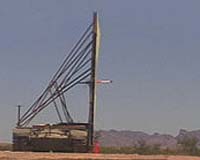
Tests conducted at Raytheon Missile Systems, Tucson, Ariz., this month further demonstrated the need for a new tailfin. The tests showed controlled deployment and locking of the six APKWS II tailfins -- Raytheon discriminators in the Army's APKWS II competition.
Because the APKWS II rockets are longer than the Hydra 70 rocket, this improved tailfin ensures the adjacent rockets are not damaged when they are fired. This test, in conjunction with previous wind tunnel and ballistic tests, further validates the need for a new tailfin.
In its APKWS II proposal, Raytheon took a system approach to APKWS II by fixing the tailfin to get a simple, low-cost guidance section that meets all the Army's key performance parameters. This simple tailfin is an easy retrofit to the current MK-66 rocket motor.
"Raytheon's new tailfin not only corrects the tailfin opening interference issue, it also greatly reduces the ballistic dispersion of the unguided 2.75-inch rockets and increases controllability of the guided 2.75-inch rockets," said Jim Tingstad, APKWS II chief engineer.
"Without this tailfin modification to the Hydra 70 rocket motor, the APKWS II guidance section will increase in complexity, risk and reliability, driving a significant increase in the overall cost of the system."
Raytheon learned four years ago during its successful Low Cost Precision Kill (LCPK) all-up-round flight tests that Hydra 70 MK-66 Mod4 tailfins cause slow spin-up rates and produce significant tip-off errors, thrust misalignments, erratic spin profiles and uncontrolled tailfin deployment interference with adjacent rockets.
"We learned from our successful LCPK firings and initial APKWS design effects," said James Sweetman, Missile Systems Land Combat chief engineer.
"We made a smart change to a simple, low-cost part -- the tailfin -- in order to eliminate the need for a costly, complex and unreliable de-roll bearing.
"Our LCPK experience enabled us to avoid the fundamental design error of placing a flexible joint in the middle of the APKWS II airframe. Replacement of the tailfin, combined with our low-cost digital semi-active-laser seeker and control actuator system, ensures an affordable and effective APKWS II system."
As further validation of the Raytheon proposed tailfin design, U.S. Army Aviation Missile Research Development and Engineering Center (AMRDEC), Applied Sensors, Guidance and Electronics Directorate, has tested and evaluated performance of a similar six-planar-tailfin design with spin vanes under Science Technology Objective (STO) III.WP.2002.01, Advanced Miniature Multi-role Precision Guided Missile (AMMPGM -- 2002-2006). AMRDEC's STO results (on its similar six-planar tailfin) showed an improved tailfin that increased guidance and control/maneuverability and reduced overall rocket cost and complexity.
APKWS II will be a multi-service, multi-user, multi-platform system designed to engage and destroy stationary, re-locatable and moving targets ranging from buildings and bunkers to tactical vehicles. The weapon also is optimized to fight in today's urban and complex terrain environment and destroy small naval targets such as patrol craft.
Related Links
 ManTech Wins US Support Army Contract
 Fairfax VA (SPX) Mar 28, 2006
| The content herein, unless otherwise known to be public domain, are Copyright 1995-2006 - SpaceDaily.AFP and UPI Wire Stories are copyright Agence France-Presse and United Press International. ESA PortalReports are copyright European Space Agency. All NASA sourced material is public domain. Additionalcopyrights may apply in whole or part to other bona fide parties. Advertising does not imply endorsement,agreement or approval of any opinions, statements or information provided by SpaceDaily on any Web page published or hosted by SpaceDaily. Privacy Statement |