|
 |
 |
 |
 |
 |
 |
 |
 |
 |

| . |  |
. |
Record Breaking Experiment on ISS
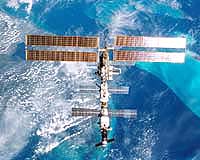
Huntsville - Mar 16, 2004 Scientists have seen the completion of a record-breaking 31-day experiment on the International Space Station, called PromISS-3. It is the longest duration experiment ever conducted inside the Microgravity Science Glovebox - built by engineers and scientists at the European Space Agency in collaboration with NASA's Marshall Space Flight Center in Huntsville, Ala. The glovebox - a sealed container with built-in gloves - provides an enclosed workspace for investigations conducted in the microgravity, environment created as the Station orbits Earth. Sponsored by the European Space Agency, PromISS-3 was an experiment to study the growth of protein crystals. Among the proteins grown were iron storage proteins found in all living things, proteins which help protect humans from bacterial infection and proteins related to anemia and neuromuscular disease in humans. The heart of the experiment was the use of a holographic microscope, which sent back images of the crystals while they were growing. The holographic microscope provided a capability to look at the physics involved in the growth of these types of crystals in order to understand more fully why some crystals grow better in space and some do not. NASA ISS Science Officer Mike Foale unpacked his Lower Extremity Monitoring Suit (LEMS) to prepare for another session of the Foot/Ground Reaction Forces during Space Flight (FOOT) experiment. Wearing black Lycra "biking tights" with 20 electrodes as well as shoes fitted with insoles that measure impact forces on the bottom of the foot, while Foale goes through a typical 12-hour on-orbit day, the hardware will measure reaction forces in his legs and feet to determine how much exercise these muscles get while in orbit. This study will provide better understanding of the bone and muscle loss in the lower extremities experienced by astronauts in microgravity.
Related Links Marshall Space Flight Center SpaceDaily Search SpaceDaily Subscribe To SpaceDaily Express  These Boots Are Made For Walking
 Houston - Mar 16, 2004
How will future space suits differ from the current ones? Well, for one thing, the boots will be made for walking. Astronauts who wear space suits for extra-vehicular activities (EVAs) don't walk. They hover and float, or their feet are placed into foot restraints so they don't drift away. In the future, however, astronauts may go to Mars as part of NASA's new vision. And they'll need very different boots to walk on the planet's surface or drive a rover. |
|
|

| The content herein, unless otherwise known to be public domain, are Copyright 1995-2006 - SpaceDaily.AFP and UPI Wire Stories are copyright Agence France-Presse and United Press International. ESA PortalReports are copyright European Space Agency. All NASA sourced material is public domain. Additionalcopyrights may apply in whole or part to other bona fide parties. Advertising does not imply endorsement,agreement or approval of any opinions, statements or information provided by SpaceDaily on any Web page published or hosted by SpaceDaily. Privacy Statement |