
 |
 |
 |
 |
 |
 |
 |
 |
 |
 |

| . |  |
. |

Paris, France (ESA) Apr 05, 2011 ESA's Envisat satellite has measured record low levels of ozone over the Euro-Atlantic sector of the northern hemisphere during March. This record low was caused by unusually strong winds, known as the polar vortex, which isolated the atmospheric mass over the North Pole and prevented it from mixing with air in the mid-latitudes. This led to very low temperatures and created conditions similar to those that occur every southern hemisphere winter over the Antarctic. As March sunlight hit this cold air mass it released chlorine and bromine atoms - ozone-destroying gases that originate from chlorofluorocarbons (CFCs) and break ozone down into individual oxygen molecules - predominantly in the lower stratosphere, around 20 km above the surface. Ozone is a protective atmospheric layer found at around 25 km altitude that acts as a sunlight filter shielding life on Earth from harmful ultraviolet rays, which can harm marine life and increase the risk of skin cancer and cataracts. Stratospheric temperatures in the Arctic show strong variations from winter to winter. Last year, temperatures and ozone above the Arctic were very high. The last unusually low stratospheric temperatures over the North Pole were recorded in 1997. Scientists are investigating why the 2011 and 1997 Arctic winters were so cold and whether these random events are statistically linked to global climate change. "In a changing climate, it is expected that on average stratospheric temperatures cool, which means more chemical ozone depletion will occur," said Mark Weber from the University of Bremen. "On the other hand, many studies show that the stratospheric circulation in the northern hemisphere may be enhanced in the future and, consequently, more ozone will be transported from the tropics into high latitudes and reduce ozone depletion." Answering this question requires more research on ozone modelling and ozone trend monitoring, which is only possible because of the historic satellite data on record. ESA's Climate Change Initiative Programme has a project dedicated to this research. "Measurements from the Envisat's Sciamachy, MIPAS and GOMOS instruments are providing unique ozone information that is important in enabling scientists to separate chemical and dynamical changes and helping to identify the influence of climate change on the stratosphere. It is, therefore, essential to keep these instruments measuring for as long as possible," said Weber. Banned under the Montreal Protocol, CFCs have still not vanished from the air but are on the decline. Nevertheless, strong chemical ozone depletion will continue to occur in the coming decades during unusually cold Arctic winters.
Share This Article With Planet Earth
Related Links University of Bremen Earth Observation News - Suppiliers, Technology and Application

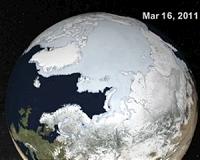 Arctic Ice Gets A Check Up
Grreenbelt MD (SPX) Apr 01, 2011 Scientists tracking the annual maximum extent of Arctic sea ice said that 2011 was among the lowest ice extents measured since satellites began collecting the data in 1979. Using satellites to track Arctic ice and comparing it with data from previous years is one way that scientists track change in the Arctic system. "For the first 20 years of the satellite record, the average annual maxim ... read more |
|
|
| The content herein, unless otherwise known to be public domain, are Copyright 1995-2010 - SpaceDaily. AFP and UPI Wire Stories are copyright Agence France-Presse and United Press International. ESA Portal Reports are copyright European Space Agency. All NASA sourced material is public domain. Additional copyrights may apply in whole or part to other bona fide parties. Advertising does not imply endorsement,agreement or approval of any opinions, statements or information provided by SpaceDaily on any Web page published or hosted by SpaceDaily. Privacy Statement |


 del.icio.us
 Digg
Digg Reddit
 YahooMyWeb
 Google
 Facebook


