|
 |
 |
 |
 |
 |
 |
 |
 |
 |

| . |  |
. |
Red Supergiant Cauldrons Let Off Steam
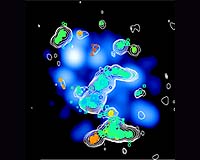
Preston UK (SPX) Apr 17, 2007 Steamy clouds have been observed bubbling away from four massive stars known as red supergiants. A team from Jodrell Bank, using the MERLIN array and European and Global VLBI Networks, found that the stars are actually 'steaming' as they enter their final death throes, driving out thick clouds of water vapour immersed in more tenuous gas. Dr Anita Richards, who is presenting results at the RAS National Astronomy Meeting in Preston on 17th April, said, "Red supergiants lose more than half their mass before ending their lives as supernovae. Our observations show that this doesn't happen smoothly, like an onion shedding layers. We see water vapour clouds which are over-dense, over-magnetised and rapidly accelerated away from the star. They are embedded in a cooler, more diffuse gas producing distinctive emission from hydroxyl, a break-down product of water." The group studied 'maser' emissions from the gas clouds surrounding the star: molecules in the gas amplify and emit beams of microwave radiation in much the same way as a laser produces very narrow, bright beams of light. Water emits at 1.3 cm wavelength, under hot, dense conditions (around 1000 degrees Kelvin). Hydroxyl emission at 18.0 cm can only occur from cooler, less dense gas and it was very unexpected to detect it as close to two of the stars as the water masers. The only explanation seems to be that the water masers come from clumps where the gas density is, typically, 50 times higher than the rest of the wind from the star. Supporting evidence comes from measurements of the magnetic field strength associated with the hydroxyl masers, which is much weaker than that of the adjacent water masers, as is expected if the hydroxyl environment is more diffuse. The water vapour clouds appear to be very dusty and are accelerating faster than the surrounding gas. Only a few of these steam clouds form each stellar period (several years), filling just a few percent of the volume of the maser shell around the star, but they contain most of the mass lost by the star. In the study, the maser emissions from the water vapour appeared to show that the clouds had a lifetime of only a few decades, although clouds were observed at distances that would have taken about a century to reach. The puzzle was solved by comparing the MERLIN results with longer-term observations from the Puschino radio telescope in Russia, which revealed individual clouds winking off and back on again due to the fickle nature of maser excitation or beaming. Dr Anita Richards said, "These observations are intriguing because, from the size of the masing shell, we estimate that the water vapour clouds take about 100 years to bubble away into interstellar space, but we can only actually 'see' any particular cloud for a few years." The group hope to follow this up by using the e-MERLIN, eVLBI and ALMA networks of radio telescopes to trace the mass loss process back to the star to discover whether star-spots, convection cells, dust formation or some other mechanism gives birth to the clumps. The research was conducted by Anita Richards, Jim Cohen, Phil Diamond, Sandra Etoka , Malcolm Gray and Wouter Vlemmings from Manchester University; Mike Masheder from Bristol University; Indra Bains from the University of Melbourne; Ania Bartkiewicz and Marian Szymczak from the Niclaus Copernicus University, Torun; Evgueny Lekht and Eduardo Mendoza-Torrez from INAOEP, Mexico; Koji Murakawa from the Max Planck Institute, Bonn; Huib van Langevelde from JIVE/Leiden University, The Netherlands and Jeremy Yates from University College London. Email This Article
Related Links  Pasadena CA (JPL) Apr 12, 2007
For the first time ever, NASA researchers have successfully demonstrated in the laboratory that a space telescope rigged with special masks and mirrors could snap a photo of an Earth-like planet orbiting a nearby star. This accomplishment marks a dramatic step forward for missions like the proposed Terrestrial Planet Finder, designed to hunt for an Earth twin that might harbor life. |
|
|

| The content herein, unless otherwise known to be public domain, are Copyright 1995-2006 - SpaceDaily.AFP and UPI Wire Stories are copyright Agence France-Presse and United Press International. ESA PortalReports are copyright European Space Agency. All NASA sourced material is public domain. Additionalcopyrights may apply in whole or part to other bona fide parties. Advertising does not imply endorsement,agreement or approval of any opinions, statements or information provided by SpaceDaily on any Web page published or hosted by SpaceDaily. Privacy Statement |