|
 |
 |
 |
 |
 |
 |
 |

| . |  |
. |

|
|
. |

 by Launchspace Staff Bethesda MD (SPX) Aug 02, 2011
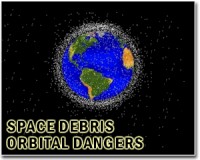
We have been using the space environment for the last 50+ years. Satellites have been placed in orbits that take advantage of natural perturbations while offering convenient geometries for various mission types. This approach has evolved since the 1960s and continues to be the way space is used today. There is nothing wrong with doing business in this manner, as long as we dominate the space environment. However, the U.S. no longer has free and unlimited access to and control of space. In fact, space has become highly contested by many other countries. Thus, the security of our space assets has been downgraded. Start with space debris. The most popular orbits for a significant fraction of our large and expensive spacecraft coincide with the densest zones of space debris. Thus, there is a continual and increasing threat of debris collisions with many billion dollar satellites. Add to this the fact that we cannot track most of the objects in space. The Air Force is tracking over 20,000 objects, but cannot identified many of them. In addition, there are thought to be hundreds of thousands of smaller objects that cannot be tracked. Next, consider the asymmetrical advantage of an adversary in terms of disabling many space assets with low-cost devices. The bottom line is that we have an intractable situation when it comes to protecting these assets. We do not know how to protect our national security satellites and they are vulnerable to various attack scenarios. It is clear that we cannot continue to launch billion dollar satellites that can be disable by space debris, or a low-cost countermeasure. So, what can we do? The answer may be a combination of innovation, new sensor technology and the application of modern information processing. Clearly, it would be highly advantageous if these important satellites were smaller, less expensive and placed in orbits that present less risk from debris and unidentifiable objects. The key may be to distribute the assets in the form of many simpler spacecraft in orbits that are safe from debris and less vulnerable to adversarial attack. But, there must be other approaches out there and Launchspace wants to hear your ideas. Please let us know your thoughts by clicking the button below.
|
. |
|
| The content herein, unless otherwise known to be public domain, are Copyright 1995-2011 - Space Media Network. AFP and UPI Wire Stories are copyright Agence France-Presse and United Press International. ESA Portal Reports are copyright European Space Agency. All NASA sourced material is public domain. Additional copyrights may apply in whole or part to other bona fide parties. Advertising does not imply endorsement,agreement or approval of any opinions, statements or information provided by Space Media Network on any Web page published or hosted by Space Media Network. Privacy Statement |

 del.icio.us
 Digg
Digg Reddit
 Google