
 |
 |
 |
 |
 |
 |
 |
 |
 |
 |

| . |  |
. |

Tucson AZ (SPX) Dec 14, 2010 Using a comet as a far-flung laboratory, a Planetary Science Institute researcher has shown that the ionization lifetime of carbon is much shorter than what is currently used in calculations by comet scientists. An accurate ionization lifetime is critical to understanding the amount of carbon released from comets, said Jeff Morgenthaler, senior scientist at PSI. A shorter lifetime suggests that the carbon content of some comets may be lower than previously estimated. This work could affect current ideas about where comets formed in the early solar system and the role they may have played in bringing the seeds of life to Earth. "Carbon is an important atom for lots of reasons," Morgenthaler said. "We need to know how much carbon there is in comets and in what molecules it can be found to answer some of the questions that have been posed." Using wide-field images recorded by the Galaxy Evolution Explorer (GALEX) satellite, Morgenthaler produced extremely high-quality radial profiles of atomic carbon emissions from comet C/2004 Q2 (Machholz). Unlike conditions seen on Earth, a comet's coma, or envelope around its nucleus, is a very simple atmosphere with no gravity and no magnetic field, and is only affected by the solar photon and solar wind environment, Morgenthaler said. "Since other researchers have established how fast the carbon moves away from the comet, we could use the fall-off of the light as a function of distance to measure how long the carbon lives in the interplanetary medium before it is ionized," said Morgenthaler, lead author of a recent paper on the topic that appeared in the Astrophysical Journal. "We got a chance to check a lot of calculations at once with our measurement," he said. "We found that a carbon atom is ionized after seven to 16 days, depending on solar activity and solar wind conditions." This marks the end point of the destruction of all of the more complex carbon-bearing molecules found in comets. Researchers have used the presence of long-chain carbon-containing molecules in comets, including some simple amino acids, as evidence that comets may have brought the seeds of life to Earth. "We need to pull back a few more layers of the onion to see if the signatures of the long-chain carbon-bearing molecules are detectable in these data," Morgenthaler said. "We definitely see the signatures of carbon monoxide and methane." The research found that more than just sunlight was affecting the carbon from the comet. "Something was hitting the carbon: the solar wind," he said. "This had been predicted earlier, but until now no one had quantitatively put all the pieces together and done a measurement that confirmed it." The research was funded by a grant to PSI from the GALEX Guest Investigator program. GALEX's wide field of view at 1 degree is 10 times larger than the typical ultraviolet telescopes used for similar research, he said. This allows GALEX to capture essentially all the emission from the comet, resulting in far more accurate results. Co-authors of the Astrophysical Journal paper are Walter M. Harris, Department of Applied Sciences, University of California at Davis; Michael R. Combi, Department of Atmospheric, Oceanic and Space Sciences, The University of Michigan; Paul D. Feldman, Department of Physics and Astronomy, The Johns Hopkins University; Harold A. Weaver, Space Department, Johns Hopkins University Applied Physics Laboratory.
Share This Article With Planet Earth
Related Links Planetary Science Institute Asteroid and Comet Mission News, Science and Technology

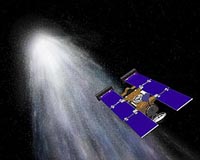 NASA Spacecraft Burns For Another Comet Flyby
Pasadena CA (JPL) Nov 23, 2010 Eighty-six days out from its appointment with a comet, NASA's Stardust spacecraft fired its thrusters to help refine its flight path. The Stardust-NExT mission will fly past comet Tempel 1 next Valentine's Day (Feb. 14, 2011). It will perform NASA's second comet flyby within four months. "One comet down, one to go," said Tim Larson, project manager for both the Stardust-NExT mission and th ... read more |
|
|
| The content herein, unless otherwise known to be public domain, are Copyright 1995-2010 - SpaceDaily. AFP and UPI Wire Stories are copyright Agence France-Presse and United Press International. ESA Portal Reports are copyright European Space Agency. All NASA sourced material is public domain. Additional copyrights may apply in whole or part to other bona fide parties. Advertising does not imply endorsement,agreement or approval of any opinions, statements or information provided by SpaceDaily on any Web page published or hosted by SpaceDaily. Privacy Statement |


 del.icio.us
 Digg
Digg Reddit
 YahooMyWeb
 Google
 Facebook


