|
 |
 |
 |
 |
 |
 |
 |
 |
 |

| . |  |
. |
Researchers Awarded NIH Grant to Develop Virtual Patient Models
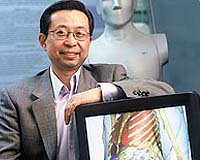
Troy NY (SPX) Aug 17, 2005 Rensselaer Polytechnic Institute is leading a team of researchers awarded a three-year, $2.1 million grant from the National Institutes of Health (NIH) to develop 3-D virtual patient models that will more accurately compute radiation doses for CT imaging, nuclear medicine, and radiation treatment of cancer patients. The grant is funded by the National Cancer Institute, part of NIH. X. George Xu, associate professor of nuclear and biomedical engineering at Rensselaer, is the principal investigator of the project. Additional researchers from Rensselaer, Vanderbilt University Medical Center, University of Florida, and Massachusetts General Hospital are bringing expertise in the diverse fields of computer science, CT imaging, nuclear medicine, and proton therapy to the multidisciplinary project. "Dr. Xu's research aims to better understand the effects of radiation interaction on the human body using virtual patients, thereby enabling radiologists to use safer and more effective doses of radiation to image and treat actual patients," said Omkaram "Om" Nalamasu, vice president for research at Rensselaer. "His work is an example of the advanced imaging and computational modeling research being conducted at Rensselaer and how it is collaboratively applied to address pressing medical and healthcare problems." In 2000, Xu and his students at Rensselaer created Visible Photographic Man (VIP-Man), an advanced computer model that simulates in 3-D how radiation affects the organs and tissues in the human body. The project combined precise organ and tissue anatomy with Monte Carlo computer codes to simulate the interactions of various radiation types, such as photons, electrons, neutrons, and protons, within the body. The research on VIP-Man, which was funded by the National Science Foundation and the National Library of Medicine, contained three billion voxels of medical image data in a computer code that formulates a virtual patient. A voxel is a 3-D volume of the patient body, similar to a pixel measuring a piece of 2-D image data. In collaboration with the interdisciplinary team, Xu plans to expand on VIP-Man in the new project by creating a library of additional 3-D models that represent virtual female and male patients of various ages and body sizes. The researchers also will develop advanced 4-D patient models that simulate organ motions. Additionally, Xu is leading an international effort to form a consortium on computational patient models as a key resource for biomedical research. "Currently accepted methods in radiation protection and nuclear medicine do not realistically consider patient variations in age and body size, resulting in very large miscalculations in the true radiation dose to the patient," said Xu. "Our project aims to bring about a paradigm change by creating a realistic patient model library and related computational tools that will facilitate image processing, simulation, and radiation dose measurement for various clinical diagnostic and therapeutic procedures." Co-investigators on the research team are: Daniel Freedman, assistant professor of computer science at Rensselaer; Charles Stewart, professor of computer science at Rensselaer; Michael Stabin, assistant professor of radiology at Vanderbilt University Medical Center; Aaron Brill, research professor of radiology at Vanderbilt University Medical Center; Wesley Bolch, professor of nuclear and radiological engineering at University of Florida; Jon Williams, professor and associate chair of radiology at University of Florida; Harald Paganetti, assistant professor of radiation oncology at Massachusetts General Hospital; Herman Suit, radiation oncologist and professor of radiation oncology at Massachusetts General Hospital. Related Links Rensselaer Polytechnic Institute SpaceDaily Search SpaceDaily Subscribe To SpaceDaily Express  MIT Engineers An Anti-Cancer Smart Bomb
 Cambridge MA (SPX) Jul 28, 2005
Imagine a cancer drug that can burrow into a tumor, seal the exits and detonate a lethal dose of anti-cancer toxins, all while leaving healthy cells unscathed. |
|
|

| The content herein, unless otherwise known to be public domain, are Copyright 1995-2006 - SpaceDaily.AFP and UPI Wire Stories are copyright Agence France-Presse and United Press International. ESA PortalReports are copyright European Space Agency. All NASA sourced material is public domain. Additionalcopyrights may apply in whole or part to other bona fide parties. Advertising does not imply endorsement,agreement or approval of any opinions, statements or information provided by SpaceDaily on any Web page published or hosted by SpaceDaily. Privacy Statement |