
 |
 |
 |
 |
 |
 |
 |
 |
 |
 |

| . |  |
. |

Tucson AZ (SPX) May 19, 2011 A tumbling comet nucleus with a changing rotational rate has been observed for the first time, according to a new paper by a Planetary Science Institute researcher. These findings, as well as information gleaned from a recent NASA EPOXI spacecraft flyby of Comet 103P/Hartley 2, are expected to offer new insights as researchers strive to better understand comets and the role they could possibly play in aiding human solar system exploration, said Nalin H. Samarasinha, senior scientist at PSI and lead author of a paper titled "Rotation of Comet 103P/Hartley 2 from Structures in the Coma" that appears in Astrophysical Journal Letters. "Understanding the makeup of comets has immediate relevance to planetary explorations efforts. Small bodies of the solar system such as asteroids and comets could potentially act as way stations, as well as to supply needed resources, for the human exploration of the solar system," Samarasinha said. "For this purpose, it is necessary to know the properties and the character of these objects to maximize our investment." The research team analyzed images of the rotationally excited, or tumbling, Hartley 2 comet taken during 20 nights between Sept. 1 and Dec. 15, 2010 using the 2.1-meter telescope at Kitt Peak National Observatory near Tucson, Ariz. A blue filter that isolates the light emitted by cyanogen (CN) molecules was used to observe CN features in the coma of the comet, Samarasinha said. This showed clear variations over time scales ranging from a few hours to over several days. The coma is the extended "atmosphere" of the comet that surrounds the solid nucleus that consists of ice and dirt. "The rotational state of a comet's nucleus is a basic physical parameter needed to accurately interpret other observations of the nucleus and coma. Analysis of these cyanogen features indicates that the nucleus is spinning down and suggests that it is in a state of a dynamically excited rotation," he said. "Our observations have clearly shown that the effective rotation period has increased during the observation window." The team is the first group to point this out based on their observations from early September and early October. Hartley 2, a relatively small comet with a 2-kilometer long nucleus, is highly active for its size, he said. It is experiencing rotational changes due to torque caused by jets of gases emitting from the icy body. Information on the makeup of Hartley 2 gleaned from this research and the EPOXI flyby, and similar research on additional comets, could offer the early tools researchers need to determine the best way to deal with a comet on a collision course with Earth. "Although extremely rare, comets can collide with Earth. This could cause regional or global damage to the environment and to life on Earth. However, fortunately for the first time, we are on the threshold of our technical knowhow to mitigate such a hazardous impact," Samarasinha said. "In order to do that we need to know the material properties of comets. The most appropriate mitigation strategy for a strong rigid body is different from that for a weakly bound agglomerate." Hartley 2 offered a significant opportunity for research, said co-author Beatrice E.A. Mueller. "This comet had such a great apparition - it came close to Earth and was observable from the ground over months with great resolution, and was encountered by the EPOXI spacecraft," said Mueller, PSI Senior Scientist and Principal Investigator of the NASA Planetary Astronomy Grant to PSI that funded the study. "Ultimately, one wants to deduce the physical parameters of the nucleus as well as its structure. This will give insights into the conditions during the formation of the solar system." Other authors of the paper are Michael F. A'Hearn, Tony L. Farnham and Alan Gersch, all of the University of Maryland Department of Astronomy.
Share This Article With Planet Earth
Related Links - Asteroid and Comet Mission News, Science and Technology

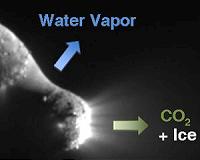 At the Heart of Hartley-2, a New Breed of Comet?
Greenbelt MD (SPX) May 18, 2011 At the heart of every comet lies a remnant of the dawn of the solar system. Or is that remnants? Astronomers don't know, but the answer would give them a clearer picture of exactly how comets were born eons ago at the birth of the Solar System. Did thin tendrils of dust and ice get drawn slowly inward and pack themselves into a single, uniform mass? Or did a hodge-podge of mini-comets come toget ... read more |
|
|
| The content herein, unless otherwise known to be public domain, are Copyright 1995-2010 - SpaceDaily. AFP and UPI Wire Stories are copyright Agence France-Presse and United Press International. ESA Portal Reports are copyright European Space Agency. All NASA sourced material is public domain. Additional copyrights may apply in whole or part to other bona fide parties. Advertising does not imply endorsement,agreement or approval of any opinions, statements or information provided by SpaceDaily on any Web page published or hosted by SpaceDaily. Privacy Statement |


 del.icio.us
 Digg
Digg Reddit
 YahooMyWeb
 Google
 Facebook


