. Military Space News .
Researchers Measure Elusive Repulsive Force From Quantum Fluctuations

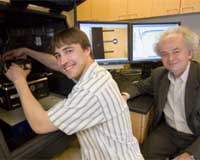
Here are researchers Jeremy Munday, Postdoctoral Scholar, California Institute of Technology, and Federico Capasso, Robert L. Wallace Professor of Applied Physics and Vinton Hayes Senior Research Fellow in Electrical Engineering at the Harvard School of Engineering and Applied Sciences. Credit: Eliza Grinnell, Harvard School of Engineering and Applied Sciences.
by Staff Writers
Boston MA (SPX) Jan 13, 2009
Researchers from Harvard University and the National Institutes of Health (NIH) have measured, for the first time, a repulsive quantum mechanical force that could be harnessed and tailored for a wide range of new nanotechnology applications.

The study, led by Federico Capasso, Robert L. Wallace Professor of Applied Physics at Harvard's School of Engineering and Applied Science (SEAS), will be published as the January 8 cover story of Nature.

The discovery builds on previous work related to what is called the Casimir force. While long considered only of theoretical interest, physicists discovered that this attractive force, caused by quantum fluctuations of the energy associated with Heisenberg's uncertainty principle, becomes significant when the space between two metallic surfaces, such as two mirrors facing one another, measures less than about 100 nanometers.

"When two surfaces of the same material, such as gold, are separated by vacuum, air, or a fluid, the resulting force is always attractive," explained Capasso.

Remarkably, but in keeping with quantum theory, when the scientists replaced one of the two metallic surfaces immersed in a fluid with one made of silica, the force between them switched from attractive to repulsive. As a result, for the first time, Capasso and his colleagues measured what they have deemed a repulsive Casimir.

To measure the repulsive force, the team immersed a gold coated microsphere attached to a mechanical cantilever in a liquid (bromobenzene) and measured its deflection as the distance from a nearby silica plate was varied.

"Repulsive Casimir forces are of great interest since they can be used in new ultra-sensitive force and torque sensors to levitate an object immersed in a fluid at nanometric distances above a surface. Further, these objects are free to rotate or translate relative to each other with minimal static friction because their surfaces never come into direct contact," said Capasso.

By contrast, attractive Casimir forces can limit the ultimate miniaturization of small-scale devices known as Micro Electromechanical Systems (MEMS), a technology widely used to trigger the release of airbags in cars, as the attractive forces may push together moving parts and render them inoperable, an effect known as stiction.

Potential applications of the team's finding include the development of nanoscale-bearings based on quantum levitation suitable for situations when ultra-low static friction among micro- or nano-fabricated mechanical parts is necessary. Specifically, the researchers envision new types of nanoscale compasses, accelerometers, and gyroscopes.

Capasso's coauthors are Jeremy Munday, formerly a graduate student in Harvard's Department of Physics and presently a postdoctoral researcher at the California Institute of Technology, and Dr. V. Adrian Parsegian, Senior Investigator at the National Institutes of Health in Bethesda, Maryland. The Harvard researchers have filed for a U.S. patent covering nanodevices based on quantum levitation.
Share This Article With Planet Earth
del.icio.usdel.icio.us DiggDigg RedditReddit
YahooMyWebYahooMyWeb GoogleGoogle FacebookFacebook


Related Links
Harvard University
Understanding Time and Space


Memory Foam Mattress Review
Newsletters :: SpaceDaily :: SpaceWar :: TerraDaily :: Energy Daily
XML Feeds :: Space News :: Earth News :: War News :: Solar Energy News


Physicist Offers Foundation For Uprooting A Hallowed Principle Of Physics
Bloomington IN (SPX) Jan 08, 2009
Physicists at Indiana University have developed a promising new way to identify a possible abnormality in a fundamental building block of Einstein's theory of relativity known as "Lorentz invariance." If confirmed, the abnormality would disprove the basic tenet that the laws of physics remain the same for any two objects traveling at a constant speed or rotated relative to one another.


  • China, US upbeat on future of bilateral relationship
  • Walker's World: Sarkozy and the Britons
  • Military Matters: Russian ally -- Part 2
  • China's Hu tells Bush Sino-US ties will remain strong: govt

  • Nuclear-related programs cost US 52 bln dollars in 2008: report
  • North Korea, Iran 'still dangerous': Bush
  • US sanctions Khan, associates linked to his nuclear network
  • Obama vows swift engagement with Iran

  • Taiwan not impressed by reported Chinese plan to withdraw missiles
  • Javelin Joint Venture Awarded Contract For Command Launch Unit Upgrade
  • NLOS-LS Completes Third Test Flight Of Precision Attack Missile
  • Russian Military Confirms 13 Strategic Missile Launches For 2009

  • Pentagon denies missile defense sales talks with India
  • BMD Watch: New missile for S-400 Triumf
  • Moscow Says Offer To On Joint Radar Use Still Stands
  • What Motivates Iran And Russia On The S-300 Deal Part Two

  • Protesters buy land earmarked for Heathrow expansion
  • NASA Balloon Mission Tunes In To A Cosmic Radio Mystery
  • Boeing Ends 2008 With 662 Commercial Airplane Orders
  • China moves to bail out aviation industry amid global crisis

  • Boeing-Insitu ScanEagle Completes 1500 Shipboard Sorties With US Navy
  • Skylark 1 LE Selected By Israeli Ministry Of Defense
  • Russia mulls unprecedented Israel drones purchase
  • Raven UAS Certified By Italian Ministry Of Defense

  • Dogs of War: Immunity and impunity
  • US hands over Green Zone security to Iraq
  • Feature: Hunting weapons in Iraqi dung
  • Key dates in Iraq's political transition

  • Lockheed Paveway 2 Laser-Guided Bomb Begins Operational Release With US Navy
  • Gazan Tank Battles 2009 - Part Three
  • Israel using Gaza as 'test laboratory' for new weapon: medics
  • Israel says all weapons legal amid phosphorus claims

  • The content herein, unless otherwise known to be public domain, are Copyright 1995-2007 - SpaceDaily.AFP and UPI Wire Stories are copyright Agence France-Presse and United Press International. ESA Portal Reports are copyright European Space Agency. All NASA sourced material is public domain. Additional copyrights may apply in whole or part to other bona fide parties. Advertising does not imply endorsement,agreement or approval of any opinions, statements or information provided by SpaceDaily on any Web page published or hosted by SpaceDaily. Privacy Statement