
 |
 |
 |
 |
 |
 |
 |
 |
 |
 |

| . |  |
. |

Calgary, Canada (SPX) Nov 18, 2010 In the movie Angels and Demons, scientists have solved one of the most perplexing scientific problems: the capture and storage of antimatter. In real life, trapping atomic antimatter has never been accomplished, until now. A team made up of researchers from the University of Calgary, institutions across Canada and around the world have discovered how to trap atomic antimatter and the results of their discovery is published in the journal Nature. "This is a major discovery. It could enable experiments that result in dramatic changes to the current view of fundamental physics or in confirmation of what we already know now," says Rob Thompson, head of physics and astronomy at the University of Calgary and co-investigator in the ALPHA collaboration, one of two teams competing to gain a better understanding of antimatter and our universe. Both teams, ALPHA and the Harvard-led ATRAP, have been at this race for over five years conducting experiments in close quarters at CERN (European Organization for Nuclear Research), the world's largest particle physics lab, located in the suburbs of Geneva, Switzerland. CERN is the only laboratory in the world with the proper equipment where this research can be carried out. "These are significant steps in antimatter research," said CERN Director General Rolf Heuer, "and an important part of the very broad research programme at CERN." The goal of the competition involves trapping and storing the simplest of all antimatter atoms, antihydrogen, with the purpose of studying it. Hydrogen is the lightest and most abundant chemical element. "We know a lot about matter, but very little about antimatter. We assume there was as much antimatter created in the Big Bang as matter. There are many questions. Where is the antimatter? Where did it go? And why does it appear that there is more matter than antimatter?" says Makoto Fujiwara, adjunct professor in the Department of Physics and Astronomy at the University of Calgary and a research scientist at TRIUMF, Canada's national laboratory for particle and nuclear physics. ALPHA-Canada scientists and students have been playing leading roles in the experiment. "It's been a rare privilege and a tremendous learning experience taking part in this groundbreaking international endeavour," says Richard Hydomako, a PhD student at the University of Calgary. Trapping antimatter is tricky. When matter and antimatter get too close, they destroy each other, in a kind of explosion, leaving behind the energy which made them. The challenge is cooling the atoms off enough, 272 degrees below zero, so that they are slow enough to be trapped in a magnetic storage device. "We've been able to trap about 38 atoms, which is an incredibly small amount, nothing like what we would need to power Star Trek's starship Enterprise or even to heat a cup of coffee," says Thompson , one of 42 co-authors of the Nature paper along with the University of Calgary's Makoto Fujiwara and graduate students Richard Hydomako and Tim Friesen. "Now we can start working on the next step which is to use tools to study it," adds Thompson
Share This Article With Planet Earth
Related Links University of Calgary Understanding Time and Space

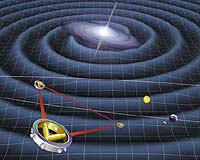 Linking Geometric Problems To Physics Could Open Door To New Solutions
Princeton NJ (SPX) Nov 17, 2010 A Princeton scientist with an interdisciplinary bent has taken two well-known problems in mathematics and reformulated them as a physics question, offering new tools to solve challenges relevant to a host of subjects ranging from improving data compression to detecting gravitational waves. Salvatore Torquato, a professor of chemistry, has shown that two abstract puzzles in geometry - known ... read more |
|
|
| The content herein, unless otherwise known to be public domain, are Copyright 1995-2010 - SpaceDaily. AFP and UPI Wire Stories are copyright Agence France-Presse and United Press International. ESA Portal Reports are copyright European Space Agency. All NASA sourced material is public domain. Additional copyrights may apply in whole or part to other bona fide parties. Advertising does not imply endorsement,agreement or approval of any opinions, statements or information provided by SpaceDaily on any Web page published or hosted by SpaceDaily. Privacy Statement |


 del.icio.us
 Digg
Digg Reddit
 YahooMyWeb
 Google
 Facebook


