
. Military Space News .
BIO FUEL
Researchers develop 3-D-printed biomaterials that degrade on demand
by Staff Writers
Providence RI (SPX) Sep 13, 2017


Brown researchers have found a way to 3-D print intricate temporary microstructures that can be degraded on demand using a biocompatible chemical trigger. The technique could be useful could be useful in fabricating microfluidic devices, creating biomaterials that respond dynamically to stimuli and in patterning artificial tissue.

Brown University engineers have demonstrated a technique for making 3-D-printed biomaterials that can degrade on demand, which can be useful in making intricately patterned microfluidic devices or in making cell cultures than can change dynamically during experiments.

"It's a bit like Legos," said Ian Wong, an assistant professor in Brown's School of Engineering and co-author of the research. "We can attach polymers together to build 3-D structures, and then gently detach them again under biocompatible conditions."

The research is published in the journal Lab on a Chip.

The Brown team made their new degradable structures using a type of 3-D printing called stereolithography. The technique uses an ultraviolet laser controlled by a computer-aided design system to trace patterns across the surface of a photoactive polymer solution. The light causes the polymers to link together, forming solid 3-D structures from the solution. The tracing process is repeated until an entire object is built from the bottom up.

Stereolithographic printing usually uses photoactive polymers that link together with covalent bonds, which are strong but irreversible. For this new study, Wong and his colleagues wanted to try creating structures with potentially reversible ionic bonds, which had never been done before using light-based 3-D printing. To do it, the researchers made precursor solutions with sodium alginate, a compound derived from seaweed that is known to be capable of ionic crosslinking.

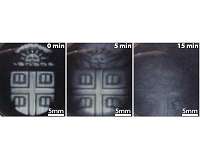
"The idea is that the attachments between polymers should come apart when the ions are removed, which we can do by adding a chelating agent that grabs all the ions," Wong said. "This way we can pattern transient structures that dissolve away when we want them to."

The researchers showed that alginate could indeed be used in stereolithography. And by using different combinations of ionic salts - magnesium, barium and calcium - they could create structures with varying stiffness, which could then be dissolved away at varying rates.

The research also showed several ways in such temporary alginate structures could be useful.

"It's a helpful tool for fabrication," said Thomas M. Valentin, a Ph.D. student in Wong's lab at Brown and the study's lead author. The researchers showed that they could use alginate as a template for making lab-on-a-chip devices with complex microfluidic channels.

"We can print the shape of the channel using alginate, then print a permanent structure around it using a second biomaterial," Valentin said. "Then we simply dissolve away the alginate and we have a hollow channel. We don't have to do any cutting or complex assembly."

The researchers also showed that degradable alginate structures are useful for making dynamic environments for experiments with live cells. They performed a series of experiments with alginate barriers surrounded by human mammary cells, observing how the cells migrate when the barrier is dissolved away. These kinds of experiments can be useful in investigating wound-healing processes or the migration of cells in cancer.

The experiments showed that neither the alginate barrier nor the chelating agent used to dissolve it away had any appreciable toxicity to the cells. That suggests that degradable alginate barriers are a promising option for such experiments.

The biocompatibility of the alginate is promising for additional future applications, including in making scaffolds for artificial tissue and organs, the researchers say.

"We can start to think about using this in artificial tissues where you might want channels running through it that mimic blood vessels," Wong said. "We could potentially template that vasculature using alginate and then dissolve it away like we did for the microfluidic channels."

The researchers plan to continue experimenting with their alginate structures, looking for ways to fine-tune their strength and stiffness properties, as well as the pace of degradation.

Research paper

BIO FUEL
A new way to directly convert methane to methanol using gold-palladium nanoparticles
Bethlehem PA (SPX) Sep 13, 2017
Liquid methanol is widely used as a feedstock for other chemicals and also has considerable potential as an alternative fuel source. However, converting methane - the primary component of abundant natural gas - into methanol is currently achieved by an indirect process which requires high heat and pressure. Now researchers have discovered a new approach that allows the direct conversion of ... read more

Related Links
Brown University
Bio Fuel Technology and Application News


Thanks for being here;
We need your help. The Space Media Network continues to grow but revenues have never been harder to maintain.

With the rise of Ad Blockers, and Facebook - our traditional revenue sources via quality network advertising continues to decline. And unlike so many other news sites, we don't have a paywall - with those annoying usernames and passwords.

Our news coverage takes time and effort to publish 365 days a year.

If you find our news sites informative and useful then please consider becoming a regular supporter or for now make a one off contribution.
SpaceMediaNetwork Contributor
$5 Billed Once


credit card or paypal
SpaceMediaNetwork Monthly Supporter
$5 Billed Monthly


paypal only


Comment using your Disqus, Facebook, Google or Twitter login.

Share this article via these popular social media networks
del.icio.usdel.icio.us DiggDigg RedditReddit GoogleGoogle

BIO FUEL
PAC-3 MSE Test Successful from Remote Launcher

Saudi intercepts Yemen rebel missile

Lockheed Martin to replace USS Fitzgerald's SPY-1D AEGIS radar

Orbital ATK launches Patriot system target vehicle

BIO FUEL
Iran tests new medium-range missile, defying US warnings

Raytheon receives $31.5M contract for TOW missiles

Turkey signs deal to buy Russian S-400 missile systems

Leonardo, Thales integrating missile-protection systems in Britain

BIO FUEL
Drones, Fighter jets on table as Mattis visits key ally India

Wanted: Novel Approaches for Detecting and Stopping Small Unmanned Air Systems

Landmark study suggests risks vary widely in drone-human impacts

US Air Force Academy to Use VBS3 and VBS Fires for Remotely Piloted Aircraft Training

BIO FUEL
82nd Airborne tests in-flight communication system for paratroopers

Spectra Airbus SlingShot Partnership Extension

Airbus prepares the future European Governmental Satellite Communications programme

Northrop awarded contract for support of Air Force communications system

BIO FUEL
Norway signs deal with Saab for Carl-Gustaf ammunition

In first, woman becomes US Marine Corps infantry officer

UK testing Ajax vehicles;supplies US Army buys Orbital ATK artillery guidance kits

DARPA Rolls Out Electronics Resurgence Initiative

BIO FUEL
Saab eyes possible U.S. factory location

Britain suspends Myanmar training; Britain, Saudi Arabia sign military deal

L3 Technologies acquires Doss Aviation

US Senate passes $700 bn defense spending bill

BIO FUEL
Japan opposition unites in election bid to topple Abe

Thousands flee huge 'sabotage' explosion at Ukraine arms depot

Five key events that shaped Abe's career

China conducts first military drills in Djibouti

BIO FUEL
Application of air-sensitive semiconductors in nanoelectronics

Creative use of noise brings bio-inspired electronic improvement

A new kind of optical nanosensor uses torque for signal processing

New insights into nanocrystal growth in liquid


The content herein, unless otherwise known to be public domain, are Copyright 1995-2024 - Space Media Network. All websites are published in Australia and are solely subject to Australian law and governed by Fair Use principals for news reporting and research purposes. AFP, UPI and IANS news wire stories are copyright Agence France-Presse, United Press International and Indo-Asia News Service. ESA news reports are copyright European Space Agency. All NASA sourced material is public domain. Additional copyrights may apply in whole or part to other bona fide parties. All articles labeled "by Staff Writers" include reports supplied to Space Media Network by industry news wires, PR agencies, corporate press officers and the like. Such articles are individually curated and edited by Space Media Network staff on the basis of the report's information value to our industry and professional readership. Advertising does not imply endorsement, agreement or approval of any opinions, statements or information provided by Space Media Network on any Web page published or hosted by Space Media Network. General Data Protection Regulation (GDPR) Statement Our advertisers use various cookies and the like to deliver the best ad banner available at one time. All network advertising suppliers have GDPR policies (Legitimate Interest) that conform with EU regulations for data collection. By using our websites you consent to cookie based advertising. If you do not agree with this then you must stop using the websites from May 25, 2018. Privacy Statement. Additional information can be found here at About Us.