
. Military Space News .
TIME AND SPACE
Researchers inaugurate a new era of precision antimatter studies
by Staff Writers
Swansea UK (SPX) Apr 11, 2018

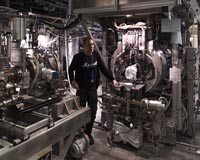
File image of the ALPHA experiment at CERN.

The ALPHA experiment at CERN, led by Swansea University scientists, has carried out the most precise and accurate measurement ever done on antimatter.

The ALPHA collaboration team of scientists has reported the most precise direct measurement of antimatter ever made, revealing the spectral structure of the antihydrogen atom in unprecedented detail.

The result, recently published in Nature, is the culmination of three decades of research and development at CERN, and opens a completely new era of high-precision tests between matter and antimatter.

The humble hydrogen atom, comprising a single electron orbiting a single proton, is a giant in fundamental physics, underpinning the modern atomic picture. Its spectrum is characterised by well-known spectral lines at certain wavelengths, corresponding to the emission of photons of a certain frequency or colour when electrons jump between different orbits. Measurements of the hydrogen spectrum agree with theoretical predictions at the level of a few parts in a quadrillion (1015) - a stunning achievement which antimatter researchers have long sought to match for antihydrogen.

Comparing such measurements with those of antihydrogen atoms, which comprise an antiproton orbited by a positron, tests a fundamental symmetry called charge-parity-time (CPT) invariance. Finding any slight difference between the two would rock the foundation of the Standard Model of particle physics and perhaps shed light on why the universe is made up almost entirely of matter, even though equal amounts of antimatter should have been created in the Big Bang.

Until now, however, it has been all but impossible to produce and trap sufficient numbers of delicate antihydrogen atoms, and to acquire the necessary optical interrogation technology, to make serious antihydrogen spectroscopy possible.

The ALPHA team makes antihydrogen atoms by taking antiprotons from CERN's Antiproton Decelerator (AD) and binding them with positrons from a sodium-22 source. Next it confines the resulting antihydrogen atoms in a magnetic trap, which prevents them from coming into contact with matter and annihilating. Laser light is then shone onto the trapped antihydrogen atoms, their response measured and finally compared with that of hydrogen.

In 2016, the ALPHA team used this approach to measure the frequency of the electronic transition between the lowest-energy state and the first excited state (the so-called 1S to 2S transition) of antihydrogen with a precision of a couple of parts in ten billion, finding good agreement with the equivalent transition in hydrogen.

The measurement involved using two laser frequencies - one matching the frequency of the 1S-2S transition in hydrogen and another "detuned" from it - and counting the number of atoms that dropped out of the trap as a result of interactions between the laser and the trapped atoms.

The latest result from ALPHA takes antihydrogen spectroscopy to the next level, using not just one but several detuned laser frequencies, with slightly lower and higher frequencies than the 1S-2S transition frequency in hydrogen.

This allowed the team to measure the spectral shape, or spread in colours, of the 1S-2S antihydrogen transition and get a more precise measurement of its central frequency. The shape matches that expected for hydrogen extremely well, and ALPHA was able to determine the 1S-2S antihydrogen transition frequency to a precision of two parts in a trillion - a factor of 100 better than the 2016 measurement.

"The precision achieved in the latest study is the ultimate accomplishment for us," explains Niels Madsen, deputy spokesperson for the ALPHA experiment and professor at Swansea University. "We have been trying to achieve this precision for 30 years and have finally done it."

Although the precision still falls short of that for ordinary hydrogen, the rapid progress made by ALPHA suggests hydrogen-like precision in antihydrogen - and thus unprecedented tests of CPT symmetry - are now within reach.

"This is real laser spectroscopy with antimatter, and the matter community will take notice," adds Swansea University Professor, Michael Charlton: "We are realizing the whole promise of CERN's AD facility; it's a paradigm change."

"This is a dream come true. Now we have our sight firmly set on improving the precision further to match experiments with ordinary hydrogen. This will be a formidable challenge but with the fantastic team we currently have I'm confident we will make progress" commented Professor Stefan Eriksson, Swansea University.

The laser team includes Dr Steven Jones, whose efforts were instrumental to the collaboration's success. Dr Jones recently completed his PhD on antihydrogen spectroscopy at Swansea University.

+ Ana Lopes from CERN provided significant parts of this synopsis of the research findings.

Research Report: Characterization of the 1S-2S transition in antihydrogen


Related Links
Swansea University
Understanding Time and Space


Thanks for being here;
We need your help. The Space Media Network continues to grow but revenues have never been harder to maintain.

With the rise of Ad Blockers, and Facebook - our traditional revenue sources via quality network advertising continues to decline. And unlike so many other news sites, we don't have a paywall - with those annoying usernames and passwords.

Our news coverage takes time and effort to publish 365 days a year.

If you find our news sites informative and useful then please consider becoming a regular supporter or for now make a one off contribution.
SpaceMediaNetwork Contributor
$5 Billed Once


credit card or paypal
SpaceMediaNetwork Monthly Supporter
$5 Billed Monthly


paypal only


TIME AND SPACE
Chemical analysis technique gets major upgrade from Russian scientists
Moscow, Russia (SPX) Apr 11, 2018
Researchers from Skoltech and MIPT have developed a device for upgrading mass spectrometers, which are used to analyze the chemical makeup of unknown substances. The new device analyzes one substance from four different perspectives. Alternatively, it enables multiple samples to be examined simultaneously. By contrast, conventional mass spectrometers analyze one substance at a time. The research paper was published in the journal Analytical Chemistry. Mass spectrometry is the most efficient way to ... read more

Comment using your Disqus, Facebook, Google or Twitter login.


Share this article via these popular social media networks
del.icio.usdel.icio.us DiggDigg RedditReddit GoogleGoogle

TIME AND SPACE
Estonia calls for deployment of Patriot missiles and US troops

Yemen rebel missiles, drones shot down over Saudi

Saudis intercept new missile fired by Yemen rebels: coalition

Japan's vaunted alert system runs up against limits

TIME AND SPACE
Lockheed tapped for long-range, anti-ship missiles

Boeing to restart production of Standoff Land Attack Missiles

US agrees guided missiles for Qatar before Trump talks

Russian delivery of S-400 missiles brought forward to July 2019

TIME AND SPACE
MSAB and URSA Partner on Drone Forensic Technology

Air Force contracts with SRC for drone supplies, services

OFFSET "Sprinters" to Pursue State-of-the-art Solutions for Second Swarm Sprint

Israeli drone crashes in southern Lebanon

TIME AND SPACE
India Struggling to Establish Lost Link With Crucial Communication Satellite

Indian scientists lose contact with satellite

Russian Soyuz launches military satellite

India set to launch S-Band satellite for military communications

TIME AND SPACE
Army researchers conduct first-ever combustion experiment with X-rays

Orbital ATK receives $115M to produce Army ammunition

State Dept. approves $1.3B sale of Howitzers to Saudi Arabia

DARPA Announces First Annual Electronics Resurgence Initiative Summit

TIME AND SPACE
US to update Saudi artillery for $1.31 billion

74% of French people against weapons sales to Saudi: poll

Mattis wins big with budget victory

US approves $1 billion in Saudi defense contracts

TIME AND SPACE
China, Japan ministers pave way for rare summits

Xi makes surprise visit to fleet in South China Sea drill

Greece, Turkey pledge to 'strengthen dialogue' after Greek pilot dies

Kremlin says won't take part in Trump's 'Twitter diplomacy'

TIME AND SPACE
A treasure trove for nanotechnology experts

UCLA researchers develop a new class of two-dimensional materials

Nanostructures made of previously impossible material

Mining hardware helps scientists gain insight into silicon nanoparticles


The content herein, unless otherwise known to be public domain, are Copyright 1995-2024 - Space Media Network. All websites are published in Australia and are solely subject to Australian law and governed by Fair Use principals for news reporting and research purposes. AFP, UPI and IANS news wire stories are copyright Agence France-Presse, United Press International and Indo-Asia News Service. ESA news reports are copyright European Space Agency. All NASA sourced material is public domain. Additional copyrights may apply in whole or part to other bona fide parties. All articles labeled "by Staff Writers" include reports supplied to Space Media Network by industry news wires, PR agencies, corporate press officers and the like. Such articles are individually curated and edited by Space Media Network staff on the basis of the report's information value to our industry and professional readership. Advertising does not imply endorsement, agreement or approval of any opinions, statements or information provided by Space Media Network on any Web page published or hosted by Space Media Network. General Data Protection Regulation (GDPR) Statement Our advertisers use various cookies and the like to deliver the best ad banner available at one time. All network advertising suppliers have GDPR policies (Legitimate Interest) that conform with EU regulations for data collection. By using our websites you consent to cookie based advertising. If you do not agree with this then you must stop using the websites from May 25, 2018. Privacy Statement. Additional information can be found here at About Us.