|
 |
 |
 |
 |
 |
 |
 |
 |
 |

| . |  |
. |
Reversing And Accelerating The Speed Of Light
Ames IA (SPX) Jul 25, 2006 Physicist Costas Soukoulis and his research group at the U.S. Department of Energy's Ames Laboratory on the Iowa State University campus are having the time of their lives making light travel backwards at negative speeds that appear faster than the speed of light. That, folks, is a mind-boggling 186,000 miles per second - the speed at which electromagnetic waves can move in a vacuum. And making light seem to move faster than that and in reverse is what Soukoulis, who is also an ISU Distinguished Professor of Liberal Arts and Sciences, said is "like rewriting electromagnetism." He predicted, "Snell's law on the refraction of light is going to be different; a number of other laws will be different." However, neither Soukoulis nor any other scientist involved in efforts to manipulate the direction and speed of light can do so with naturally occurring materials. The endeavor requires exotic, artificially created materials. Known as metamaterials, these substances can be manipulated to respond to electromagnetic waves in ways that natural materials cannot. Natural materials refract light, or electromagnetic radiation, to the right of the incident beam at different angles and speeds. However, metamaterials, also called left-handed materials, make it possible to refract light at a negative angle, so it emerges on the left side of the incident beam. This backward-bending characteristic of metamaterials allows enhanced resolution in optical lenses, which could potentially lead to the development of a flat superlens with the power to see inside a human cell and diagnose disease in a baby still in the womb. The challenge that Soukoulis and other scientists face who work with metamaterials is to fabricate them so that they refract light negatively at ever smaller wavelengths, with the ultimate goal of making a metamaterial that refracts light at visible wavelengths and achieving the much-sought-after superlens. Admittedly, that goal is a ways off. To date, existing metamaterials operate in the microwave or far infrared regions of the electromagnetic spectrum. The near infrared region of the spectrum still lies between the microwave and visible regions, and the wavelengths become ever shorter moving along the electromagnetic spectrum to visible light. Correspondingly, to negatively refract light at these shorter wavelengths requires fabricating metamaterials at extremely small length scales - a tricky feat. However, recent research by Soukoulis and his co-workers from the University of Karlsruhe, Germany, published in the May 12, 2006, issue of Science demonstrates they have done just that. "We have fabricated for the first time a metamaterial that has a negative index of refraction at 1.5 micrometers," said Soukoulis. "This is the smallest wavelength obtained so far." Small, indeed; these wavelengths are microscopic and can be used in telecommunications. Soukoulis' success moves metamaterials into the near infrared region of the electromagnetic spectrum - very close to visible light, superior resolution and a wealth of potential applications! In addition, Soukoulis and his University of Karlsruhe colleagues have also shown that both the velocity of the individual wavelengths, called phase velocity, and the velocity of the wave packets, called group velocity, are both negative, which Soukoulis said accounts for the ability of negatively refracted light to seemingly defy Einstein's theory of relativity and move backwards faster than the speed of light. Elaborating, Soukoulis said, "When we have a metamaterial with a negative index of refraction at 1.5 micrometers that can disperse, or separate a wave into spectral components with different wavelengths, we can tune our lasers to play a lot of games with light. We can have a wavepacket hit a slab of negative index material, appear on the right-hand side of the material and begin to flow backward before the original pulse enters the negative index medium." Continuing, he explained that the pulse flowing backward also releases a forward pulse out the end of the medium, a situation that causes the pulse entering the front of the material appear to move out the back almost instantly. "In this way, one can argue that that the wave packet travels with velocities much higher than the velocities of light," said Soukoulis. "This is due to the dispersion of the negative index of refraction; there is nothing wrong with Einstein's theory of relativity." (These effects are clearly seen in the simulations that accompany this press release. Go to: Light Movies) The Basic Energy Sciences Office of the DOE's Office of Science funds Ames Laboratory's research on metamaterials. Ames Laboratory is operated for the Department of Energy by Iowa State University. The Lab conducts research into various areas of national concern, including energy resources, high-speed computer design, environmental cleanup and restoration, and the synthesis and study of new materials. Related Links US DoE Ames Laboratory  Planet-Forming Disks Might Put Brakes On Stars
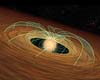 Pasadena CA (SPX) Jul 25, 2006
Astronomers using NASA's Spitzer Space Telescope have found evidence that dusty disks of planet-forming material tug on and slow down the young, whirling stars they surround. |
|
|

| The content herein, unless otherwise known to be public domain, are Copyright 1995-2006 - SpaceDaily.AFP and UPI Wire Stories are copyright Agence France-Presse and United Press International. ESA PortalReports are copyright European Space Agency. All NASA sourced material is public domain. Additionalcopyrights may apply in whole or part to other bona fide parties. Advertising does not imply endorsement,agreement or approval of any opinions, statements or information provided by SpaceDaily on any Web page published or hosted by SpaceDaily. Privacy Statement |