
. Military Space News .
FARM NEWS
Rice crops that can save farmers money and cut pollution
by Staff Writers
Toronto, Canada (SPX) Aug 02, 2016


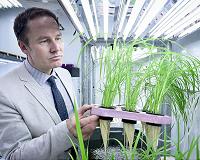
U of T Scarborough Professor Herbert Kronzucker has helped identify "superstar" varieties of rice that can reduce fertilizer loss and cut down on environmental pollution in the process. Image courtesy Ken Jones. For a larger version of this image please go here.

A new U of T Scarborough study has identified "superstar" varieties of rice that can reduce fertilizer loss and cut down on environmental pollution in the process. The study, authored by U of T Scarborough Professor Herbert Kronzucker in collaboration with a team at the Chinese Academy of Sciences, looked at 19 varieties of rice to see which ones were more efficient at using nitrogen.

"We have this bucolic idea of agriculture - animals grazing or vast fields of majestic crops - but the global reality is it's one of the biggest drivers of environmental pollution and climate change," says Kronzucker.

Nitrogen, when applied as fertilizer, is taken up inefficiently by most crops. In tropical rice fields, as much as 50 to 70 per cent can be lost. The problem is that nitrogen negatively impacts water quality by contaminating nearby watersheds or leaching into ground water.

It's also a significant source of gases such as ammonia and nitrogen oxide, which are not only harmful to aquatic life but also a significant source of greenhouse gas emissions. While nitrogen is one of three main nutrients required for crops to grow, it also costs the most to produce, adds Kronzucker.

"Anything we can do to reduce demand for nitrogen, both environmentally and for farmers in the developing world struggling to pay for it, is a significant contribution."

Kronzucker's study for the first time identifies a novel class of chemicals produced and released by the roots of rice crops that directly influence the metabolism of soil microbes. They found that key microbial reactions that lead to an inefficiency in nitrogen capture can be significantly reduced in certain varieties of rice plants through the action of those specific chemicals released from root cells.

One of the main reasons crops waste so much fertilizer is that they were bred that way. In the past fertilizers were relatively inexpensive to produce because fossil fuels were abundant and cheap. As a result, plant geneticists bred crops that responded to high fertilizer use regardless of how efficient they were at using nitrogen.

"These inefficiencies used to be of little interest, but now, with fluctuating fuel prices and growing concerns over climate change, it's a much bigger issue," says Kronzucker, who is the Director of the Canadian Centre for World Hunger Research at U of T Scarborough.

There are more than 120,000 varieties of rice stored at the germplasm bank at the International Rice Research Institute (IRRI) in the Philippines, but Kronzucker's team only focused on varieties that met important criteria.

For one they concentrated only on Japonica (the rice used in sushi) and Indica, the world's most popular rice type commonly grown in China, India and Southeast Asia.

The varieties also had to be currently grown by farmers, have a high yield potential, be disease and pest-resistant, grow to the right size and have strong enough roots to withstand monsoon-force winds.

"They had to be proven in the field as viable options. It's not practical if a rice farmer isn't going to touch it," adds Kronzucker.

Going forward the hope is for this study to inform rice-growing strategies throughout Asia. One option could be to provide farmers with government incentives like tax credits, to switch to a more nitrogen-friendly variety. Another outcome could be better breeding programs where even better species of crops can be produced.

"There's no reason a crop can't result in less pollution while also saving farmers money; the two aren't incompatible," says Kronzucker. "If we can produce more responsible plants that don't waste fertilizer needlessly, everyone wins."


Thanks for being here;
We need your help. The Space Media Network continues to grow but revenues have never been harder to maintain.

With the rise of Ad Blockers, and Facebook - our traditional revenue sources via quality network advertising continues to decline. And unlike so many other news sites, we don't have a paywall - with those annoying usernames and passwords.

Our news coverage takes time and effort to publish 365 days a year.

If you find our news sites informative and useful then please consider becoming a regular supporter or for now make a one off contribution.
SpaceMediaNetwork Contributor
$5 Billed Once


credit card or paypal
SpaceMediaNetwork Monthly Supporter
$5 Billed Monthly


paypal only


.


Related Links
University of Toronto
Farming Today - Suppliers and Technology


Comment on this article via your Facebook, Yahoo, AOL, Hotmail login.

Share this article via these popular social media networks
del.icio.usdel.icio.us DiggDigg RedditReddit GoogleGoogle

Previous Report
FARM NEWS
To keep soil health, scientists say mix up plant species
Manchester, England (UPI) Jul 28, 2016
Soil health is deteriorating around the globe. A combination of commercial agricultural practices, global warming and pollution are draining nutrients and encouraging the accumulation of contaminants. The solution, scientists say, is biodiversity. New research highlights the importance of soil structure for soil health. As a new paper in the journal Ecology Letters explains, the ... read more


FARM NEWS
Russia Designing Blimps Aimed at Reducing Threat of US Cruise Missiles

Protests as S. Korea president defends US anti-missile system

Orbital ATK gets $182 million Missile Defense Agency contract

S. Korea confirms anti-missile system site

FARM NEWS
Navy conducts first LCS Harpoon missile test

Lockheed demonstrates LRASM's surface launch capability

MBDA fires Brimstone missile from Apache helicopter

State Dept. approves $821 million SM-2 missile sale to Japan

FARM NEWS
Donuts in flight in first US-approved drone delivery

Virtek's graphene-winged Prospero drone to take flight

Germany's U.N. peacekeepers to use Heron 1 drones

Facebook internet drone passes first full-scale test

FARM NEWS
L-3 Communications gets $216 million U.S. Army aircraft contract modification

Raytheon developing next-gen airborne communications

Rethinking the Space Environment in a Globalized World

What Industry Can Teach the DoD About Innovation

FARM NEWS
DFNDR chooses Honeywell's Spectra fiber for new body armor

Lockheed Martin: $99 million in new Sniper ATP orders

Battelle to up-armor Special Forces trucks

Faster Speeding Bullets: Russia Test-Fires Its Own Railgun

FARM NEWS
Russia has $4.6B in military exports in 2016

Guns, not roses: Conflicts fire up Bulgaria arms trade

CAE gets $111 million in UAE defense contracts

Senators look to block U.S. sale of bombs to Saudis for bombing of Yemen

FARM NEWS
Turkey was planning anti-Gulen army purge before coup: minister

US tells Beijing sea patrols will continue: official

Turkey has chance to end polarisation after coup: opposition chief

Turkey issues warrants for 47 ex-staff of Zaman daily

FARM NEWS
New nanoscale technologies could revolutionize microscopes, study of disease

Biggest Little Self-Assembling Protein Nanostructures Created

New reaction for the synthesis of nanostructures

Electron spin control: Levitated nanodiamond is research gem


The content herein, unless otherwise known to be public domain, are Copyright 1995-2024 - Space Media Network. All websites are published in Australia and are solely subject to Australian law and governed by Fair Use principals for news reporting and research purposes. AFP, UPI and IANS news wire stories are copyright Agence France-Presse, United Press International and Indo-Asia News Service. ESA news reports are copyright European Space Agency. All NASA sourced material is public domain. Additional copyrights may apply in whole or part to other bona fide parties. All articles labeled "by Staff Writers" include reports supplied to Space Media Network by industry news wires, PR agencies, corporate press officers and the like. Such articles are individually curated and edited by Space Media Network staff on the basis of the report's information value to our industry and professional readership. Advertising does not imply endorsement, agreement or approval of any opinions, statements or information provided by Space Media Network on any Web page published or hosted by Space Media Network. General Data Protection Regulation (GDPR) Statement Our advertisers use various cookies and the like to deliver the best ad banner available at one time. All network advertising suppliers have GDPR policies (Legitimate Interest) that conform with EU regulations for data collection. By using our websites you consent to cookie based advertising. If you do not agree with this then you must stop using the websites from May 25, 2018. Privacy Statement. Additional information can be found here at About Us.