|
 |
 |
 |
 |
 |
 |
 |
 |
 |

| . |  |
. |
Rich Zurek And The Mystery Of The Disappearing Spacecraft
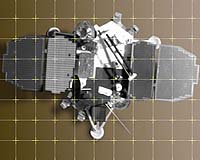
San Diego CA (SPX) Apr 18, 2005 Imagine if the illustrious Sherlock Holmes lived in modern times. He might decide to take on the challenge of solving the mysterious disappearance of the Beagle 2, a British spacecraft that vanished without a trace after entering the atmosphere of Mars on Christmas Day, 2003. Malin Space Science Systems of San Diego looked for signs of the lost spacecraft in early 2004. Scrutinizing images from a camera the company built for NASA's Mars Global Surveyor orbiter, Malin researchers detected an unfamiliar black spot on the surface of the planet. Alas, after using special software to improve photographic detail, Malin's optical experts concluded that the spot was an eroded meteor crater with some dark-colored sand on the crater floor. Based on the evidence, one might surmise that Beagle 2 never made it to Mars. Rich Zurek, however, is something of a modern-day, scientific Sherlock who wants more clues about both Beagle 2 and a lost US spacecraft, Mars Polar Lander. As project scientist for the Mars Reconnaissance Orbiter, he knows that just because we don't see it, doesn't necessarily mean it's not there.
Scientific Sherlock Seeks Clues An atmospheric scientist by training, Zurek appears an honest sort of fellow, with friendly blue eyes, slightly bushy eyebrows, a receding hairline, and a scientist's penchant for describing things in great detail. His eyes appear even more penetrating than usual when they match the blue shirt he is wearing. "On Mars Reconnaissance Orbiter, we're going to have the biggest 'magnifying glass' possible," Zurek explains. "If there are clues, we're going to find them." Zurek is firmly resolved to conduct some intensive detective work. "We all know how hard it is to get to Mars," Zurek related. "The worst is not quite knowing what happened. We really felt for our European colleagues, because we've been through it ourselves. We know how painful it is to lose a spacecraft that you've dedicated so many years to build." In 1999, the U.S. sent Mars Polar Lander, but it too never made it successfully to the surface. In fact, two-thirds of all international missions to the red planet have failed. It isn't trivial getting spacecraft safely to a planet that is hundreds of thousands of miles away, and solving some of the mysteries surrounding those that were lost will help future missions be successful.
Largest Magnifying Glass Possible Mars Reconnaissance Orbiter will use three cameras to look at geology and search for lost landers. "In effect, it's like having a planetary microscope," explains Zurek. "You start with low magnification and switch to increasingly higher magnification for a closer look." As the spacecraft circles the planet 12 times a day, the Mars Color Imager, or MARCI for short, will take large-scale snapshots. A MARCI image might reveal a volcano, a few large craters, several smaller craters, a canyon, and some flat areas. Next, a Context Camera image will zoom in farther, perhaps showing some meandering channels that weren't clearly visible in the MARCI image. Finally, the Hi-RISE camera will provide the most detailed view of the surface. Hi-RISE is the most powerful camera on the spacecraft in terms of the smallness of the features that will be visible. From space, it can take pictures of objects on the surface of Mars that are about the size of a small dining room table. A HiRISE image might reveal a large flat ledge next to one of the canyons. On top of that ledge might be a small dark object, perhaps the missing spacecraft. "Of course," Zurek cautions, "the three-foot-wide Beagle 2 still may be too small for our cameras to see, unless it left a telltale track in the martian soil."
Looking for a Mineral "Fingerprint" Undaunted, Zurek continues: "There may be another potential line of investigation." The Compact Reconnaissance Imaging Spectrometer for Mars, or CRISM for short, will identify minerals on the surface of Mars. If Beagle crashed into the surface and churned up a rather large area of soil in the process, CRISM might find signs of different minerals in the newly exposed subsurface that don't match those of the surrounding terrain. "It would be like having a mineral fingerprint pointing to the spot where Beagle 2 landed," Zurek said. Mars Reconnaissance Orbiter will begin looking for these clues when it arrives at the red planet and settles into its orbit in 2006. Stay tuned! Related Links Mars Reconnaissance Orbiter Mars Exploration Program SpaceDaily Search SpaceDaily Subscribe To SpaceDaily Express  Opportunity Resumes Limited Driving But Problems Persist
 Los Angeles, CA (SPX) Apr 16, 2005
The terrain that Opportunity is crossing has been steadily getting more wavy. After a long drive southward from "Voyager" crater, Opportunity's right-front steering motor stalled out on sol 433 during an end-of-drive turn. |
|
|

| The content herein, unless otherwise known to be public domain, are Copyright 1995-2006 - SpaceDaily.AFP and UPI Wire Stories are copyright Agence France-Presse and United Press International. ESA PortalReports are copyright European Space Agency. All NASA sourced material is public domain. Additionalcopyrights may apply in whole or part to other bona fide parties. Advertising does not imply endorsement,agreement or approval of any opinions, statements or information provided by SpaceDaily on any Web page published or hosted by SpaceDaily. Privacy Statement |