
 |
 |
 |
 |
 |
 |
 |
 |
 |
 |

| . |  |
. |
Robots Learn To Follow
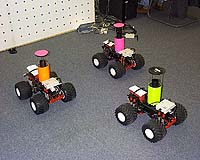
Davis CA (SPX) Sep 01, 2008 Whether driving on the highway or walking down the street, we pick up on both deliberate signals and unconscious cues to predict what other people are going to do and act accordingly. But robots have trouble following each other around, for example, when a leader turns a corner and disappears from sight. Researchers at UC Davis have come up with a control system that allows a robot to pick up on cues that the leader is about to turn, predict where it is going and follow it. "The following problem is a quite fundamental problem in robotics," said Sanjay Joshi, associate professor of mechanical and aeronautical engineering at UC Davis. Robots that are better at following could be easier for people to work with, he said. A hospital robot could follow a doctor around the wards. Humans use signals and unconscious cues to build a model that predicts where other people are going. Behavioral studies show that people unconsciously turn their heads a fraction of a second before making a left or right turn. Joshi and his team of researchers developed a control system that could take such behavioral cues into account in making decisions about which way to move. Joshi, graduate student Michael Chueh, and undergraduate students William Au Yeung and Calvin Lei tested the system using a small commercially available robot, the Evolution Robotics Scorpion. The robot's camera could identify a target on the lead robot, and the robot's onboard computer could combine the target information with behavioral cue information. Rather than have the lead robot signal the follower directly, the research team sent "behavioral cues" to the follower via wireless link. Effectively, the cues told the robot, "the leader might be about to turn right" or "might be about to turn left." To develop a decision on how to move, the follower robot was programmed to take into account the lead robot's behavioral cues and the follower's prediction of the lead robot's movement, based on the leader's current speed and direction. Robots that incorporated behavioral information into their decisions performed much better at following the leader around corners than others, the researchers found. "We think that if we can embed these cues in control systems, we can make following more reliable," Joshi said. Community Email This Article Comment On This Article Share This Article With Planet Earth
Related Links UC Davis All about the robots on Earth and beyond!
 Robot-assisted surgery repairs fistulas
 Winston-Salem, N.C. (UPI) Aug 20, 2008
 U.S. urologic surgeons say they have successfully used robot-assisted laparoscopic surgery to repair abnormal openings between the bladder and vagina. |
|
|

| The content herein, unless otherwise known to be public domain, are Copyright 1995-2007 - SpaceDaily.AFP and UPI Wire Stories are copyright Agence France-Presse and United Press International. ESA Portal Reports are copyright European Space Agency. All NASA sourced material is public domain. Additional copyrights may apply in whole or part to other bona fide parties. Advertising does not imply endorsement,agreement or approval of any opinions, statements or information provided by SpaceDaily on any Web page published or hosted by SpaceDaily. Privacy Statement |
 del.icio.us
 Digg
Digg Reddit
 YahooMyWeb
 Google
 Facebook