|
 |
 |
 |
 |
 |
 |
 |

| . |  |
. |

|
|
. |

 by Xin Dingding for China Daily Beijing (XNA) Aug 22, 2011
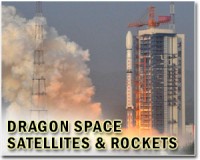
An experimental satellite launched on Thursday failed to enter its designated orbit after its rocket malfunctioned. It was the first launch failure to occur in China since August 1996, when a Long March III launch vehicle proved unable to send Chinasat-7, a communications satellite, into orbit. The latest failure followed on a string of successes China has seen this year in its attempts to send equipment into space and came before the country's first mission to have a space craft rendezvous and dock with a space module in outer space. The satellite, SJ-11-04, was launched atop a Long March II-C rocket from the Jiuquan Satellite Launch Center in Northwest China's Gansu province at 5:28 pm on Thursday. The mission marked the first time that type of rocket had failed. A report from Xinhua News Agency on Thursday did not say when the rocket first ran into trouble during its flight. Nor did it cite a specific cause of the malfunction, a matter that is now being investigated. Wang Jiaqi, an academician at the China Academy of Sciences, told Beijing News that the satellite was to be used in scientific experiments. In the past, three satellites have been sent into orbit for scientific purposes atop the same type of rockets, according to media reports. The first satellite, SJ-11-01, was launched on Nov 12, 2009. Another, SJ-11-03, followed on July 6 and the third, SJ-11-02, on July 29. It remains unknown what effect the recent failure will have on the possibility of further launches taking place this year. Previous media reports said China's first rendezvous and docking mission was to be carried out in the second half of the year, bringing the Tiangong-1 space module and the Shenzhou VIII spacecraft together in outer space. According to the official website of the China Manned Space Engineering Office, Tiangong-1 and its launch vehicle, Long March II-F, had both arrived at the Jiuquan Satellite Launch Center for testing by July. The office did not comment on Friday on whether the satellite failure will affect the plan to launch Tiangong-1. An anonymous observer was quoted by Beijing News as saying that the rocket that is to send Tiangong-1 into space is different from the one that was used in the failed satellite launch. So that failure is unlikely to change the plans for Tiangong-1. China intends to launch more than 20 satellites and spacecraft this year, making up a significant percentage of the 70 or more launches that are to take place throughout the world, Xinhua reported in March. On Tuesday, a maritime satellite, HY-2, was successfully sent into space atop a Long March IV-B rocket from the Taiyuan Satellite Launch Center in Shanxi province. Four other successful launches took place in July. Source: Xinhua News Agency
|
. |
|
| The content herein, unless otherwise known to be public domain, are Copyright 1995-2011 - Space Media Network. AFP and UPI Wire Stories are copyright Agence France-Presse and United Press International. ESA Portal Reports are copyright European Space Agency. All NASA sourced material is public domain. Additional copyrights may apply in whole or part to other bona fide parties. Advertising does not imply endorsement,agreement or approval of any opinions, statements or information provided by Space Media Network on any Web page published or hosted by Space Media Network. Privacy Statement |

 del.icio.us
 Digg
Digg Reddit
 Google