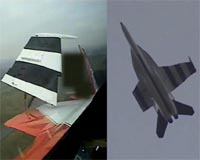
Subscale F/A-18 with 60% wing loss. Photo: Business Wire
Subscale F/A-18 with 60% wing loss. Photo: Business Wire |
During the first flight test, nearly half of the airplane's right wing was ejected to simulate battle damage and in-flight failure. During the second flight, almost 60 percent of the airplane's right wing was ejected.
Upon ejecting the wing section during both flights, Rockwell Collins' Automatic Supervisory Adaptive Control (ASAC) technology reacted to the airplane's new vehicle configuration, automatically regained baseline performance, continued to fly the plane, and then autonomously landed it using internal Inertial Navigation System/Global Positioning System (INS/GPS) reference only.
The flight test campaign followed a similar successful DARPA sponsored demonstration in April 2007, during which an aileron was ejected in-flight from the unmanned subscale F/A-18.
"DARPA asked us to significantly increase the level of damage and risk in this latest flight test campaign to really put the Rockwell Collins controls technology through its paces," said Mike Myers, vice president of Business Development for Rockwell Collins Government Systems.
"We are pleased with the ability of our adaptive controls to instantly detect and react to the new vehicle configuration after loss of major sections of the wing. The ASAC controls technology enabled the airplane to continue to fly completely autonomously without a hitch and land without further damage."
Damage tolerance is an enabling capability for increasing the mission reliability of UAVs operating in hazardous and high-threat environments.
The technology provides for real-time autonomous accommodation of damage, followed by an adaptation process that alters the flight control system to compensate for the effects of the damage. During the flight test, Rockwell Collins demonstrated a capability that could be applicable to all military aircraft operating in combat environments and to commercial, business and general aviation for full flight automation and backup.
"This demonstration highlights the challenge and importance of autonomously controlling and landing an airplane that has sustained catastrophic damage or failure in flight," said Dr. David Vos, senior director of Control Technologies at Rockwell Collins.
"This powerful capability can save the military the expense of lost UAVs. When applied to both manned and unmanned aircraft, damage tolerance is a key technology that can facilitate the convergence of manned and unmanned aircraft in increasingly crowded controlled airspace; but more importantly, the solution can save lives."
Community
 del.icio.us del.icio.us |
 Digg Digg |
 Reddit Reddit |
 YahooMyWeb YahooMyWeb |
 Google Google |
 Facebook Facebook |
 Predator, Reaper Unit Becomes Air Expeditionary Wing
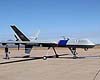 Creech AFB NV (AFNS) Jun 11, 2008
| The content herein, unless otherwise known to be public domain, are Copyright 1995-2007 - SpaceDaily.AFP and UPI Wire Stories are copyright Agence France-Presse and United Press International. ESA Portal Reports are copyright European Space Agency. All NASA sourced material is public domain. Additional copyrights may apply in whole or part to other bona fide parties. Advertising does not imply endorsement,agreement or approval of any opinions, statements or information provided by SpaceDaily on any Web page published or hosted by SpaceDaily. Privacy Statement |