
 |
 |
 |
 |
 |
 |
 |
 |
 |
 |

| . |  |
. |
Rosetta Encounters Asteroid (2867) Steins
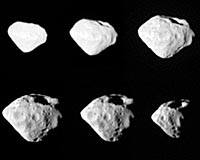
Paris, France (SPX) Oct 15, 2008 The Rosetta spacecraft has performed a successful close fly-by at main-belt asteroid (2867) Steins, which belongs to the rare class of E-type asteroids that had not been directly observed by an interplanetary spacecraft before. The fly-by started on 4 August 2008 with optical navigation on the asteroid itself. This technique was used for the first time in the history of ESA spacecraft operations. Rosetta had its closest approach to the asteroid on 5 September 2008, 18:58:19 UTC, when (2867) Steins was at distances of 2.14 AU from the Sun and 2.41 AU from the Earth. The spacecraft encountered with a relative velocity of 8.62 km/s and reached a minimum distance of 800 +/- 3 km. The fly- by took place on the Sun side of the asteroid in the plane defined by the relative velocity and the Sun direction. The selected fly-by strategy allowed continuous observations of the asteroid before, during and after closest approach as well as passing through phase angle zero. To keep the small asteroid in the field of view of the scientific instruments during the closest approach phase the spacecraft had to target with accuracy better than 2 km and to perform an attitude flip manoeuvre of 20 minutes duration after which the autonomous tracking on asteroid (2867) Steins started. The spacecraft flip occurred 40 minutes before closest approach. The International Rosetta Mission is one of ESA's Planetary Cornerstone Missions on its way to rendezvous with comet 67P/Churyumov-Gerasimenko, go in orbit around its nucleus and accompany the comet for more than a year while it approaches the inner solar system, goes through perihelion and moves outbound again. Rosetta was launched with an Ariane 5 from Kourou on 2 March 2004 and will rendezvous with the comet in spring 2014. While travelling to the comet Rosetta performs two fly-bys at main belt asteroids with the scientific objective of providing a global characterisation of these asteroids, including the determination of their dynamic properties, surface morphology and composition. (2867) Steins was Rosetta's first asteroid target to be visited, and the fly-by at asteroid (21) Lutetia will follow in July 2010. Altogether 14 instruments were switched on during the fly-by, providing spatially resolved multi-wavelength observations of the asteroid and in-situ measurements of its dust, plasma, magnetic, and radiation environment. The 4 remote sensing instruments ALICE, OSIRIS, VIRTIS, MIRO provided imaging and/or spectrometry at ultraviolet, visible, infrared, and sub-mm wavelengths. The 5 instruments of the Rosetta Plasma Consortium (IES, ICA, LAP, MIP, MAG), as well as ROMAP and, SREM investigated the charged-particle, magnetic and radiation environment near the asteroid. The Radio Science Experiment was switched on and the in-situ instruments ROSINA and GIADA searched for gas and dust particles around the asteroid. All science data acquired during the asteroid fly-by have been successfully down linked. To date, seven asteroids were encountered by spacecraft, five S- type, one V-type and one C-type asteroid. (2867) Steins is the first E-type asteroid visited by a space mission. Its detailed characterization will add to the understanding of the different types of asteroids existing and add to solving the puzzle of how the solar system formed and evolved. Community Email This Article Comment On This Article Share This Article With Planet Earth
Related Links Rosetta Asteroid and Comet Mission News, Science and Technology
 Boulder-Sized Asteroid Will Burn Up In Earth's Atmosphere Tonight
 Boston MA (SPX) Oct 07, 2008
A tiny asteroid discovered just hours ago at an Arizona observatory will enter Earth's atmosphere harmlessly at approximately 10:46 p.m. Eastern time tonight (2:46 a.m. Greenwich Mean Time). There is no danger to people or property since the asteroid will not reach the ground. |
|
|

| The content herein, unless otherwise known to be public domain, are Copyright 1995-2007 - SpaceDaily.AFP and UPI Wire Stories are copyright Agence France-Presse and United Press International. ESA Portal Reports are copyright European Space Agency. All NASA sourced material is public domain. Additional copyrights may apply in whole or part to other bona fide parties. Advertising does not imply endorsement,agreement or approval of any opinions, statements or information provided by SpaceDaily on any Web page published or hosted by SpaceDaily. Privacy Statement |
 del.icio.us
 Digg
Digg Reddit
 YahooMyWeb
 Google
 Facebook