
 File image. |
Similar to magnetic resonance imaging (MRI), conventional NMR uses short pulses of radio waves to drive nuclei away from equilibrium and a 'signal' emerges as nuclei slowly realign with the field.
Results reported in The Journal of Chemical Physics introduce an alternative path to this information, by using light to observe nuclei indirectly via the orbiting electrons.
"We are not looking at a way to replace the conventional technique but there are a number of applications in which optical detection could provide complementary information," says author Carlos Meriles of the City University of New York.
The new technique is based on Optical Faraday Rotation (OFR), a phenomenon in which the plane of linearly polarized light rotates upon crossing a material immersed in a magnetic field.
When nuclei are sufficiently polarized, the extra magnetic field they produce is 'felt' by the electrons in the sample thus leading to Faraday rotation of their own.
Because the interaction between electrons and nuclei depends on the local molecular structure, OFR-detected NMR spectroscopy provides complementary information to conventional detection.
Another interesting facet of the technique is that, unlike conventional NMR, the signal response is proportional to the sample length, but not its volume. "Although we have not yet demonstrated it, our calculations show that we could magnify the signal by creating a very long optical path in a short, thin tube," Meriles says.
This signal magnification would use mirrors at both ends of a channel in a microfluidics device to reflect laser light repeatedly through the sample, increasing the signal amplitude with each pass.
 del.icio.us del.icio.us |
 Digg Digg |
 Reddit Reddit |
 YahooMyWeb YahooMyWeb |
 Google Google |
 Facebook Facebook |

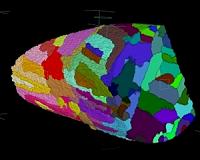 Imaging With Neutrons Reveals Magnetic Domains In 3D
| The content herein, unless otherwise known to be public domain, are Copyright 1995-2010 - SpaceDaily. AFP and UPI Wire Stories are copyright Agence France-Presse and United Press International. ESA Portal Reports are copyright European Space Agency. All NASA sourced material is public domain. Additional copyrights may apply in whole or part to other bona fide parties. Advertising does not imply endorsement,agreement or approval of any opinions, statements or information provided by SpaceDaily on any Web page published or hosted by SpaceDaily. Privacy Statement |


