
 |
The Russian defence ministry confirmed that it had lost sight of the craft -- a dual-use vessel that can draw a three-dimensional map of the Earth and locate the precise positions of various targets.
The incident came just a month after President Dmitry Medvedev sacked two top space officials for a similar setback and delivered another humiliating blow to Russia's much-maligned space industry.
The seriousness of the situation was underscored late Tuesday by reports that the defence ministry had set up an urgent joint task force with the Russia's space agency to look for the missing craft.
The Geo-IK-2 satellite was created in Russia to help the military survey land and create a detailed three-dimensional map of the Earth. It was designed to spin in a circular orbit 1,000 kilometres (600 miles) above ground.
But news reports said that the satellite had been put in an an elliptical orbit whose lowest point brought it to within 330 kilometres of Earth.
"We have still not been able to establish contact with the craft, and it looks like most likely, it will be declared lost," a Russian space source told the Interfax-AVN news service.
"The spacecraft will not be able to perform its intended functions at these orbit characteristics," another space official told the news agency.
Reports pointed the initial blame for the failure on the satellite's Briz-KM upper stage rocket.
The satellite's launch had already been delayed from December because of technical malfunctions that were detected at its northern Russian launch site in Plesetsk.
Tuesday's malfunction came less than five weeks after Medvedev fired two top space officials and reprimanded the space agency chief for a launch failure caused Russia to delay the deployment of its own navigation system.
Russia's Proton-M rocket had on that occasion proven too heavy to reach its initial orbit and had been forced to dump its three high-tech Glonass-M satellites near the Hawaii Islands.
Investigators said that accident was caused by a basic fuel miscalculation that made the craft too heavy to reach its required height.
The three Glonass satellites would have completed a system whose research had been started by the Soviet Union in 1976.
 del.icio.us del.icio.us |
 Digg Digg |
 Reddit Reddit |
 YahooMyWeb YahooMyWeb |
 Google Google |
 Facebook Facebook |

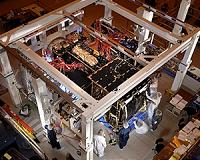 SBIRS Team Passes Major Flight Ops Test Milestone On Path To GEO-1 Launch
| The content herein, unless otherwise known to be public domain, are Copyright 1995-2010 - SpaceDaily. AFP and UPI Wire Stories are copyright Agence France-Presse and United Press International. ESA Portal Reports are copyright European Space Agency. All NASA sourced material is public domain. Additional copyrights may apply in whole or part to other bona fide parties. Advertising does not imply endorsement,agreement or approval of any opinions, statements or information provided by SpaceDaily on any Web page published or hosted by SpaceDaily. Privacy Statement |


