|
 |
 |
 |
 |
 |
 |
 |

| . |  |
. |

|
|
. |

 by Staff Writers Houston TX (SPX) Aug 02, 2011
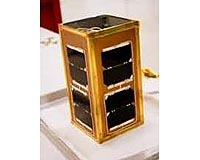
Two Russian cosmonauts will leave the confines of the International Space Station on Aug.3 to move a cargo boom from one airlock to another, install a prototype laser communications system and deploy an amateur radio micro-satellite. Expedition 28 Flight Engineers Sergei Volkov and Alexander Samokutyaev are scheduled to venture outside the Pirs airlock at 10:30 a.m. EDT Wednesday to begin the six-hour excursion. Both spacewalkers will wear Russian Orlan-MK spacesuits. Coverage of the spacewalk will be broadcast live on NASA Television beginning at 10 a.m. EDT. Volkov, making his third spacewalk, and Samokutyaev, making his first, will both wear spacesuits marked with blue stripes. Volkov's previous two spacewalks occurred while he was Expedition 17 commander in 2008. During the spacewalk, Commander Andrey Borisenko and NASA Flight Engineer Ron Garan will close the hatches on the Poisk docking module, which is opposite the Pirs airlock, and seal the hatches between Zvezda and Poisk. This gives them access to their Soyuz 26 spacecraft, protects against the unlikely possibility of a sudden station depressurization and allows the forward transfer compartment of Zvezda to be used as a backup airlock. Flight Engineers Mike Fossum of NASA, and Satoshi Furukawa of the Japan Aerospace Exploration Agency, will be in the U.S. segment and will have access to their Soyuz 27 spacecraft, which is docked to the Rassvet module. The duo's first task will be to deploy a boxy, 57-pound satellite, called alternately ARISSat-1 and Radioskaf-V, which is the prototype test flight of a proposed series of educational satellites being developed in a partnership with the Radio Amateur Satellite Corp. (AMSAT), the NASA Office of Education ISS National Lab Project, the Amateur Radio on ISS (ARISS) working group and RSC-Energia. The ARISSat design can carry up to four student experiments and the data from these experiments will be transmitted to the ground via an amateur radio link. This prototype ARISSat-1 carries one student experiment, a pressure sensor built at Kursk University in Russia, to measure atmospheric pressure for the lifetime of the satellite. In addition to transmitting student experiment data, ARISSat-1 will transmit still-frame video Earth views from four onboard cameras, commemorative greetings in the native languages from students around the world, including messages to commemorate the 50th anniversary of the launch of Russian cosmonaut Yuri Gagarin as the first human in space. The satellite, which uses off-the-shelf equipment and software provided by AMSAT, also features a Morse code tracking beacon and will function as a space communications utility for use by "ham" radio operators world-wide. Their next job will be to install a barbecue grill-shaped experiment to test the use of a laser-based system for high-speed transmissions at up to 100 megabytes a second to the Earth from Russian science experiments. The system will be installed on a universal work platform outside the Zvezda service module hull just behind its solar arrays. After that, they'll take photographs of a nearby antenna that has been showing signs of degraded performance. The imagery will be used to help engineers on the ground find the root cause of the antenna's problem. Next, they'll retrieve an antenna that was used for docking of the Poisk module when it arrived at the station in November 2009. The antenna is no longer needed and will be brought back inside the station. Then it is on to the major objective of the spacewalk, the move of the telescoping STRELA-1 cargo boom from the Pirs docking compartment to the Poisk docking compartment. The task is expected to take nearly three hours to complete, and will involve the use of the STRELA-2 boom, with its base attached to Pirs. At the completion of the task, STRELA-1 will be ready for use from Poisk, and STRELA-2 will remain on Pirs. The cargo booms extend somewhat like a fishing rod, and can be used to help move massive components around the outside of the Russian segment of the space station. Once the boom relocation is complete, the spacewalkers will retrieve an experiment known as Biorisk from the airlock, and install it on a handrail outside the Pirs module. Biorisk is short for the Influence of Factors of the Space Environment on the Condition of the System of Microorganisms-Hosts Relating to the Problem of Environmental Safety of Flight Techniques and Planetary Quarantine. The experiment will look at the effects of bacteria and fungus on structural materials used in spacecraft construction with a focus on how solar activity may affect the growth of these microbes. With all tasks complete, Volkov and Samokutyaev will take some final photographs, reenter the Pirs airlock and end their spacewalk. The next Russian spacewalk is planned for February 2012, when the Expedition 30 crew will be in orbit aboard the station.
|
. |
|
| The content herein, unless otherwise known to be public domain, are Copyright 1995-2011 - Space Media Network. AFP and UPI Wire Stories are copyright Agence France-Presse and United Press International. ESA Portal Reports are copyright European Space Agency. All NASA sourced material is public domain. Additional copyrights may apply in whole or part to other bona fide parties. Advertising does not imply endorsement,agreement or approval of any opinions, statements or information provided by Space Media Network on any Web page published or hosted by Space Media Network. Privacy Statement |

 del.icio.us
 Digg
Digg Reddit
 Google