|
|
|
|
|
|
|
|
|
|
|


| . |  |
. |
|
|
|
 by Staff Writers Seattle WA (SPX) Jan 07, 2015
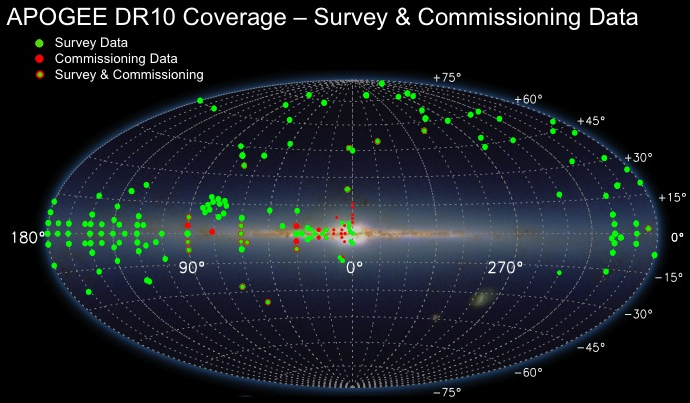
Today, the Sloan Digital Sky Survey (SDSS) issues its latest public data release, the final release of the third epoch of the survey (SDSS-III). Weighing in at more than 100 terabytes, "Data Release 12" (DR12) contains measurements of the properties of nearly half a billion stars and galaxies, making it one of the largest and richest databases in the history of astronomy. "The most astonishing feature of the SDSS is the breadth of ground-breaking research it enables," says Daniel Eisenstein of the Harvard-Smithsonian Center for Astrophysics, the director of SDSS-III. "We've searched nearby stars for planets, probed the history of our Milky Way, and measured nine billion years of our universe's accelerated expansion." After a decade of design and construction, the SDSS began mapping the cosmos in 1998, using the dedicated 2.5-meter Sloan Foundation Telescope at Apache Point Observatory in New Mexico. Each phase of the project has used this telescope, equipped with a succession of powerful instruments, for a distinct set of astronomical surveys. SDSS-III started observations in July 2008 and completed its six-year, $45 million program in June 2014. The SDSS-III Collaboration includes 51 member institutions and a thousand scientists from around the world. SDSS-III has devoted most of its 2,000 nights of observing to measuring spectra: passing light from individual stars and galaxies through a fiber-optic spectrograph, which divides light into component wavelengths much like a prism separates light into the colors of the rainbow. "For each object that we observe, we're actually measuring several thousand light intensities at different wavelengths," says Jon Holtzman of New Mexico State University, which operates the Observatory on behalf of the consortium. "We can then pick out the light produced by particular kinds atoms and molecules, which lets us measure the motions and chemical compositions of stars and galaxies." "Mapping out the elements in a star is like reading its DNA," says Steve Majewski of the University of Virginia. "We're using those DNA readings to decode the history of the Milky Way from the stars that we can observe today." Majewski is the principal investigator of APOGEE (the Apache Point Observatory Galactic Evolution Experiment), one of the four surveys that comprise SDSS-III. By looking in near-infrared wavelengths to see through obscuring dust clouds, APOGEE has mapped the distribution of 15 separate chemical elements in more than 100,000 stars, probing all regions of the Milky Way. "That's a huge amount of information," says Majewski, "and each element reveals a different subplot in this galactic screenplay. Sometimes the interactions between the characters are quite surprising!" In addition to these elemental measurements from APOGEE, SDSS DR12 provides the first public release of data from MARVELS (the Multi-Object APO Radial Velocity Exoplanet Large-Area Survey). MARVELS has made repeated measurements of 3000 stars to detect the back-and-forth motions that could reveal unseen orbiting planets, explains the project's principal investigator, Jian Ge of the University of Florida. "MARVELS is the first large-scale survey to measure these tiny motions for dozens of stars simultaneously," says Ge, "which means we can probe and characterize the full population of giant planets in ways that weren't possible before." DR12 also presents 3-dimensional maps of cosmic structure traced by galaxies and intergalactic hydrogen from the Baryon Oscillation Spectroscopic Survey (BOSS). "With these maps we've detected the fossil imprints of sound waves that filled the universe during the first half-million years after the Big Bang," explained BOSS principal investigator David Schlegel of Lawrence Berkeley National Laboratory. The BOSS team is using those imprints to trace the expansion of the universe across nine billion years of cosmic history, with unprecedented precision. Their final analysis, expected later this year, "will provide the sharpest test yet for theories of dark energy and the accelerating universe," according to Schlegel. The Sloan Extension for Galactic Understanding and Exploration (SEGUE), begun in SDSS-II and completed in SDSS-III, measured visible-light spectra of a quarter-million Milky Way stars. With so many stars, SEGUE gives us a great map of structure in the outer Galaxy," says Constance Rockosi of the University of California at Santa Cruz, who led the SDSS-III component of SEGUE. "In combination with the much more detailed view of the inner galaxy from APOGEE, we're getting a truly holistic picture of the Milky Way." Data Release 12 will fuel science analyzes for years to come, and puts the full power of the SDSS-III into the hands of the public. "One of the most important decisions we made at the beginning of the SDSS was that we would release all of our data, so everyone could use it," says Alex Szalay of Johns Hopkins University, which developed the powerful online interfaces that most astronomers and many in the general public use to access SDSS data. "Nowadays we hear about Big Data left and right. The SDSS launched Big Data astronomy years before anyone was using that term." The Sloan Survey is continuing at full speed with SDSS-IV, which began in July 2014 on its six-year mission to study cosmology, galaxies, and the Milky Way. "Crossing the DR12 finish line is a huge accomplishment by hundreds of people," says Eisenstein. "But it's a big universe out there, so there is plenty more to observe."
Related Links SDSS Astronomy News from Skynightly.com
|
|
| ||||||||||||||||||
| The content herein, unless otherwise known to be public domain, are Copyright 1995-2014 - Space Media Network. All websites are published in Australia and are solely subject to Australian law and governed by Fair Use principals for news reporting and research purposes. AFP, UPI and IANS news wire stories are copyright Agence France-Presse, United Press International and Indo-Asia News Service. ESA news reports are copyright European Space Agency. All NASA sourced material is public domain. Additional copyrights may apply in whole or part to other bona fide parties. Advertising does not imply endorsement, agreement or approval of any opinions, statements or information provided by Space Media Network on any Web page published or hosted by Space Media Network. Privacy Statement All images and articles appearing on Space Media Network have been edited or digitally altered in some way. Any requests to remove copyright material will be acted upon in a timely and appropriate manner. Any attempt to extort money from Space Media Network will be ignored and reported to Australian Law Enforcement Agencies as a potential case of financial fraud involving the use of a telephonic carriage device or postal service. |


 del.icio.us
 Digg
Digg Reddit
 Google