|
 |
 |
 |
 |
 |
 |
 |
 |
 |

| . |  |
. |
Saturn Joins Venus In The Vortex Club
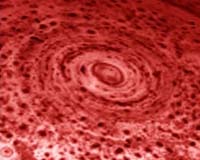
Paris, France (ESA) Nov 27, 2006 Cassini's spectacular image of Saturn's polar vortex, published this month by NASA, may provide astronomers with a missing piece in the puzzle of how that planet's atmosphere works. For planetary scientists studying Venus, the image was strangely familiar. Ever since the late 1970s, scientists have known of a similar polar vortex on Earth's nearest neighbour. For six months now, ESA's Venus Express has been studying this enigmatic atmospheric structure. NASA's Pioneer Venus spacecraft discovered the north polar vortex over 25 years ago. It is perhaps the most puzzling vortex to be found in the Solar System because it has two 'eyes'. When Venus Express arrived in orbit around Venus in April 2006, one of the top priorities was to discover whether the South pole possessed a similar double-vortex. It did. Polar vortices represent a key element in the planet's atmospheric dynamics but they are not hurricanes. "Hurricanes are caused by moist air rising into the atmosphere," says Pierre Drossart, Observatoire de Paris, France. In addition, they require the Coriolis force - the interplay between the circulation of the atmosphere and the rotation of the planet - to whip them up. But the Coriolis force is inefficient for driving vortices at the poles and on Venus it is virtually non-existent anyway because of the planet's slow rotation: the planet rotates just once every 243 Earth days. Instead, a polar vortex is created by an area of low air pressure that sits at the rotation pole of a planet. This causes air to spiral down from higher in the atmosphere. Polar vortices are common structures and can be found at the poles of any planet with an atmosphere, even Earth. What sets Venus apart is the double-lobed structure of the vortices. "This double structure is not well understood at present," says Drossart, who is the co-Principal Investigator on Venus Express's Visible and Infrared Thermal Imaging Spectrometer (VIRTIS). To help understand the vortex, every time Venus Express draws within range, its instruments target a polar region. Collecting as much information as possible is vital because of the rapid variability of the vortices. By watching them change, scientists can see how they behave, and this can give them vital clues as to the way the whole atmosphere circulates. At the same time, data on the Saturn polar vortex will continue to be collected by Cassini. In addition to his work with Venus Express, Drossart is also part of the team that controls the Visual Infrared Mapping Spectrometer (VIMS) on Cassini. The VIMS team will use their instrument to peer down into the heart of Saturn's polar vortex. By using infrared wavelengths, they can see through the clouds that normally block the view. "We will see down to more than 100 kilometres below the visible cloud tops," says Drossart. Such observations will allow the scientists to build a picture of the three-dimensional structure of each polar vortex. With these in hand, they can make detailed comparisons of the vortices on Venus with those on Saturn and other worlds. The similarities and differences between the polar vortices should then give vital clues to the differences between the various planetary atmospheres that planetary scientists see throughout our Solar System. Such studies are called comparative planetology. By studying Earth-like phenomena on other planets, we can better understand the Earth. Related Links Venus Express Hot Stuff At Venus  Venus Express Program Wins Popular Science Award
 Paris, France (SPX) Nov 21, 2006
Venus Express just received an extra birthday present. In the same week as the first anniversary of the spacecraft's launch, the editors of Popular Science magazine named Venus Express as one of the top 100 technological innovations of the year. The award recognises both the speed with which the mission was put together and the unprecedented study it is making of Earth's nearest planetary neighbour. |
|
|

| The content herein, unless otherwise known to be public domain, are Copyright 1995-2006 - SpaceDaily.AFP and UPI Wire Stories are copyright Agence France-Presse and United Press International. ESA PortalReports are copyright European Space Agency. All NASA sourced material is public domain. Additionalcopyrights may apply in whole or part to other bona fide parties. Advertising does not imply endorsement,agreement or approval of any opinions, statements or information provided by SpaceDaily on any Web page published or hosted by SpaceDaily. Privacy Statement |