
 |
 |
 |
 |
 |
 |
 |
 |
 |
 |

| . |  |
. |

Pasadena CA (JPL) Jul 09, 2010 Scientists using NASA's Cassini spacecraft at Saturn have stalked a new class of moons in the rings of Saturn that create distinctive propeller-shaped gaps in ring material. It marks the first time scientists have been able to track the orbits of individual objects in a debris disk. The research gives scientists an opportunity to time-travel back into the history of our solar system to reveal clues about disks around other stars in our universe that are too far away to observe directly. "Observing the motions of these disk-embedded objects provides a rare opportunity to gauge how the planets grew from, and interacted with, the disk of material surrounding the early sun," said Carolyn Porco, Cassini imaging team lead based at the Space Science Institute in Boulder, Colo., and a co-author on the paper. "It allows us a glimpse into how the solar system ended up looking the way it does." The results are published in a new study in the July 8, 2010, issue of the journal Astrophysical Journal Letters. Cassini scientists first discovered double-armed propeller features in 2006 in an area now known as the "propeller belts" in the middle of Saturn's outermost dense ring, known as the A ring. The spaces were created by a new class of moonlets - smaller than known moons, but larger than the particles in the rings - that could clear the space immediately around them. Those moonlets, which were estimated to number in the millions, were not large enough to clear out their entire path around Saturn, as do the moons Pan and Daphnis. The new paper, led by Matthew Tiscareno, a Cassini imaging team associate based at Cornell University, Ithaca, N.Y., reports on a new cohort of larger and rarer moons in another part of the A ring farther out from Saturn. With propellers as much as hundreds of times as large as those previously described, these new objects have been tracked for as long as four years. The propeller features are up to several thousand kilometers (miles) long and several kilometers (miles) wide. The moons embedded in the ring appear to kick up ring material as high as 0.5 kilometers (1,600 feet) above and below the ring plane, which is well beyond the typical ring thickness of about 10 meters (30 feet). Cassini is too far away to see the moons amid the swirling ring material around them, but scientists estimate that they are about a kilometer (half a mile) in diameter because of the size of the propellers. Tiscareno and colleagues estimate that there are dozens of these giant propellers, and 11 of them were imaged multiple times between 2005 to 2009. One of them, nicknamed Bleriot after the famous aviator Louis Bleriot, has been a veritable Forrest Gump, showing up in more than 100 separate Cassini images and one ultraviolet imaging spectrograph observation over this time. "Scientists have never tracked disk-embedded objects anywhere in the universe before now," Tiscareno said. "All the moons and planets we knew about before orbit in empty space. In the propeller belts, we saw a swarm in one image and then had no idea later on if we were seeing the same individual objects. With this new discovery, we can now track disk-embedded moons individually over many years." Over the four years, the giant propellers have shifted their orbits, but scientists are not yet sure what is causing the disturbances in their travels around Saturn. Their path may be upset by bumping into other smaller ring particles, or responding to their gravity, but the gravitational attraction of large moons outside the rings may also be a factor. Scientists will continue monitoring the moons to see if the disk itself is driving the changes, similar to the interactions that occur in young solar systems. If it is, Tiscareno said, this would be the first time such a measurement has been made directly. "Propellers give us unexpected insight into the larger objects in the rings," said Linda Spilker, Cassini project scientist based at NASA's Jet Propulsion Laboratory in Pasadena, Calif. "Over the next seven years, Cassini will have the opportunity to watch the evolution of these objects and to figure out why their orbits are changing." The Cassini-Huygens mission is a cooperative project of NASA, the European Space Agency and the Italian Space Agency. The Jet Propulsion Laboratory, a division of the California Institute of Technology in Pasadena, manages the Cassini-Huygens mission for NASA's Science Mission Directorate in Washington. The Cassini orbiter and its two onboard cameras were designed, developed and assembled at JPL. The imaging operations center is based at the Space Science Institute in Boulder, Colo.
Share This Article With Planet Earth
Related Links Cassini-Huygens mission Explore The Ring World of Saturn and her moons Jupiter and its Moons The million outer planets of a star called Sol News Flash at Mercury

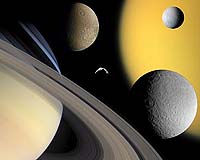 Saturn System Moves Oxygen From Enceladus To Titan
Washington DC (SPX) Jul 05, 2010 Complex interactions between Saturn and its satellites have led scientists using NASA's Cassini spacecraft to a comprehensive model that could explain how oxygen may end up on the surface of Saturn's icy moon Titan. The presence of these oxygen atoms could potentially provide the basis for pre-biological chemistry. The interactions are captured in two papers, one led by John Cooper and ano ... read more |
|
|
| The content herein, unless otherwise known to be public domain, are Copyright 1995-2010 - SpaceDaily. AFP and UPI Wire Stories are copyright Agence France-Presse and United Press International. ESA Portal Reports are copyright European Space Agency. All NASA sourced material is public domain. Additional copyrights may apply in whole or part to other bona fide parties. Advertising does not imply endorsement,agreement or approval of any opinions, statements or information provided by SpaceDaily on any Web page published or hosted by SpaceDaily. Privacy Statement |


 del.icio.us
 Digg
Digg Reddit
 YahooMyWeb
 Google
 Facebook


