|
 |
 |
 |
 |
 |
 |
 |
 |
 |

| . |  |
. |
Saving Robots To Save Battlefield Lives
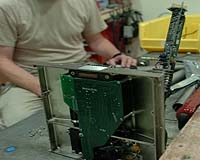
Baghdad, Iraq (AFNS) Jun 11, 2007 One arm and a visceral cavity, wide open with its contents scattered about, is the cost of saving Soldiers' lives. But the brain is intact. Despite the destruction, the remotely operated vehicle can be rebuilt and salvaged by Camp Victory's Joint Robotics Repair Facility. This is an all-volunteer workshop that keeps warfighters safe by ensuring the first line of contact with insurgents and their devices is not human. "The robotics aspect here removes the (troops) from the dangerous situations they don't need to be in the proximity of," Lance Cpl. Aaron Bridgewater, an incoming technician in training at JRRF, said. Most of the robots maintained by the facility are used as preventive measures against improvised explosive devices. "(Explosive ordnance disposal detachments) have a rough job," said Marine Chief Warrant Officer Luis Viera, JRRF executive officer, 65th Regional Readiness Command. "The enemy has chosen the place and time. What separates them from the enemy are these little guys." One of the robots Viera is referring to is the Talon III B, a smart robot that can tell the operator the grade angle it is maneuvering at and the position of its arm. It also comes with four cameras, night vision, a microphone with which to listen to the environment, and a bounty on its head. "A lot of times they send this guy down and the insurgents are waiting," Viera said. "They shoot at it because they know it is effective." The Talon III B and other robots are used to visually examine and sometimes detonate improvised explosive devices while keeping ground forces a safe distance and, mostly, out of harms way. When the robots are damaged and can no longer perform their duties, they are taken to one the forward repair facilities or brought to the workshop. "We make it a point that no one leaves this facility without an actual working robot," said Chuck Burns, JRRF shop manager. Viera added that the facility maintains a fourhour standard for repairs so units do not have to risk lives performing their jobs without one. Despite the quick turnaround time, operators who bring in their robots do not always get the same one back, but no robot is too damaged to be repaired. "When we repair a robot, we also repair their [damaged] parts to reuse, if we can," said Rick Ramsey, JRRF technician. "Occasionally one of the boards will be cracked and we'll go down to that level too." While some robots are too damaged to be rebuilt, they are few and far between. "Some of the robots are completely destroyed," Burns said. "Now, we have more robots and more parts in theater. A year and a half ago, we didn't have nearly as many resources. As long as we have a serial plate we can rebuild a robot. We can rebuild from just about anything (and) create a robot from mix and match parts." Since its inception three years ago, the program has increased exponentially in use and size. "Three years ago there was a requirement for EOD robots to visually inspect (IEDs)," said Maj. Stephen Mufuka, facility manager. "The initial requirement was for 162 systems, now we have more than 4,000." The end mission saving lives is the primary motivator for the success of the program. "Before, EOD had to visually inspect an IED, now they send a robot to do that," Mufuka said. "If a robot gets blown up, you can replace it. If a robot arm gets blown off, you can replace it, but you cannot replace a human." Community Email This Article Comment On This Article Related Links All about the robots on Earth and beyond!
 Rescue Robot Tests To Offer Responders High-Tech Help
 Boulder CO (SPX) Jun 11, 2007
National Institute of Standards and Technology (NIST) engineers are organizing the fourth in a series of Response Robot Evaluation Exercises for urban search and rescue (US and R) responders to be held on June 18-22, 2007, at Texas A and M's "Disaster City" training facility in College Station, Texas. |
|
|

| The content herein, unless otherwise known to be public domain, are Copyright 1995-2006 - SpaceDaily.AFP and UPI Wire Stories are copyright Agence France-Presse and United Press International. ESA PortalReports are copyright European Space Agency. All NASA sourced material is public domain. Additionalcopyrights may apply in whole or part to other bona fide parties. Advertising does not imply endorsement,agreement or approval of any opinions, statements or information provided by SpaceDaily on any Web page published or hosted by SpaceDaily. Privacy Statement |