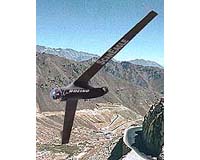
The prototype ScanEagle (pictured) Block D vehicle flew 22 hours and 8 minutes in its baseline configuration.
The prototype ScanEagle (pictured) Block D vehicle flew 22 hours and 8 minutes in its baseline configuration. |
Block upgrades for ScanEagle are typically released every 6 to 12 months. Key product enhancements in Block D include a new improved IR (infrared) camera with a factor of 3 improvement in the resolution; a new inertially stabilized turret with a factor of 5 improvement in disturbance rejection; a custom, ultra-light, Mode C transponder to facilitate airspace deconfliction; new video transmitter system; Rover interoperability; in-flight fuel measurement systems; and numerous improvements for reliability and modularity.
The prototype ScanEagle Block D vehicle flew 22 hours and 8 minutes in its baseline configuration before a successful recovery at Insitu's and Boeing's flight test center in Boardman, Oregon. The UA landed with a fuel reserve of approximately 1 hour. The transponder was operated for the entire flight and over 100 telemetry values were downloaded more than 10 times per second to compare with nominal values during the endurance flight.
Dr. Steven M. Sliwa, Insitu's President and CEO stated after the flight: "Block D of ScanEagle demonstrates our continued commitment to listen to users and rapidly incorporate suggestions. Our engineering challenge is to integrate these improvements and still maintain the system performance, which can be a victim of "feature creep." We are pleased that we exceeded our design goals for each subsystem and for overall performance including flight endurance."
ScanEagle was introduced in 2003 by Boeing and Insitu as an economical, long- endurance UAS that could provide persistent staring and flexible deployment options. It is already a significant contributor to Operation Iraqi Freedom with the USMC and the Global War on Terror for various sea- and land-based missions.
Related Links
 Iran Uses UAV To Watch US Aircraft Carrier On Gulf Patrol
 Tehran (AFP) Nov 11, 2006
| The content herein, unless otherwise known to be public domain, are Copyright 1995-2006 - SpaceDaily.AFP and UPI Wire Stories are copyright Agence France-Presse and United Press International. ESA PortalReports are copyright European Space Agency. All NASA sourced material is public domain. Additionalcopyrights may apply in whole or part to other bona fide parties. Advertising does not imply endorsement,agreement or approval of any opinions, statements or information provided by SpaceDaily on any Web page published or hosted by SpaceDaily. Privacy Statement |