
 |
 |
 |
 |
 |
 |
 |
 |
 |
 |

| . |  |
. |

Paris, France (ESA) Jul 06, 2010 With the launch of Gaia only two years away, the European science community is actively engaged in training the next generation of young astronomers who will exploit the flood of data from this 'Cornerstone' science mission. In many ways, Gaia is a follow-on to ESA's groundbreaking Hipparcos satellite, which mapped the sky between 1989 and 1993. Hipparcos was the first space mission designed for astrometry - the precise measurement of the positions, distances and proper motions of stars. Although Gaia builds on the European expertise established through Hipparcos, the new mission will take astrometry to a new level of complexity and precision. Over its five-year lifetime, Gaia's three instruments will gather huge amounts of astrometric, photometric and spectroscopic data on stars in the Milky Way, as well as more distant galaxies, quasars and Solar System objects. "Hipparcos could detect stars to the 12th magnitude, whereas Gaia will go down to 20th magnitude," explained Timo Prusti, ESA Project Scientist for Gaia. "Hipparcos measured the positions of almost 120 000 stars, but Gaia will map over one billion stars. As for the error in parallax determination, Hipparcos was accurate to within one milliarcsecond, but Gaia's positional data will be about 100 times more precise." Various initiatives are already under way to ensure that the European scientific community is ready to handle and analyse this deluge of data. More than 400 scientists from many different countries have been selected by ESA for the Gaia Data Processing and Analysis Consortium (DPAC) in order to prepare for the extremely challenging task of processing all of the data, with the eventual creation of an all-sky catalogue. Meanwhile, 15 PhD and post-doctorate students have been funded for the past four years under the European Leadership in Space Astrometry (ELSA) programme, working in collaboration with DPAC. Supported by the European Community's Sixth Framework Programme (FP6), the students have been collaborating on specific problems related to the astrophysical, instrument modelling, algorithmic, numerical and software engineering aspects of the mission. Their activities complement, and are partly integrated into, the joint European effort to develop a complete scientific data analysis system for Gaia. Projects undertaken by the ELSA fellows have included development of improved models of stars, their spectra and spatial distributions, and methods to solve the complex mathematical equations required to determine their positions. Another important contribution has involved modelling the effects of long-term exposure to particle radiation on Gaia's detectors. "This was not originally seen as part of the preparations for Gaia, but it has been very valuable," said Lennart Lindegren of Lund Observatory, Sweden, the scientific coordinator for ELSA. "Gaia will be placed in an orbit at the L2 Lagrange Point, 1.5 million kilometres from Earth, where it will be fully exposed to charged particles from the Sun. This will cause a gradual deterioration of the CCDs over the 5-year mission, but the work done under ELSA will hopefully make it possible to eliminate most of the effects." As ELSA draws to a close, another community-based initiative, known as the Gaia Research for European Astronomy Training (GREAT) project, is getting under way. Although everyone in ELSA is also involved in GREAT, the two projects are very different. "ELSA has helped to prepare for the creation of the Gaia catalogue," said Lennart Lindegren, "while GREAT will prepare the community to use the data once it has been produced." Over 550 researchers from 17 European countries and ESA will be participating in the network, which is organised by the Gaia Science Team and the Data Processing and Analysis Consortium Executive (DPACE). "GREAT will cover all of the areas of scientific study covered by Gaia," said Nicholas Walton, chairman of the GREAT network and a researcher at the Institute of Astronomy, University of Cambridge, UK. "Its overall objective is to support a science-oriented network which will address the scientific issues in which Gaia will have a major impact." "Initial funding for five years to cover attendance at conferences and workshops, and visits to other institutions, has been provided by the European Science Foundation. These will help to bring the Gaia community together and enable scientists to share their expertise and ideas," he added. Since Gaia will detect large numbers of supernovas, microlensing events, novas, gamma ray burst afterglows, and other interesting transient or anomalous phenomena, the most recent workshop involved discussions about the impact that Gaia will have on studies of these objects and the importance of follow-up observations by ground-based instruments. A previous meeting looked at the ways in which Gaia will revolutionise studies of star formation and the evolution of open star clusters. Five more GREAT workshops and conferences are being organised for the coming year. Discussions with the European Union concerning funding under the Seventh Framework Programme (FP7) for 17 Early Stage Researchers are currently in progress, and it is hoped that this Initial Training Network will be able to start in early 2011.
Share This Article With Planet Earth
Related Links ESA Gaia Stellar Chemistry, The Universe And All Within It

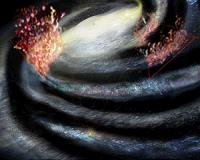 Astronomers Discover Clue To Origin Of Milky Way Gas Clouds
Washington DC (SPX) May 27, 2010 A surprising discovery that hydrogen gas clouds found in abundance in and above our Milky Way Galaxy have preferred locations has given astronomers a key clue about the origin of such clouds, which play an important part in galaxy evolution. "We've concluded that these clouds are gas that has been blown away from the Galaxy's plane by supernova explosions and the fierce winds from young st ... read more |
|
|
| The content herein, unless otherwise known to be public domain, are Copyright 1995-2010 - SpaceDaily. AFP and UPI Wire Stories are copyright Agence France-Presse and United Press International. ESA Portal Reports are copyright European Space Agency. All NASA sourced material is public domain. Additional copyrights may apply in whole or part to other bona fide parties. Advertising does not imply endorsement,agreement or approval of any opinions, statements or information provided by SpaceDaily on any Web page published or hosted by SpaceDaily. Privacy Statement |


 del.icio.us
 Digg
Digg Reddit
 YahooMyWeb
 Google
 Facebook


