|
 |
 |
 |
 |
 |
 |
 |
 |
 |

| . |  |
. |
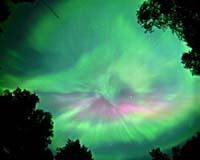
Scientists Reveal Why The Aurora Shines
Beijing (XNA) Sep 10, 2006 Chinese space scientists, working with American and European colleagues, have revealed the origin of the brilliant auroras - often referred to as "northern lights" or "southern lights" - seen at night. Cao Jinbin, a researcher with the Center for Space and Applied Research under the Chinese Academy of Sciences, who was closely involved in the research, said that people previously believed auroras were caused by solar winds. Using data collected from four satellites, scientists were able to overturn this view. "We have found that auroras caused by solar winds are very weak and can scarcely be seen with the naked eye. The splendid and colorful auroras we see are actually caused by magnetic substorms," Cao said. By studying the data collected by the Cluster satellites of European Space Agency (ESA), scientists found that high-speed flows of electrified gas, known as bursty bulk flows (BBFs), are generated by magnetic substorms. Auroras are caused mostly by energetic BBFs spiraling down Earth's magnetic field lines and colliding with atmospheric atoms at about 100 kilometers altitude. "When magnetic substorms occur, BBFs strike our atmosphere, making auroras shine," Cao explained. BBFs contain electrons and other charged particles such as protons coming from the magnetotail, a region of space on the night-side of Earth where the sun's particle winds push Earth's magnetic field into a long tail, said the scientist. At the tail's center is a denser region known as the plasmasheet. Violent changes of the plasmasheet are known as magnetic substorms. They last up to a couple of hours and somehow hurl electrons and protons earthward, Cao said. Scientists were able to discover how the process works by using the four Cluster spacecraft, nicknamed Rumba, Samba, Salsa and Tango, launched in 2000. The four spacecraft, all carrying identical instruments, flew through Earth's magnetosphere, or the region where the planet's magnetic field is dominant. Cao became one of several Chinese co-researchers of the ESA's Cluster mission in 1996. His paper about magnetic substorms has been published in the authoritative science magazine, Journal of Geophysical Research. Another key finding is that the average duration of a BBF is longer than previously thought, said Cao. "The multiple spacecraft data offered by Cluster revealed more about Earth's magnetic environment than data collected by a single spacecraft," Cao said. Apart from creating beautiful light shows, substorms also excite Earth's ionosphere, disturbing the reception of GPS signals and communications between Earth and orbiting satellites, said the scientist. Clarifying the origin of Earth's aurora phenomena will help human beings understand weather in space, which is a key factor in ensuring the safety of space probe missions and astronauts, said Pu Zuyin, a professor at the School of Earth and Space Sciences at Beijing University. According to Cao, the research team's next task is to build an aurora monitoring system, capable of forecasting and analyzing aurora movements. The colorful auroras regularly light the higher latitudes in the northern and southern hemisphere. In China, people can see it only in the city of Mohe in northeast China's Heilongjiang Province. But the history of aurora observation in China can be dated back more than 2,000 years.
Source: Xinhua News Agency Related Links by Staff Writers  China Launches Satellite For Super Fruit And Vegetables
 Beijing (AFP) Sep 09, 2006
China on Saturday launched a satellite carrying fruit and vegetable as part of a plan to help develop space-enhanced produce to feed the country's 1.3 billion people, state press reported. The Shijian-8, a recoverable satellite, was launched aboard a Long March 2C rocket for a mission that will expose 2,000 seeds from nine different categories to cosmic radiation and micro-gravity, Xinhua news agency reported. |
|
|

| The content herein, unless otherwise known to be public domain, are Copyright 1995-2006 - SpaceDaily.AFP and UPI Wire Stories are copyright Agence France-Presse and United Press International. ESA PortalReports are copyright European Space Agency. All NASA sourced material is public domain. Additionalcopyrights may apply in whole or part to other bona fide parties. Advertising does not imply endorsement,agreement or approval of any opinions, statements or information provided by SpaceDaily on any Web page published or hosted by SpaceDaily. Privacy Statement |