. Military Space News .
SOLAR SCIENCE
Scientists See Solar Outburst In Exquisite Detail

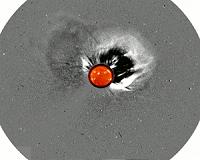
A visible light image of the CME as it travelled from the Sun towards the Earth on 20 March 2010 made with the HI instrument on the STEREO observatory. The x-axis of the image corresponds to a distance of 48 million km from left to right. Credit: Anthony Williams / NASA / Richard Harrison
by Staff Writers
London, UK (SPX) Apr 20, 2011
The largest disturbances to the Earth's geomagnetic environment occur when it is buffeted by solar material hurled in our direction by explosive changes in the Sun's atmosphere. These Coronal Mass Ejections or CMEs contain approximately a billion tonnes of ionized gas or plasma and can have a dramatic and damaging impact on everything from satellites to power grids.

Now a team of scientists have used two spacecraft to study these events in unprecedented detail. Graduate student Anthony Williams of the University of Leicester will present their results at the Royal Astronomical Society's National Astronomy Meeting in Llandudno, Wales.

Mr Williams and his team used the Heliospheric Imagers (HI) on the Solar TErrestrial RElations Observatory (STEREO) spacecraft to examine the internal structure of an Earth-impacting CME - seen as sunlight scattered from high density blobs of plasma - as it travels outwards from the Sun.

They compared this with the internal structure measured in situ by the Advanced Composition Explorer (ACE) spacecraft as the CME engulfed the spacecraft and impacted the Earth. This meant that the scientists have for the first time been able to compare the evolution of the CME structure as it races towards the Earth and the internal structure observed as it arrives.

The CME studied was ejected from the Sun on 19 March 2010, when the STEREO A spacecraft was in a position to watch from the side as the CME hurtled outwards towards the Earth.

The structure of the CME was examined in HI images spanning a distance of approximately 48 million km at different distances between the Sun and the Earth. Analysing the images indicated that its speed was close to 350 km per second, which allowed its time of impact on the Earth to be predicted some 3 days after the initial ejection.

The results indicate that the CME structure evolves considerably on its outward journey, and that the internal structure can be difficult to predict from the images. And there is another key facet to this work - imaging CMEs with spacecraft like STEREO is an extremely effective means of forecasting their impact on Earth and the large scale disruption that can sometimes result.


Share This Article With Planet Earth
del.icio.usdel.icio.us DiggDigg RedditReddit
YahooMyWebYahooMyWeb GoogleGoogle FacebookFacebook


Related Links
Royal Astronomical Society
Solar Science News at SpaceDaily


Memory Foam Mattress Review
Newsletters :: SpaceDaily :: SpaceWar :: TerraDaily :: Energy Daily
XML Feeds :: Space News :: Earth News :: War News :: Solar Energy News


SOLAR SCIENCE
The Watched Pot And Fast CMEs
Greenbelt MD (SPX) Apr 18, 2011
Back in 2008, the solar cycle plunged into the deepest minimum in nearly a century. Sunspots all but vanished, solar flares subsided, and the sun was eerily quiet. "Ever since, we've been waiting for solar activity to pick up," says Richard Fisher, head of the Heliophysics Division at NASA Headquarters in Washington DC. "It's been three long years." Quiet spells on the sun are nothin ... read more


SOLAR SCIENCE
Biden, Putin discuss trade, missile defense

Sea-Based Missile Defense Flight Test Results In Successful Intercept

Netanyahu thanks Obama for 'Dome' missile funding

Aegis BMD System Engages Intermediate Range Ballistic Missile For First Time

SOLAR SCIENCE
Pakistan test fires nuclear-capable missile

LockMart Tests JAGM Tri-Mode Seeker On Sabreliner

Pakistan tests latest defensive missile

MBDA Demos VL Mica Proficiency Against Stand-Off Weapons

SOLAR SCIENCE
LockMart Tactical Reconn Radar Completes UAV Test Flights

US carries out first drone strike in Libya: Pentagon

US drone attack kills six militants in Pakistan

US mulling drones for Pakistan despite tensions

SOLAR SCIENCE
Preparations Underway As US Army Gears Up For Large-Scale Network Evaluations

Global Military Communications Market In 2010

Raytheon BBN Technologies To Protect Internet Comms For Military Abroad

Gilat Announces New Military Modem For Robust Tactical Satcom-On-The-Move

SOLAR SCIENCE
RAF Typhoon Project 'Under Control And Back On Track'

Northrop Grumman T-38 Talon Honored For 50 Years Of Service

New Warhead Reduces Size Of Raytheon Small Tactical Munition

Australian military abuse could lead to payouts

SOLAR SCIENCE
Canadian Defense Budget To Reach Twenty Billion By 2015

Seoul: No barter deal for T-50 jet trainer

EADS offer for Vector valid until May 26

Mideast: Western arms sales under scrutiny

SOLAR SCIENCE
Defiant China church vows to hold Easter service

Japan seeks stronger military ties with US: report

Outside View: America strikes out

Australia pushes defence ties with Japan

SOLAR SCIENCE
MLD Test Moves Navy A Step Closer To Lasers For Ship Self-Defense

US Navy And Northrop Grumman Accomplish Goals For At-Sea Demonstration Of Maritime Laser

Scientists Build World's First Anti-Laser

Yale scientists build 'anti-laser'


The content herein, unless otherwise known to be public domain, are Copyright 1995-2010 - SpaceDaily. AFP and UPI Wire Stories are copyright Agence France-Presse and United Press International. ESA Portal Reports are copyright European Space Agency. All NASA sourced material is public domain. Additional copyrights may apply in whole or part to other bona fide parties. Advertising does not imply endorsement,agreement or approval of any opinions, statements or information provided by SpaceDaily on any Web page published or hosted by SpaceDaily. Privacy Statement