|
 |
 |
 |
 |
 |
 |
 |
 |
 |

| . |  |
. |
Scientists Set Out To Discover Amount Of Snow On Earth
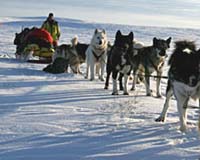
Circle AK (SPX) Mar 20, 2006 An expedition into the frozen Arctic using dogsled teams kicks off March 12 from Alaska to help NASA find out how much snow blankets the Earth. The trek is one leg of a multi-sponsor five-year Go North! expedition made up of multiple dogsled treks that will explore the Arctic in pursuit of environmental samples and observations. Seven explorers, including scientists and teachers, will mush from Circle, Alaska, across the Arctic through May with two dog teams of 25 polar huskies with names like Ginger, Jupiter and Hershey, to collect samples of hydro-meteorological snow data. The samples, to be gathered in five communities spread across the Alaskan Arctic, will be analyzed to help validate snow pack observations from NASA's Aqua satellite. Snow pack refers to the snow that remains on the ground for weeks at a time. Researchers hope that analysis of the snow samples will also improve our understanding of how snow metamorphoses, or changes, after it lands on Earth. Snow crystals scatter microwave radiation that emanates from the ground. Researchers want to know better what type of crystals are more likely to be found in a particular region at a particular time of year. The more information they have about snow crystals from various areas of the snow-covered portion of the globe, the better they are positioned to more fully understand and interpret the satellite-derived data. "In recent years snow cover has been declining in many areas of the globe," said physical scientist James Foster of NASA's Goddard Space Flight Center, Greenbelt, Md. "It has become ever more important to accurately measure the amount of snow in large watersheds, areas where melted snow drains into waterways. Public officials can then better determine how to manage limited water resources, especially in areas with the densest populations." In the American West, snow is a particularly vital resource. According to Foster, about 70 percent of the water supply in western states comes from melting snow pack. Snow also drains from the Rockies and the Dakotas into rivers that feed the Mississippi and Missouri Rivers, America's primary sources of fresh water. The ability to accurately measure snow packs has implications all over the globe. "Melting snow in the Himalayan region, for example, feeds rivers that supply water to over a half billion people. So it's key for us to better understand how much water is made available on a worldwide scale from melting snow packs," said Foster. The Advanced Microwave Scanning Radiometer-EOS (AMSR-E) instrument aboard the Aqua satellite can measure snow in remote areas where ground and air surveys are difficult. Validation of the satellite measurements must be done, however, to ensure that the data from space are reliable. Validating snow measurements is especially difficult in regions where the terrain is not uniform, thereby posing a significant challenge for the AMSR-E sensors. This is where the dogsled teams come in: they will be gathering data from extremely remote locations to help confirm the satellite observations. "The dogs are the super stars of the project. Without their abilities to get us from point A to point B we could not conduct this kind of critical work," said Paul Pregont of the University of Minnesota, Minneapolis, the trek's expedition leader. "Much of the route we are traveling does not allow motorized vehicles, so the only way to get there is by skiing or dog sledding." At each data-collection point, researchers will dig a snow pit, confirm the location, air temperature, and snow depth. They will then collect snow crystals from the snow pit at different depths. The samples will be stored in liquid nitrogen and shipped to the U.S. Department of Agriculture (USDA)'s Henry A. Wallace Beltsville Agricultural Research Center where the crystals will be imaged with a low temperature scanning electron microscope to measure their size and denote their shape. Polar huskies, a mixed breed of Northern native huskies, boast double coats of fur and strong legs. Dogsled team veterinarian Eric Jayne ensures that the dogs are in top condition and that each has a fully stocked medical kit of essentials. Each of the two dog teams consists of 12-13 huskies. "The dogs have so much positive energy, that no matter how rough the weather, they are there in the morning to give you a lick and they are eager to get moving," said Pregont. "They really love being out in the cold air and out on the trek. They are born to live and work in these conditions." The NASA-funded project is a collaborative effort with the University of Minnesota, USDA, the National Oceanic and Atmospheric Administration, the U.S. Geological Survey, the Meteorological Service of Canada, Quebec, and several other universities in the U.S., Canada and Europe. Over 3,000 classrooms around the world are learning along with GoNorth! through a K-12 distance learning program. Related Links NASA's Aqua Satellite  Unique Weather Radar To Investigate Snowfall
 Helsinki, Finland (SPX) Mar 20, 2006
The Department of Physical Sciences at the University of Helsinki has acquired a state-of-the-art polarimetric weather radar. The new radar is reserved exclusively for research. Its most important meteorological research target is the physics of rain clouds, and scientists intend to focus on snow and sleet in particular. |
|
|

| The content herein, unless otherwise known to be public domain, are Copyright 1995-2006 - SpaceDaily.AFP and UPI Wire Stories are copyright Agence France-Presse and United Press International. ESA PortalReports are copyright European Space Agency. All NASA sourced material is public domain. Additionalcopyrights may apply in whole or part to other bona fide parties. Advertising does not imply endorsement,agreement or approval of any opinions, statements or information provided by SpaceDaily on any Web page published or hosted by SpaceDaily. Privacy Statement |