
Subscribe free to our newsletters via your
. Military Space News .


FARM NEWS
Scientists develop strategy to contain GMOs to the lab
by Brooks Hays
Boston (UPI) Jan 22, 2015


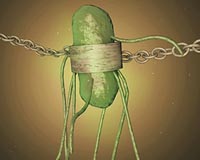
Scientists have genetically recoded a strain of E. coli to depend on a synthetic amino acid so the bacteria can�t survive outside the lab. Image: Jennifer Hinkle

The term GMO, short for "genetically modified organism," comes with a lot crippling baggage -- it's a bloated word full of foreboding futures. The truth is, GMOs are already everywhere. But even if their dangers are often exaggerated, they don't come without risks.

Some GMOs do have the potential to disrupt the natural order of things -- cause havoc in rivers and other ecosystems. To prevent that, researchers at Harvard have developed a safety mechanism to ensure GMOs stay where they're supposed to be.

"If you make a chemical that's potentially explosive, you put stabilizers in it. If you build a car, you put in seat belts and airbags," George Church, a geneticist at Harvard Medical School, explained in a recent press release.

GMOs are more than just mutant corn strains designed to withstand high levels of pesticides. They're mosquitos engineered to not spread malaria. They're insulin- or hormone-producing bacteria. They're in laundry detergents and cosmetics. And keeping them where they're supposed to be is an important job. Now, scientists have a better way of doing so.

Church and his colleagues have found a way to install a sort of disarming or disabling mechanism in GMOs, so these organisms can't live where they're not supposed to. More specifically, researchers have found a way to install a unique strain of E. coli in GMOs. The genome of this harmless version of the bacteria has been altered so that it's addicted -- entirely reliant on -- an unnatural synthetic amino acid, only produced in the lab setting and not found in the outside world.

Thus, GMOs outfitted with this uniquely designed strain of E. coli wouldn't be able to exist without their amino acid fix. Without that fix, the escaped organism will die.

"It really addresses a longstanding problem in biotechnology," researcher Farren Isaacs told The New York Times. "[It is a] really compelling solution to engineering biocontainment, or biological barriers that limit the spread and survival of organisms in natural environments."

The new containment strategy is detailed in two papers, both published this week in the journal Nature.


Thanks for being here;
We need your help. The Space Media Network continues to grow but revenues have never been harder to maintain.

With the rise of Ad Blockers, and Facebook - our traditional revenue sources via quality network advertising continues to decline. And unlike so many other news sites, we don't have a paywall - with those annoying usernames and passwords.

Our news coverage takes time and effort to publish 365 days a year.

If you find our news sites informative and useful then please consider becoming a regular supporter or for now make a one off contribution.
SpaceMediaNetwork Contributor
$5 Billed Once


credit card or paypal
SpaceMediaNetwork Monthly Supporter
$5 Billed Monthly


paypal only


.


Related Links
the Wyss Institute
Farming Today - Suppliers and Technology


Comment on this article via your Facebook, Yahoo, AOL, Hotmail login.

Share this article via these popular social media networks
del.icio.usdel.icio.us DiggDigg RedditReddit GoogleGoogle


FARM NEWS
Biological safety lock for genetically modified organisms
Boston MA (SPX) Jan 23, 2015
The creation of genetically modified and entirely synthetic organisms continues to generate excitement as well as worry. Such organisms are already churning out insulin and other drug ingredients, helping produce biofuels, teaching scientists about human disease and improving fishing and agriculture. While the risks can be exaggerated to frightening effect, modified organisms do have the p ... read more


FARM NEWS
Raytheon given $2.4B FMS contract for Patriot fire units

US delivers second radar defense system to Japan

US Ballistic Missile Defense Needs More Testing

Israel, US in abortive missile defence test

FARM NEWS
Russia Will Test Launch Iskander-M Missiles During March Drills

Navy authorizes SM-6 missile for more ships

Hezbollah chief threatens Israel over Syria strikes

New Navy missile ready for operational testing

FARM NEWS
UN saw drones before Israeli air strike on Syria

US Air Force moves to stem shortage of drone pilots

10 news organizations join drone-test program

Global Hawks achieve flight-hour record

FARM NEWS
Third MUOS Satellite Launched And Responding To Commands

MUOS-3 satellite ready for launch

Marines order Harris wideband tactical radios

New Israeli defense contracts for Elbit Systems C4i services

FARM NEWS
BAE Systems announces new thermal weapon sight

Navy contracts for modified MK46 guns

USMC orders marksmanship training simulators

Nammo in Finland inaugurates ammo production line

FARM NEWS
NATO chief urges Germany to lead way on defence spending

Four Afghan Guantanamo detainees repatriated: Pentagon

Global arms treaty enters into force on Wednesday

Plunging oil price to reset global defence budgets: IHS

FARM NEWS
China's Xi gets 62 percent pay rise: report

China planning naval base in Namibia: report

US-Cuba relations: Tense ties take new turn

'Russian forces' attack Ukraine troops in separatist east

FARM NEWS
Carbon nanotube finding could boost battery life

Revealing the inner workings of a molecular motor

New technology focuses diffuse light inside living tissue

Mysteries of 'molecular machines' revealed


The content herein, unless otherwise known to be public domain, are Copyright 1995-2014 - Space Media Network. All websites are published in Australia and are solely subject to Australian law and governed by Fair Use principals for news reporting and research purposes. AFP, UPI and IANS news wire stories are copyright Agence France-Presse, United Press International and Indo-Asia News Service. ESA news reports are copyright European Space Agency. All NASA sourced material is public domain. Additional copyrights may apply in whole or part to other bona fide parties. Advertising does not imply endorsement, agreement or approval of any opinions, statements or information provided by Space Media Network on any Web page published or hosted by Space Media Network. Privacy Statement All images and articles appearing on Space Media Network have been edited or digitally altered in some way. Any requests to remove copyright material will be acted upon in a timely and appropriate manner. Any attempt to extort money from Space Media Network will be ignored and reported to Australian Law Enforcement Agencies as a potential case of financial fraud involving the use of a telephonic carriage device or postal service.