
. Military Space News .
INTERN DAILY
Scientists discover why elephants rarely get cancer
by Staff Writers
Miami (AFP) Oct 8, 2015


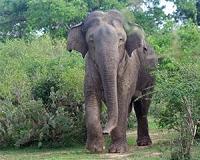
Despite their big size, elephants rarely get cancer, and scientists said Thursday they have discovered the secret to the creatures' special protection. It's in the genes.

Elephants have 38 additional modified copies of a gene that encodes p53, a compound that suppresses tumor formation.

Humans, on the other hand, have only two, according to the study in the Journal of the American Medical Association (JAMA).

This means that as elephants evolved, their bodies made many extra copies of a gene that prevents tumors from forming.

Elephants have been considered an enigma for years because they have far more cells than people, which would presumably place them at higher risk of cancer over their lifespans which can last 50-70 years.

And yet, the analysis of a large database of elephant deaths showed that less than five percent of elephants die of cancer, compared to 11 to 25 percent in people.

"By all logical reasoning, elephants should be developing a tremendous amount of cancer, and in fact, should be extinct by now due to such a high risk for cancer," said co-senior author Joshua Schiffman, pediatric oncologist at Huntsman Cancer Institute, University of Utah School of Medicine.

"We think that making more p53 is nature's way of keeping this species alive."

Elephants also come naturally equipped with a more aggressive internal mechanism for killing damaged cells that are at risk for becoming cancerous, researchers said.

"In isolated elephant cells, this activity is doubled compared to healthy human cells," said the study, which was co-authored by experts from Arizona State University and the Ringling Bros. Center for Elephant Conservation.

Researchers hope that their findings could one day lead to new cancer-fighting therapies in people.

But that day could be far off, according to Mel Greaves, director of the Centre for Evolution and Cancer at The Institute of Cancer Research, London.

"The new research provides a plausible answer to one of the most celebrated riddles in evolutionary biology -- why some big animals with lots of cells still manage to have quite low rates of cancer," said Greaves, who was not involved in the study.

"It is not immediately clear what lessons there are from this elephant tale for risk of cancer in humans. The main impact of this remarkable story is to bring into focus the question of why we are so uniquely predisposed to cancer for our size and lifespan -- and what we can do to change this."


Thanks for being here;
We need your help. The Space Media Network continues to grow but revenues have never been harder to maintain.

With the rise of Ad Blockers, and Facebook - our traditional revenue sources via quality network advertising continues to decline. And unlike so many other news sites, we don't have a paywall - with those annoying usernames and passwords.

Our news coverage takes time and effort to publish 365 days a year.

If you find our news sites informative and useful then please consider becoming a regular supporter or for now make a one off contribution.
SpaceMediaNetwork Contributor
$5 Billed Once


credit card or paypal
SpaceMediaNetwork Monthly Supporter
$5 Billed Monthly


paypal only


.


Related Links
Hospital and Medical News at InternDaily.com


Comment on this article via your Facebook, Yahoo, AOL, Hotmail login.

Share this article via these popular social media networks
del.icio.usdel.icio.us DiggDigg RedditReddit GoogleGoogle

Previous Report
INTERN DAILY
Wearable electronic health patches cheaper and easier to make
Austin TX (SPX) Oct 06, 2015
A team of researchers in the Cockrell School of Engineering at The University of Texas at Austin has invented a method for producing inexpensive and high-performing wearable patches that can continuously monitor the body's vital signs for human health and performance tracking, potentially outperforming traditional monitoring tools such as cardiac event monitors. The researchers published a ... read more


INTERN DAILY
Russia's Aerospace Forces Never Miss a Missile Launch... Anywhere

Space-based missile warning continues expansion

Lockheed Martin delivers enhanced Patriot interceptor

Patriot missiles to be pulled from Turkey as planned

INTERN DAILY
Russia Develops Portable Aerosol Cloud Generator to Conceal Missiles

Russia denies US claim that four Syria-bound missiles crashed in Iran

U.S. Navy sends guided-missile destroyer to Japan

Tomahawk demos new cruise missile capabilities

INTERN DAILY
Drone market to hit $10 billion by 2024: experts

Russian firm creating new UAV sensor technologies

Britain to increase UAV fleet, modernize Special Forces gear

Britain will double drone fleet: Cameron

INTERN DAILY
LGS Innovations enhances ISR technologies

Harris supplying tactical radios to Special Operations Forces

Skynet 5A satellite move to Asia-Pacific complete

Harris Corporation supplying ground-to-air radios to ANG

INTERN DAILY
New ammunition for tanks under development

Jordan awards Raytheon $18.6 million to expand border security

Saab upgrading training system for Bulgaria

U.S. Marines introduce 29 gender-neutral jobs

INTERN DAILY
Pakistan continues defense export push

Raytheon takes over Foreground Security

France to increase defense spending in 2016

Pentagon concerned about defense industry mergers

INTERN DAILY
UN launches audit of funds linked to bribery scandal

USAF expands OIR mission in Turkey

U.K. Defense Secretary announces more support for Ukraine

Belarus says 'does not need' Russian airbase

INTERN DAILY
Pirouetting in the spotlight

Nanocellulose materials by design

Smaller is better for nanotube analysis

Scientists build wrench 1.7 nanometers wide


The content herein, unless otherwise known to be public domain, are Copyright 1995-2024 - Space Media Network. All websites are published in Australia and are solely subject to Australian law and governed by Fair Use principals for news reporting and research purposes. AFP, UPI and IANS news wire stories are copyright Agence France-Presse, United Press International and Indo-Asia News Service. ESA news reports are copyright European Space Agency. All NASA sourced material is public domain. Additional copyrights may apply in whole or part to other bona fide parties. All articles labeled "by Staff Writers" include reports supplied to Space Media Network by industry news wires, PR agencies, corporate press officers and the like. Such articles are individually curated and edited by Space Media Network staff on the basis of the report's information value to our industry and professional readership. Advertising does not imply endorsement, agreement or approval of any opinions, statements or information provided by Space Media Network on any Web page published or hosted by Space Media Network. General Data Protection Regulation (GDPR) Statement Our advertisers use various cookies and the like to deliver the best ad banner available at one time. All network advertising suppliers have GDPR policies (Legitimate Interest) that conform with EU regulations for data collection. By using our websites you consent to cookie based advertising. If you do not agree with this then you must stop using the websites from May 25, 2018. Privacy Statement. Additional information can be found here at About Us.