|
 |
 |
 |
 |
 |
 |
 |
 |
 |

| . |  |
. |
Second Stage Vega Motor Roars To Life In ESA Test
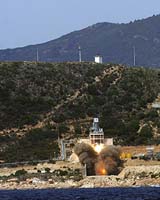
Paris, France (SPX) Jun 27, 2006 ESA announced its Vega small-satellite launch vehicle has made a new step toward its maiden flight, late next year, with the success of the first firing test Monday on its second stage motor, the Zefiro 23. The static firing was performed at the Italian Ministry of Defense test center in Salto di Quirra, Sardinia. The 7.5-meter (24-foot) tall, two-meter (six-foot) diameter motor, featuring a carbon epoxy filament wound casing, delivered more than 100 metric tons of thrust, burning some 24 metric tons of solid propellant in 75 seconds. Engineers gathered numerous data during the test and now are analyzing the figures to improve technical knowledge of the motor's behavior and refine the launcher's future performance, ESA said in a news release. Also tested during the firing were various sub-systems, including a thrust-vector-control system that will steer the motor's nozzle to provide flight control. The next step is to proceed with the critical design review, at which stage the engine's technical characteristics will be finalized, the release continued. Built by Avio in Colleferro, near Rome, the Zefiro 23 motor will be the basis for the second stage of ESA's Vega launcher. Engineers performed the first firing test with the third stage motor � the Zefiro 9 � in December 2005. Conducted on behalf of ESA's Vega development program, the latest two firing tests followed three static firings of the Zefiro 16 demonstrator in 1998, 1999 and 2000. Both the Zefiro 23 and Zefiro 9 will undergo an additional ground firing test each to complete their development and qualification. "The Zefiro 23 is one of the largest composite casing solid rocket motors ever test fired in Western Europe, said Antonio Fabrizi, ESA's director of launchers, "but it will be dwarfed shortly, when we will fire Vega's first stage motor, the P80, with its 88 tons of propellant, in Kourou, French Guiana, in November." That first Vega flight currently is scheduled for the end of 2007. Under development since 1998 with the support of seven ESA Member States - including Italy, France, Belgium, Switzerland, Spain, the Netherlands and Sweden - ESA's Vega small-satellite launcher is an all-solid three-stage vehicle with a liquid-fueled injection module. ELV SpA, a joint venture of Avio and ASI, the Italian Space Agency, was delegated the responsibility for Vega development. CNES, the French space agency, holds similar responsibility for the P80 first stage. Vega is designed to loft single or multiple payloads to orbits up to 1,500 kilometers (930 miles) in altitude. Its baseline payload capability is about 1,500 kilograms (3,300 pounds) to a circular 700-kilometer (435-mile) high sun-synchronous orbit, but it can also loft satellites from 300 kilograms (660 pounds) to more than 2 metric tons (2.2 tons), as well as piggyback micro-satellites. This range of performance covers the needs for multiple applications in the fields of remote sensing, environmental monitoring, Earth science, space science, fundamental science and research and technology for future space applications and systems. Once qualified, Vega will be marketed and operated by Arianespace, as a complement to Ariane 5 and Soyuz, and will address the small-satellite launch market. Related Links ESA  NASA Announces CLV Support Contract
 Washington DC (SPX) Jun 21, 2006
NASA announced Wednesday it has selected MTS Systems Corp. of Eden Prairie, Minn., to support the agency's Crew Launch Vehicle Program. The maximum value of the fixed-price contract is about $9 million, with the maximum period of performance 25 months. |
|
|

| The content herein, unless otherwise known to be public domain, are Copyright 1995-2006 - SpaceDaily.AFP and UPI Wire Stories are copyright Agence France-Presse and United Press International. ESA PortalReports are copyright European Space Agency. All NASA sourced material is public domain. Additionalcopyrights may apply in whole or part to other bona fide parties. Advertising does not imply endorsement,agreement or approval of any opinions, statements or information provided by SpaceDaily on any Web page published or hosted by SpaceDaily. Privacy Statement |