. Military Space News .


.
MOON DAILY
Second bid to launch NASA's Moon-bound spacecraft
by Staff Writers
Washington (AFP) Sept 8, 2011

CAPE CANAVERAL AIR FORCE STATION, Fla. (NASA) The launch of a Delta II rocket carrying NASA's Gravity Recovery and Interior Laboratory (GRAIL) has been postponed one day to allow additional time to review propulsion system data from Thursday's detanking operation after the launch attempt was scrubbed due to upper level winds. The postponement will allow the launch team additional time to review the data.The launch now is planned for Saturday, Sept. 10, from Space Launch Complex-17B at Cape Canaveral Air Force Station, Fla. There are two instantaneous launch opportunities at 8:29:45 a.m. and 9:08:52 a.m. EDT (5:29:45 a.m. and 6:08:52 a.m. PDT). The forecast for Sept. 10 shows a 60 percent chance of favorable weather conditions for a Saturday morning launch.

NASA will try again Saturday to launch a $500 million pair of unmanned spacecraft that will use gravity tools to map the Moon's inner core for the first time, after high winds delayed a first attempt.

The GRAIL (Gravity Recovery And Interior Laboratory) mission, aims to launch on a single Delta II rocket as early as 8:29 am (1229 GMT). A second launch window opens at 9:08 am (1308 GMT).

NASA had planned to try again on Friday, but decided to delay the launch another day to allow additional time to review propulsion system data from Thursday's detanking operation after the launch attempt was scrubbed due to upper level winds. Scientists hope the satellites will shed light on how the Moon formed and whether there was once another Moon that melded with it, forming lunar mountains.

Despite 109 past missions to study the Moon since 1959, and the fact that 12 humans have walked on its surface, GRAIL program scientist Bobby Fogel said there has never been a serious attempt to peer inside.

"GRAIL will be the first mission to determine the internal structure of the Moon," he told reporters this week.

"We have used gravity science before to try to gain some insight as to what is going on inside the Moon, however these have been very primitive attempts.

"If those previous attempts could be likened to a magnifying glass, GRAIL by contrast would be a high-powered microscope."

Scientists believe that the Moon was formed when a planet-sized object crashed into the Earth, throwing off a load of material that eventually became what we now recognize as our planet's airless, desolate satellite.

How it heated up over time, creating a magma ocean that later crystallized, remains a mystery.

A recent hypothesis that there may have been two Moons that slowly merged into each other can also be tested with this mission, said principal investigator Maria Zuber.

"If we want to reconstruct the evolution of the Moon over time, we certainly need to reconstruct the temperature structure of the Moon right now," she said.

Little is known for certain about what lies inside the Moon. The widely held belief that there is a small solid iron core surrounded by a liquid iron core is unproven, said Zuber.

"It is actually quite possible that deep inside the Moon the core could be titanium oxide which is a material that would have fallen out or would have crystallized out of the magma ocean and sunk to the deep interior of the Moon," she said.

The GRAIL twins will journey for more than three months, both entering orbit around New Year's Day.

Once there, they will line up with each other and "essentially chase each other around in a polar orbit as the Moon rotates slowly underneath them," said Zuber.

They will hover about 34 miles (55 kilometers) above the lunar surface, with the distance between them ranging from 37 to 140 miles (60 to 225 kilometers), collecting measurements of the terrain beneath.

The duo will accomplish the mission's primary aim of understanding the Moon's inner character by performing a series of low-altitude gravity field measurements using what is known as a Ka-band ranging instrument.

The mission itself is relatively short in duration, just 90 days once the two spacecraft reach orbit.

About 40 days after their work is done, the pair will plunge into the lunar surface, NASA said. Scientific analysis of their data is expected to continue for a year.


Related Links
Mars News and Information at MarsDaily.com
Lunar Dreams and more


.
Get Our Free Newsletters Via Email
...
Buy Advertising Editorial Enquiries


. Comment on this article via your Facebook, Yahoo, AOL, Hotmail login.

Share this article via these popular social media networks
del.icio.usdel.icio.us DiggDigg RedditReddit GoogleGoogle


MOON DAILY
NASA Spacecraft Images Offer Sharper Views of Apollo Landing Sites
Greenbelt MD (SPX) Sep 07, 2011
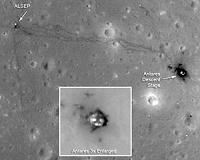
NASA's Lunar Reconnaissance Orbiter (LRO) captured the sharpest images ever taken from space of the Apollo 12, 14 and 17 landing sites. Images show the twists and turns of the paths made when the astronauts explored the lunar surface. At the Apollo 17 site, the tracks laid down by the lunar rover are clearly visible, along with the last foot trails left on the moon. The images also show wh ... read more


MOON DAILY
U.S.: Missile shield fears 'unfounded'

Iran ups criticism of Turkey over NATO missile shield

Iran criticises NATO's Turkey radar plan

Turkey to host radar for NATO missile defense

MOON DAILY
Brazil to recondition Argentine missiles

Taiwan to produce new anti-China missiles: lawmaker

India postpones latest Agni missile launch

Raytheon-Boeing Team Continues to Validate JAGM Single Rocket-Motor Solution

MOON DAILY
Embraer joins forces with Elbit to make unmanned aircraft

Lockheed Martin/KAMAN K-MAX Completes US Navy Unmanned Cargo Assessment

AeroVironment Wins Switchblade Agile Munition Systems and Services Contract

AeroVironment Introduces Shrike VTOL Unmanned Aircraft System

MOON DAILY
Environmental Testing of New Military Communications Satellite Completed

Lockheed Martin AMF JTRS Team Delivers Joint Tactical Radio to AFRL For C-130J And C-5 Integration Risk Reduction

ASC Signal Will Support L-3 Communications with Multi-Band Transportable Communications for a U.S. Government Agency

Lockheed Martin Introduces Virtual Capability That Connects Interpreters with Battlefield Troops

MOON DAILY
Miniature Air Launched Decoy Jammer Demonstrates Capability to Protect Manned Aircraft

Sweden orders Australian weapons stations

Elbit Systems Completes Customer Tests For First 30mm Unmanned Turret Supplied To Brazil

Curtiss-Wright Signs Contract With Selex Galileo

MOON DAILY
Turkey says Israel lacks "trade ethics" in military deals

Budget cuts will mean smaller US Army: general

Google effect worries judge in Viktor Bout trial

Australia selling off its last Sea Kings

MOON DAILY
China seeks to dispel fears over military build-up

Biden says China rise not America's demise

Outside View: Lead Britannia!

China state news agency accuses US of 'interfering'

MOON DAILY
Boeing and BAE Systems to Develop Integrated Directed Energy Weapon for US Navy

System Integration of High Energy Laser Technology Demonstrator Completed

Raytheon Acquires Directed Energy Capabilities of Ktech Corporation


Memory Foam Mattress Review
Newsletters :: SpaceDaily Express :: SpaceWar Express :: TerraDaily Express :: Energy Daily
XML Feeds :: Space News :: Earth News :: War News :: Solar Energy News
.

The content herein, unless otherwise known to be public domain, are Copyright 1995-2011 - Space Media Network. AFP and UPI Wire Stories are copyright Agence France-Presse and United Press International. ESA Portal Reports are copyright European Space Agency. All NASA sourced material is public domain. Additional copyrights may apply in whole or part to other bona fide parties. Advertising does not imply endorsement,agreement or approval of any opinions, statements or information provided by Space Media Network on any Web page published or hosted by Space Media Network. Privacy Statement