|
 |
 |
 |
 |
 |
 |
 |
 |
 |

| . |  |
. |
Self-Assembled Probes Allow Researchers To See Tumors Through Flesh
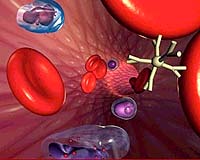
Philadelphia PA (SPX) Feb 08, 2005 Nano-sized particles embedded with bright, light-emitting molecules have enabled researchers to visualize a tumor more than one centimeter below the skin surface using only infrared light. A team of chemists, bioengineers and medical researchers based at the University of Pennsylvania and the University of Minnesota has lodged fluorescent materials called porphyrins within the surface of a polymersome, a cell-like vesicle, to image a tumor within a living rodent. Their findings, which represent a proof of principle for the use of emissive polymersomes to target and visualize tumors, appear in the Feb. 7 online early edition of the Proceedings of the National Academy of Science. "We have shown that the dispersion of thousands of brightly emissive multi-porphyrin fluorophores within the polymersome membrane can be used to optically image tissue structures deep below the skin � with the potential to go even deeper," said Michael J. Therien, a professor of chemistry at Penn. "It should also be possible to use an emissive polymersome vesicle to transport therapeutics directly to a tumor, enabling us to actually see if chemotherapy is really going to its intended target." This work takes advantage of years of effort in the Therien laboratory focused on the design of highly fluorescent compounds. Polymersomes, which were developed by Penn professors Daniel A. Hammer and Dennis Discher in the mid-1990s, function much like the bilayered membranes of living cells. Whereas cell membranes are created from a double layer of fatty phospholipid chains, a polymersome is comprised of two layers of synthetic co-polymers. Like a living cell, the polymersome membrane has a hydrophobic core. The study shows that the fluorophores evenly disperse within this core, giving rise to a nanometer-sized light-emitting structure. "These polymers are also larger than phospholipids, so that there is enough space for the fluorophores, which are larger than the average molecule that is found inside cell membranes," said Hammer, professor and chair of the Department of Bioengineering at Penn's School of Engineering and Applied Sciences. "Another feature that makes emissive polymersomes so useful is that they self-assemble. Simply mixing together all component parts gives rise to these functional nanometer-sized, cell-like vesicles." In their study, the researchers demonstrate how they can use these emissive polymersomes to target markers on the surface of a specific type of tumor cells. When exposed to near-infrared light, which can travel through tissue, the fluorophores within the polymersome respond with a bright near-infrared signal that can then be detected. "The fluorophores function like reflectors stuck in the spokes of a bicycle tire," Therien said. "When this structure absorbs light, it gives rise to an intense, localized fluorescence signal that is uniquely suited for visualizing living biological systems." According to Therein, there is keen interest in developing new technology that will enable optical imaging of cancer tissue, as such technology will be less costly and more accessible than MRI-based methods and free of the harmful side effects associated with radioactivity. In this imaging system, the flourophores can also be tuned to respond to different wavelengths of near-infrared light. This sets the stage for using emissive polymersomes to target multiple cancer cell-surface markers in the body simultaneously. Emissive polymersomes perform much like in vivo imaging systems that use semiconductor-based "quantum dots." These quantum dots, however, are hard matter, which could collect within the circulatory system, potentially causing a stroke. According to the Penn researchers, brightly emissive polymersomes define the first nanotech optical imaging platform based on non-aggregating "soft matter" (polymers and porphyrins) and hence have enormous potential in biomedicine. P. Peter Ghoroghchian, a graduate student in Penn's Department of Bioengineering, was the lead author on the study. Graduate student Paul R. Frail and senior research associate Kimihiro Susumu, both of Penn's Department of Chemistry, designed the emissive structures. Dana Blessington and Britton Chance of the Department of Biochemistry and Biophysics in Penn's School of Medicine performed the live-animal imaging experiments described in the paper. Co-authors Aaron K. Brannan and Frank S. Bates, from the Department of Chemical Engineering and Materials Science at the University of Minnesota, carried out cryogenic transmission electron microscope studies of the emissive polymersome structures and provided design principles for the polymers used in the study. Related Links University of Pennsylvania SpaceDaily Search SpaceDaily Subscribe To SpaceDaily Express  Telemedicine Is Healthcare's New Frontier
 Paris, France (ESA) Jan 28, 2005
Telemedicine is healthcare's new frontier, a means of facilitating the distribution of human resources and professional competences. It can speed up diagnosis and therapeutic care delivery and allow peripheral and primary healthcare providers to receive continuous assistance from specialised centres. |
|
|

| The content herein, unless otherwise known to be public domain, are Copyright 1995-2006 - SpaceDaily.AFP and UPI Wire Stories are copyright Agence France-Presse and United Press International. ESA PortalReports are copyright European Space Agency. All NASA sourced material is public domain. Additionalcopyrights may apply in whole or part to other bona fide parties. Advertising does not imply endorsement,agreement or approval of any opinions, statements or information provided by SpaceDaily on any Web page published or hosted by SpaceDaily. Privacy Statement |