
. Military Space News .
INTERN DAILY
Sensor sees nerve action as it happens
by Staff Writers
Durham NC (SPX) Nov 30, 2015


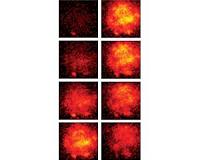
A series of images from a Duke engineering experiment show voltage spreading through a fruitfly neuron over a matter of just 4 milliseconds, a hundred times faster than the blink of an eye. The technology can see impulses as fleeting as 0.2 millisecond -- 2000 times faster than a blink. Image courtesy Yiyang Gong, Duke University.

Researchers at Duke and Stanford Universities have devised a way to watch the details of neurons at work, pretty much in real time. Every second of every day, the 100 billion neurons in your brain are capable of firing off a burst of electricity called an action potential up to 100 times per second. For neurologists trying to study how this overwhelming amount of activity across an entire brain translates into specific thoughts and behaviors, they need a faster way to watch.

Existing techniques for monitoring neurons are too slow or too tightly focused to generate a holistic view. But in a new study, researchers reveal a technique for watching the brain's neurons in action with a time resolution of about 0.2 milliseconds - a speed just fast enough to capture the action potentials in mammalian brains.

"We set out to combine a protein that can quickly sense neural voltage potentials with another protein that can amplify its signal output," said Yiyang Gong, assistant professor of biomedical engineering at Duke and first author on the paper. "The resulting increase in sensor speed matches what is needed to read out electrical spikes in the brains of live animals."

Gong did the work as a postdoctoral fellow in the laboratory of Mark Schnitzer, associate professor of biological sciences and applied physics at Stanford, and an investigator of the Howard Hughes Medical Institute. Gong and his colleagues sought out a voltage sensor fast enough to keep up with neurons. After several trials, the group landed on one found in algae, and engineered a version that is both sensitive to voltage activity and responds to the activity very quickly.

The amount of light it puts out, however, wasn't bright enough to be useful in experiments. It needed an amplifier.

To meet this engineering challenge, Gong fused the newly engineered voltage sensor to the brightest fluorescing protein available at the time. He linked the two close enough to interact optically without slowing the system down.

"When the voltage sensing component we engineered detects a voltage potential, it absorbs more light," explained Gong.

"And by absorbing more of the bright fluorescent protein's light, the overall fluorescence of the system dims in response to a neuron firing."

The new sensor was delivered to the brains of mice using a virus and incorporated into fruit flies through genetic modification. In both cases, the researchers were able to express the protein in selected neurons and observe voltage activity. They were also able to read voltage movements in different sub-compartments of individual neurons, which is very difficult to do with other techniques.

"Being able to read voltage spikes directly from the brain and also see their specific timing is very helpful in determining how brain activity drives animal behavior," said Gong.

"Our hope is that the community will explore those types of questions in more detail using this particular sensor. Already I've received multiple emails from groups interested in trying the technique in their own labs."

"High-speed recording of neural spikes in awake mice and flies with a fluorescent voltage sensor," Yiyang Gong, Cheng Huang, Jin Zhong Li, Benjamin F. Grewe, Yanping Zhang, Stephan Eismann, Mark J. Schnitzer. Science, November 20, 2015. DOI: 10.1126/science.aab0810


Thanks for being here;
We need your help. The Space Media Network continues to grow but revenues have never been harder to maintain.

With the rise of Ad Blockers, and Facebook - our traditional revenue sources via quality network advertising continues to decline. And unlike so many other news sites, we don't have a paywall - with those annoying usernames and passwords.

Our news coverage takes time and effort to publish 365 days a year.

If you find our news sites informative and useful then please consider becoming a regular supporter or for now make a one off contribution.
SpaceMediaNetwork Contributor
$5 Billed Once


credit card or paypal
SpaceMediaNetwork Monthly Supporter
$5 Billed Monthly


paypal only


.


Related Links
Duke University
Hospital and Medical News at InternDaily.com


Comment on this article via your Facebook, Yahoo, AOL, Hotmail login.

Share this article via these popular social media networks
del.icio.usdel.icio.us DiggDigg RedditReddit GoogleGoogle

Previous Report
INTERN DAILY
Bright prospects: Repairing neurons with light
Munich, Germany (SPX) Nov 27, 2015
The nervous system is built to last a lifetime, but diverse diseases or environmental insults can overpower the capacity of neurons to maintain function or to repair after trauma. A team led by Dr. Hernan Lopez-Schier, head of the Research Unit Sensory Biology and Organogenesis at Helmholtz Zentrum Munchen, now succeeded in promoting the repair of an injured neural circuit in zebrafish. Ke ... read more


INTERN DAILY
Poland's new govt rethinks Patriot missiles, Airbus choppers

Thales sub-contracted for NATO BMD test activities

Patriot takes out two ballistic missiles in latest test

Army system integrates different radars for Patriot-3 interceptor

INTERN DAILY
Saab to modernize Sweden's RBS 97 Hawk missile system

India test fires ship-based nuclear-capable missile

US has 'concerns' over Russian missile system: US official

India test fires Advanced Air Defense missile

INTERN DAILY
US approves drone sale to Japan

Developing new standards of drone operations

CACI launches SkyTracker UAV detection system

Japan to acquire Global Hawk drones

INTERN DAILY
Australia contracts for defense computer network upgrades

Harris Corporation Wins $40 Million Air Force Satellite Control Network Contract Extension

Commercialization is coming to WGS

DARPA's RadioMap Program Enters Third Phase

INTERN DAILY
BAE Systems, SAIC making amphibious armored vehicle prototypes

Raytheon moves forward with Multi-Object Kill Vehicle program

U.S. Air Force orders more JDAM bomb kits

U.K. awards Cook Defence Systems contract for armored vehicle tracks

INTERN DAILY
British PM David Cameron announces boost in defense spending

US approves $1.29 bn sale of bombs to Saudi Arabia

New York City turns tide on homeless vets

Orbital ATK and Boeing open offices in UAE

INTERN DAILY
China Communist Party reshuffles military, extends control

Russia targets Turkish economy over downed warplane

Polish call to scrap NATO-Russia deal 'extraordinarily dangerous': Moscow

Putin inaugurates museum honouring ex-leader Yeltsin

INTERN DAILY
Electric fields remove nanoparticles from blood with ease

Navy researchers recruit luminescent nanoparticles to image brain function

Light wave technique an advance for optical research

Nanostructuring technology can simultaneously control heat and electricity


The content herein, unless otherwise known to be public domain, are Copyright 1995-2024 - Space Media Network. All websites are published in Australia and are solely subject to Australian law and governed by Fair Use principals for news reporting and research purposes. AFP, UPI and IANS news wire stories are copyright Agence France-Presse, United Press International and Indo-Asia News Service. ESA news reports are copyright European Space Agency. All NASA sourced material is public domain. Additional copyrights may apply in whole or part to other bona fide parties. All articles labeled "by Staff Writers" include reports supplied to Space Media Network by industry news wires, PR agencies, corporate press officers and the like. Such articles are individually curated and edited by Space Media Network staff on the basis of the report's information value to our industry and professional readership. Advertising does not imply endorsement, agreement or approval of any opinions, statements or information provided by Space Media Network on any Web page published or hosted by Space Media Network. General Data Protection Regulation (GDPR) Statement Our advertisers use various cookies and the like to deliver the best ad banner available at one time. All network advertising suppliers have GDPR policies (Legitimate Interest) that conform with EU regulations for data collection. By using our websites you consent to cookie based advertising. If you do not agree with this then you must stop using the websites from May 25, 2018. Privacy Statement. Additional information can be found here at About Us.