
 |
 |
 |
 |
 |
 |
 |
 |
 |
 |

| . |  |
. |

Moffett Field CA (SPX) Aug 27, 2010 Astronomers using ESO's HARPS instrument have discovered a planetary system containing at least five planets, orbiting the Sun-like star HD 10180. The researchers also have tantalizing evidence that two other planets may be present, one of which would have the lowest mass ever found. This would make the system similar to our solar system in terms of the number of planets (seven as compared to the solar system's eight planets). Furthermore, the team also found evidence that the distances of the planets from their star follow a regular pattern, as also seen in our solar system. "We have found what is most likely the system with the most planets yet discovered," says Christophe Lovis, lead author of the paper reporting the result. "This remarkable discovery also highlights the fact that we are now entering a new era in exoplanet research: the study of complex planetary systems and not just of individual planets. Studies of planetary motions in the new system reveal complex gravitational interactions between the planets and give us insights into the long-term evolution of the system." The team of astronomers used the HARPS spectrograph, attached to ESO's 3.6-meter telescope at La Silla, Chile, for a six-year-long study of the Sun-like star HD 10180, located 127 light-years away in the southern constellation of Hydrus (the Male Water Snake). HARPS is an instrument with unrivalled measurement stability and great precision and is the world's most successful exoplanet hunter. Thanks to the 190 individual HARPS measurements, the astronomers detected the tiny back and forth motions of the star caused by the complex gravitational attractions from five or more planets. The five strongest signals correspond to planets with Neptune-like masses - between 13 and 25 Earth masses - which orbit the star with periods ranging from about 6 to 600 days. These planets are located between 0.06 and 1.4 times the Earth-Sun distance from their central star. "We also have good reasons to believe that two other planets are present," says Lovis. One would be a Saturn-like planet (with a minimum mass of 65 Earth masses) orbiting in 2200 days. The other would be the least massive exoplanet ever discovered, with a mass of about 1.4 times that of the Earth. It is very close to its host star, at just 2 percent of the Earth-Sun distance. One "year" on this planet would last only 1.18 Earth-days. "This object causes a wobble of its star of only about 3 km/hour - slower than walking speed - and this motion is very hard to measure," says team member Damien Segransan. If confirmed, this object would be another example of a hot rocky planet, similar to Corot-7b. The newly discovered system of planets around HD 10180 is unique in several respects. First of all, with at least five Neptune-like planets lying within a distance equivalent to the orbit of Mars, this system is more populated than our solar system in its inner region, and has many more massive planets there. Furthermore, the system probably has no Jupiter-like gas giant. In addition, all the planets seem to have almost circular orbits. So far, astronomers know of fifteen systems with at least three planets. The last record-holder was 55 Cancri, which contains five planets, two of them being giant planets. "Systems of low-mass planets like the one around HD 10180 appear to be quite common, but their formation history remains a puzzle," says Lovis. Using the new discovery as well as data for other planetary systems, the astronomers found an equivalent of the Titius-Bode law that exists in our solar system: the distances of the planets from their star seem to follow a regular pattern. "This could be a signature of the formation process of these planetary systems," says team member Michel Mayor. Another important result found by the astronomers while studying these systems is that there is a relationship between the mass of a planetary system and the mass and chemical content of its host star. All very massive planetary systems are found around massive and metal-rich stars, while the four lowest-mass systems are found around lower-mass and metal-poor stars. Such properties confirm current theoretical models.
Share This Article With Planet Earth
Related Links European Southern Observatory Lands Beyond Beyond - extra solar planets - news and science Life Beyond Earth

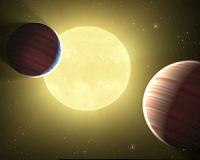 Kepler Discovers Multiple Planets Transiting A Single Star
Huntsville AL (SPX) Aug 27, 2010 NASA's Kepler spacecraft has discovered the first confirmed planetary system with more than one planet crossing in front of, or transiting, the same star. The transit signatures of two distinct Saturn-sized planets were seen in the data for a sun-like star designated "Kepler-9." The planets were named Kepler-9b and 9c. The discovery incorporates seven months of observations of more than 15 ... read more |
|
|
| The content herein, unless otherwise known to be public domain, are Copyright 1995-2010 - SpaceDaily. AFP and UPI Wire Stories are copyright Agence France-Presse and United Press International. ESA Portal Reports are copyright European Space Agency. All NASA sourced material is public domain. Additional copyrights may apply in whole or part to other bona fide parties. Advertising does not imply endorsement,agreement or approval of any opinions, statements or information provided by SpaceDaily on any Web page published or hosted by SpaceDaily. Privacy Statement |


 del.icio.us
 Digg
Digg Reddit
 YahooMyWeb
 Google
 Facebook


