
. Military Space News .
SOLAR SCIENCE
Shedding light on the science of auroral breakups
by Staff Writers
Tokyo, Japan (SPX) Feb 11, 2019

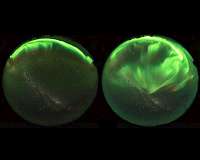
All-sky images of the auroral breakup that occurred around 2220 UT on June 30, 2017. Photographed at Syowa Station, Antarctica. Left: five minutes before the breakup. Right: right after the breakup.

Auroras, also known as Northern or Southern lights depending on whether they occur near the North or South Pole, are natural displays of light in the Earth's sky. Typically these lights are dimly present at night. However, sometimes these otherwise faint features explode in brightness and can even break up into separate glowing hallmarks, appearing as spectacular bursts of luminous manifestations. This striking and picturesque phenomenon is known as an auroral breakup.

Now, Japanese scientists have quantitatively confirmed how energetic this phenomenon can be. Using a combination of cutting-edge ground-based technology and new space-borne observations, they have demonstrated the essential role of an auroral breakup in ionizing the deep atmosphere. The research furthers our understanding of one of the most visually stunning natural phenomena.

The findings were published in Earth, Planets and Space on January 23, 2019.

The sun fires beams of charged particles, or plasma, toward Earth. Also referred to as solar winds, this plasma is mostly made up of electrons, protons and alpha particles. When these particles interact with the Earth's magnetic field, electrical currents are carried by electrons into the Earth's atmosphere.

This reaction between the electrons and their atmospheric constituents emits light of varying color and complexity, visible as an aurora. However, little is known about how energetic the electrons can be when these lights explode into the stunning lightshows known as auroral breakups. So far, the assumption has been that electrons of a specific energy level are responsible for this rare phenomenon.

In the new study, the scientists report that, contrary to conventional thinking, a specific kind of electrons with much higher energy, called radiation belt electrons, are involved in the auroral breakup. Named after their location in the Earth's radiation belt, radiation belt electrons had not been clearly associated with auroral breakups before. The research team based their conclusions on a dataset collected via advanced technology and simulations.

"Radiation belt electrons are released from the Earth's magnetic field and charge the mesosphere during auroral breakup. This fact was quantitatively confirmed by both cutting-edge ground-based and new space-borne observations," adds Ryuho Kataoka, Ph.D., associate professor at the National Institute of Polar Research and the corresponding author. "This study also provides a good example how Arase satellite and PANSY radar can collaborate to understand the connection between space and atmosphere."

In their future research endeavors, the Professor Kataoka and his team hope to understand how the radiation belt electrons are released during the short-lasting period of auroral breakup. "The ultimate goal is to understand the interplay between auroras and radiation belts," Professor Kataoka adds.

This research was supported by several Japan Society for the Promotion of Science-Kakenhi grants.

Research paper


Related Links
Research Organization of Information and Systems
Solar Science News at SpaceDaily


Thanks for being here;
We need your help. The Space Media Network continues to grow but revenues have never been harder to maintain.

With the rise of Ad Blockers, and Facebook - our traditional revenue sources via quality network advertising continues to decline. And unlike so many other news sites, we don't have a paywall - with those annoying usernames and passwords.

Our news coverage takes time and effort to publish 365 days a year.

If you find our news sites informative and useful then please consider becoming a regular supporter or for now make a one off contribution.
SpaceMediaNetwork Contributor
$5 Billed Once


credit card or paypal
SpaceMediaNetwork Monthly Supporter
$5 Billed Monthly


paypal only


SOLAR SCIENCE
Surprising Explanation for Differences in Southern and Northern Lights
Bergen, Norway (SPX) Jan 25, 2019
For many years, scientists assumed the aurora seen around the north pole was identical to the aurora seen around the south pole. The poles are connected by magnetic field lines, and auroral displays are caused by charged particles streaming along these field lines. Because the charged particles follow these field lines, it would make sense that the auroras would be mirror images of each other. However, in 2009, scientists discovered aurora can look differently around the north pole and the south p ... read more

Comment using your Disqus, Facebook, Google or Twitter login.


Share this article via these popular social media networks
del.icio.usdel.icio.us DiggDigg RedditReddit GoogleGoogle

SOLAR SCIENCE
U.S. Army to purchase Israel's Iron Dome anti-missile system

US Army to buy two Israeli Iron Dome air defense systems

Raytheon, Lockheed contracted for Patriot systems for foreign customers

Japan approved for $2.15B buy of Aegis Ashore missile defense systems

SOLAR SCIENCE
General Atomics awarded $30.9M more for MQ-9 missile defense testing

BAE awarded $225M for APKWS kits rocket upgrades

Iran in 'successful test' of new cruise missile on revolution anniversary

Iran denies any intention of boosting range of missiles

SOLAR SCIENCE
German Forces Begin Training Courses on Armed Israeli Surveillance Drones

Airborne Response supports fire and rescue exercise with drones and aerostats

ZX Lidars achieves world-first wind Lidar measurements from a drone

Ecuador eradicates Galapagos rats using drones

SOLAR SCIENCE
Lockheed Martin to develop cyber electronic warfare pod for UAVs

Britain to spend $1.3M for satellite antennas in light of Brexit

Reflectarray Antenna offers high performance in small package: DARPA

BAE signs $79.8M contract with Navy for Pacific comms support

SOLAR SCIENCE
Denmark, France, Netherlands receive first land munitions through NATO pact

Honeywell awarded $85.7M for C-5 software, hardware support

BAE Systems wins $21M contract to supply artillery to British army

Marine Corps distributing 1,300 new night vision devices at base

SOLAR SCIENCE
Federal budget to be released mid-March, Pentagon expects nearly $750B

Senators urge Pentagon to continue its internal audit

Report: Pentagon allowed $28B in available funds to expire

Croatia threatens to axe plans to buy F-16 jets from Israel

SOLAR SCIENCE
Ukraine amends constitution to cement EU, NATO course

Billionaire's ban seen as pushback against Chinese foreign influence ops

Macedonia takes major step on road to NATO membership

Top general not consulted before Trump's Syria pull-out decision

SOLAR SCIENCE
Rice lab adds porous envelope to aluminum plasmonics

Research details sticky situations at the nanoscale

Nano-infused ceramic could report on its own health

Aerosol-assisted biosynthesis strategy enables functional bulk nanocomposites


The content herein, unless otherwise known to be public domain, are Copyright 1995-2024 - Space Media Network. All websites are published in Australia and are solely subject to Australian law and governed by Fair Use principals for news reporting and research purposes. AFP, UPI and IANS news wire stories are copyright Agence France-Presse, United Press International and Indo-Asia News Service. ESA news reports are copyright European Space Agency. All NASA sourced material is public domain. Additional copyrights may apply in whole or part to other bona fide parties. All articles labeled "by Staff Writers" include reports supplied to Space Media Network by industry news wires, PR agencies, corporate press officers and the like. Such articles are individually curated and edited by Space Media Network staff on the basis of the report's information value to our industry and professional readership. Advertising does not imply endorsement, agreement or approval of any opinions, statements or information provided by Space Media Network on any Web page published or hosted by Space Media Network. General Data Protection Regulation (GDPR) Statement Our advertisers use various cookies and the like to deliver the best ad banner available at one time. All network advertising suppliers have GDPR policies (Legitimate Interest) that conform with EU regulations for data collection. By using our websites you consent to cookie based advertising. If you do not agree with this then you must stop using the websites from May 25, 2018. Privacy Statement. Additional information can be found here at About Us.