
 |
 |
 |
 |
 |
 |
 |
 |
 |
 |

| . |  |
. |

Boulder CO (SPX) Aug 27, 2010 Large changes in the Sun's energy output may drive unexpectedly dramatic fluctuations in Earth's outer atmosphere, new research indicates. A new study links a recent, temporary shrinking of a high atmospheric layer with a sharp drop in the Sun's ultraviolet radiation levels. The research, led by scientists at the National Center for Atmospheric Research (NCAR) and the University of Colorado at Boulder (CU), indicates that the Sun's magnetic cycle, which produces differing numbers of sunspots over an approximately 11-year cycle, may vary more than previously thought. "Our work demonstrates that the solar cycle not only varies on the typical 11-year time scale, but also can vary from one solar minimum to another," says lead author Stanley Solomon, a scientist at NCAR's High Altitude Observatory. "All solar minima are not equal." The findings may have implications for orbiting satellites, as well as for the International Space Station. The fact that the layer in the upper atmosphere known as the thermosphere is shrunken and less dense means that satellites can more easily maintain their orbits. But it also indicates that space debris and other objects that pose hazards may persist longer in the thermosphere. "With lower thermospheric density, our satellites will have a longer life in orbit," says CU professor Thomas Woods, a co-author. "This is good news for those satellites that are actually operating, but it is also bad because of the thousands of non-operating objects remaining in space that could potentially have collisions with our working satellites." The study, published this week in Geophysical Research Letters, was funded by NASA and by the National Science Foundation, NCAR's sponsor.
Radiation or carbon dioxide? The thermosphere, which ranges in altitude from about 55 to more than 300 miles (90 to 500 kilometers), is a rarified layer of gas at the edge of space where the Sun's radiation first makes contact with Earth's atmosphere. It typically cools and becomes less dense during low solar activity. But the magnitude of the density change during the recent solar minimum appeared to be about 30% greater than would have been expected by low solar activity. The study team used computer modeling to analyze two possible factors implicated in the mystery of the shrinking thermosphere. They simulated both the impacts of solar output and the role of carbon dioxide, a potent greenhouse gas that, according to past estimates, is reducing the density of the outer atmosphere by about 2% to 5% per decade. Their work built on several recent studies. Earlier this year, a team of scientists from the Naval Research Laboratory and George Mason University, measuring changes in satellite drag, estimated that the density of the thermosphere declined in 2007-09 to about 30% less than during the previous solar minimum in 1996. Other studies by scientists at the University of Southern California and CU, using measurements from sub-orbital rocket flights and space-based instruments, have estimated that levels of extreme-ultraviolet radiation-a class of photons with extremely short wavelengths-dropped about 15% during the same period. However, scientists remained uncertain whether the decline in extreme-ultraviolet radiation would be sufficient to have such a dramatic impact on the thermosphere, even when combined with the effects of carbon dioxide. To answer this question, Solomon and his colleagues turned to an NCAR computer tool, known as the Thermosphere-Ionosphere-Electrodynamics General Circulation Model. They used the model to simulate how the Sun's output during 1996 and 2008 would affect the temperature and density of the thermosphere. They also created two simulations of thermospheric conditions in 2008-one with a level that approximated actual carbon dioxide emissions and one with a fixed, lower level. The results showed the thermosphere cooling in 2008 by 41 kelvins (about 74 degrees Fahrenheit) compared to 1996, with just 2 K attributable to the carbon dioxide increase. The results also showed the thermosphere's density decreasing by 31%, with just 3% attributable to carbon dioxide. The results closely approximated the 30% reduction in density indicated by measurements of satellite drag. "It is now clear that the record low temperature and density were primarily caused by unusually low levels of solar radiation at the extreme-ultraviolet level," Solomon says. Woods says the research indicates that the Sun could be going through a period of relatively low activity, similar to periods in the early 19th and 20th centuries. This could mean that solar output may remain at a low level for the near future. "If it is indeed similar to certain patterns in the past, then we expect to have low solar cycles for the next 10 to 30 years," Woods says.
Share This Article With Planet Earth
Related Links National Center for Atmospheric Research (NCAR) Solar Science News at SpaceDaily

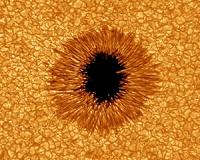 Amazing New Sun Images From NJIT's Big Bear Solar Observatory
Newark NJ (SPX) Aug 26, 2010 NJIT Distinguished Professor Philip R. Goode and the Big Bear Solar Observatory (BBSO) team have achieved "first light" using a deformable mirror in what is called adaptive optics at Big Bear Solar Observatory (BBSO). "This photo of a sunspot is now the most detailed ever obtained in visible light," according to Ciel et l'Espace. In September, the publication, a popular astronomy magazine, ... read more |
|
|
| The content herein, unless otherwise known to be public domain, are Copyright 1995-2010 - SpaceDaily. AFP and UPI Wire Stories are copyright Agence France-Presse and United Press International. ESA Portal Reports are copyright European Space Agency. All NASA sourced material is public domain. Additional copyrights may apply in whole or part to other bona fide parties. Advertising does not imply endorsement,agreement or approval of any opinions, statements or information provided by SpaceDaily on any Web page published or hosted by SpaceDaily. Privacy Statement |


 del.icio.us
 Digg
Digg Reddit
 YahooMyWeb
 Google
 Facebook


