
. Military Space News .
INTERN DAILY
Smartphones could improve skin cancer detection in developing countries
by Staff Writers
Houston TX (SPX) Mar 22, 2016


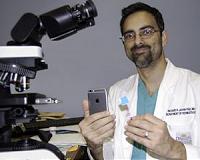
With the help of a smartphone microscope, UTHealth's Richard Jahan-Tigh, M.D., was able to detect non-melanoma skin cancer about 90 percent of the time. Image courtesy University of Texas Health Science Center at Houston (UTHealth). For a larger version of this image please go here.

Everyone knows smartphones can be used as calendars, calculators, radios and cameras. But, did you know they can also be used as microscopes that have the potential to save lives?

They are called smartphone microscopes and dermatologists at The University of Texas Health Science Center at Houston (UTHealth) think these devices could improve the detection of skin cancer in developing countries.

"Doctors in some remote areas don't have access to the high-powered microscopes we use to evaluate skin samples," said Richard Jahan-Tigh, M.D., assistant professor of dermatology at John P. and Kathrine G. McGovern Medical School at UTHealth. "Doctors there could conceivable use their smartphones to photograph growths and forward them for examination."

When it comes to the diagnosis of cancer, smartphone microscopes are reasonably accurate, according to a study conducted by Jahan-Tigh and colleagues at McGovern Medical School and Harvard Medical School. Findings appear in the ARCHIVES of Pathology and Laboratory Medicine.

"We did a head-to-head comparison with a traditional light microscope and while the smartphone microscope wasn't as accurate it resulted in the detection of about 90 percent of the non-melanoma skin cancers," said Jahan-Tigh, the paper's lead author. "With the smartphone microscope, the detection rate for melanomas was 60 percent."

The incidence of both non-melanoma and melanoma skin cancers has been increasing in recent decades, the World Health Organization reports. Between 2 and 3 million non-melanoma skin cancers and 132,000 melanoma skin cancers occur globally each year.

"This is a good first step to show that smartphone microscopy has a future in dermatology and pathology," Jahan-Tigh said.

A smartphone microscope can be made with a 3 mm ball lens, a tiny piece of plastic to hold the ball lens over the smartphone lens and tape to grip everything in place. A ball lens costs about $14 at an electronics store and is typically used for laser optics.

Here is how a smartphone microscope works. A doctor or technician holds a smartphone microscope over a skin sample that has been placed on a slide and waits for the sample to come into focus. The doctor then either reads the sample if he or she is a pathologist, or takes a photo and emails it to a pathologist for interpretation.

Researchers examined 1,021 slides of specimens, which had a total of 136 basal cell carcinomas, 94 squamous cell carcinomas and 15 melanomas. The smartphone microscope was used to pick up 95.6 percent of the basal cell carcinomas and 89 percent of squamous cell carcinomas.

Jahan-Tigh said additional studies are needed to enhance the detection rate.

Jahan-Tigh used a smartphone microscope to evaluate the specimens and the conventional microscope was operated by Ronald Rapini, M.D., chairman of the Department of Dermatology, Marvin E. Chernosky, M.D. Endowed Distinguished Chair in Dermatology and Josey Professor in Dermatology with McGovern Medical School.

Both men are dermatologists and dermatopathologists, which means that in addition to being able to screen patients for skin cancer they can examine biopsied tissue to determine if it cancerous.

Rapini was the paper's senior author and Garrett M. Chinn, M.D., of Harvard, a co-author.

In their conclusion, the authors wrote that mobile phone-based microscopy has excellent performance characteristics for the inexpensive diagnosis of non-melanoma skin cancers in a setting where a traditional microscope is not available.

"This is just the tip of the iceberg," Jahan-Tigh said.


Thanks for being here;
We need your help. The Space Media Network continues to grow but revenues have never been harder to maintain.

With the rise of Ad Blockers, and Facebook - our traditional revenue sources via quality network advertising continues to decline. And unlike so many other news sites, we don't have a paywall - with those annoying usernames and passwords.

Our news coverage takes time and effort to publish 365 days a year.

If you find our news sites informative and useful then please consider becoming a regular supporter or for now make a one off contribution.
SpaceMediaNetwork Contributor
$5 Billed Once


credit card or paypal
SpaceMediaNetwork Monthly Supporter
$5 Billed Monthly


paypal only


.


Related Links
University of Texas Health Science Center at Houston
Hospital and Medical News at InternDaily.com


Comment on this article via your Facebook, Yahoo, AOL, Hotmail login.

Share this article via these popular social media networks
del.icio.usdel.icio.us DiggDigg RedditReddit GoogleGoogle

Previous Report
INTERN DAILY
Reverse engineering human biology with organs-on-chips
Washington DC (SPX) Mar 15, 2016
"Organs-on-Chips," added last May to the collection of the Museum of Modern Art in New York City and winner of the 2015 Design Award from the London Design Museum, have kept their "classical" design over the years, but have grown in complexity thanks to recent advances. The family of chips, which are microfluidic devices containing hollow channels lined by living human cells, now includes everyt ... read more


INTERN DAILY
S. Korea, US open missile shield talks

Israeli Air Force deploying 'David's Sling' missile defense system

US Missile Defense Outdated

China Interfering in THAAD Deployment Decision Process Preposterous

INTERN DAILY
Raytheon to offer new tactical missile design to U.S. Army

Missile tests don't violate nuclear deal: Iran FM

Russia opposes UN sanctions on Iran over missile tests

US asks UN Security Council to meet on Iran missile tests Monday

INTERN DAILY
Drones promise to improve ecological monitoring

Pentagon, Other Federal Agencies Use Drones for Domestic Surveillance

Researchers develop miniaturized fuel cell that makes drones fly more than 1 hour

Inside the Pentagon's Drone Proving Ground

INTERN DAILY
In-orbit delivery of Laos' 1st satellite launched

Upgrade set for Britain's tactical communications system

Airbus continues operating German military satellites

BAE Systems supports Navy communications and electronics

INTERN DAILY
Northrop to develop new IMU guidance system for weapons

DynCorp wins U.S. intelligence support contract

Ford offers police greater ballistic protection for vehicles

Factory for Ajax armored vehicles inaugurated

INTERN DAILY
Lockheed Martin plans voluntary layoffs for 1,000

Defense Industry center opens in South Australia

China defence spending to rise '7 to 8%' in 2016: official

EU lawmakers urge Saudi arms embargo

INTERN DAILY
Hong Kong tycoon Li dismisses independence, calls for unity

Japan submarine to visit Philippines, other ships to Vietnam

Tiananmen dissident warns of Trump danger

Vietnam anti-China activists mark Spratly island battle

INTERN DAILY
ASRC professor leads study on reconfigurable magnetic nanopatterns

Atomic vibrations in nanomaterials

NIST invents fleet and fast test for nanomanufacturing quality control

Building a better mouse trap, from the atoms up


The content herein, unless otherwise known to be public domain, are Copyright 1995-2024 - Space Media Network. All websites are published in Australia and are solely subject to Australian law and governed by Fair Use principals for news reporting and research purposes. AFP, UPI and IANS news wire stories are copyright Agence France-Presse, United Press International and Indo-Asia News Service. ESA news reports are copyright European Space Agency. All NASA sourced material is public domain. Additional copyrights may apply in whole or part to other bona fide parties. All articles labeled "by Staff Writers" include reports supplied to Space Media Network by industry news wires, PR agencies, corporate press officers and the like. Such articles are individually curated and edited by Space Media Network staff on the basis of the report's information value to our industry and professional readership. Advertising does not imply endorsement, agreement or approval of any opinions, statements or information provided by Space Media Network on any Web page published or hosted by Space Media Network. General Data Protection Regulation (GDPR) Statement Our advertisers use various cookies and the like to deliver the best ad banner available at one time. All network advertising suppliers have GDPR policies (Legitimate Interest) that conform with EU regulations for data collection. By using our websites you consent to cookie based advertising. If you do not agree with this then you must stop using the websites from May 25, 2018. Privacy Statement. Additional information can be found here at About Us.